

By Dorian
Fed Watch | November 6, 2026
The Fed has not changed its statement since October 28, but the market has rewritten its forecast twice.
When a central bank refuses to guide, the price of its next move is set by everything else.
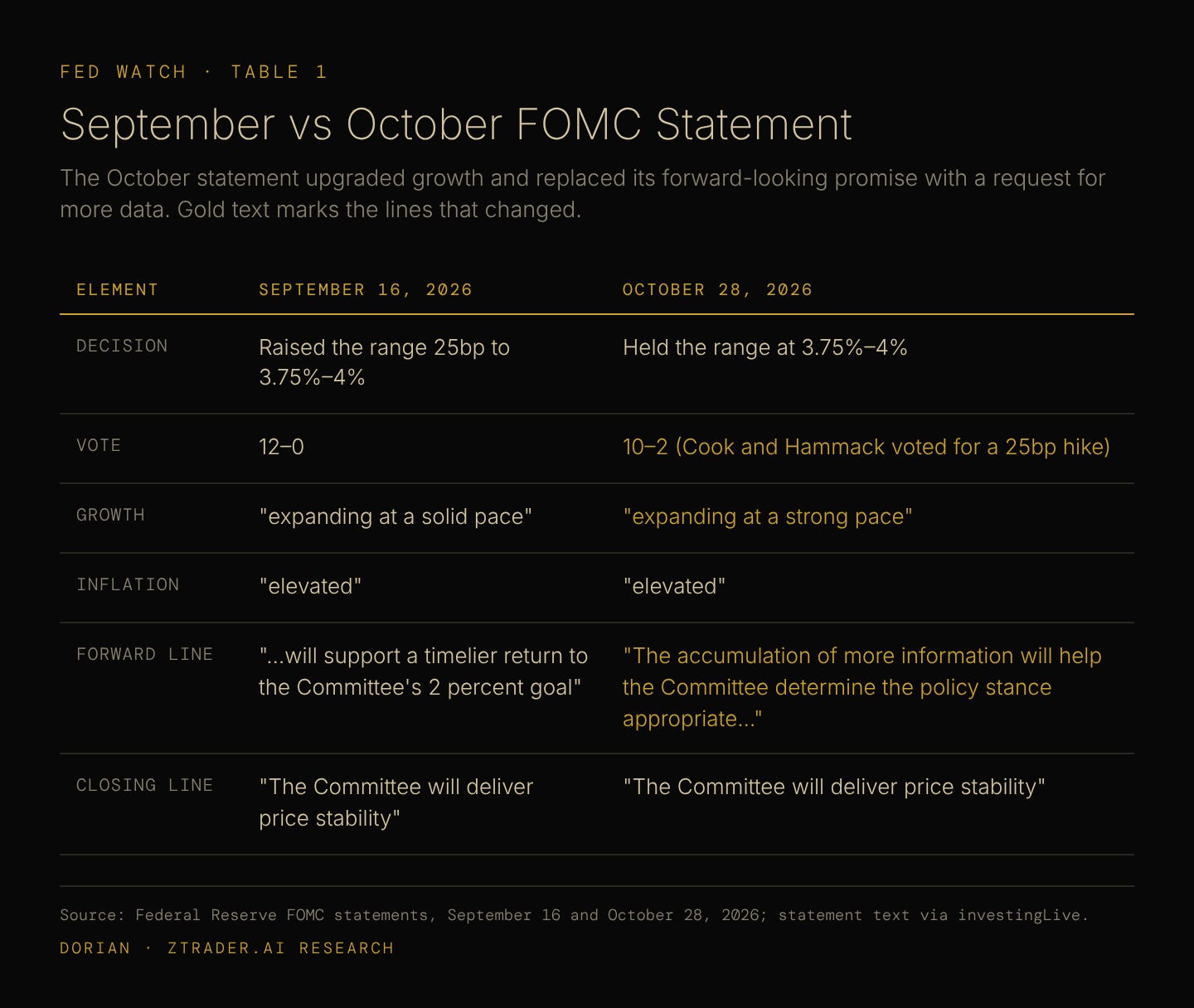
On October 28 the Federal Open Market Committee held the federal funds rate at 3.75% to 4% in a 10-2 vote, with Governor Lisa Cook and Cleveland Fed President Beth Hammack voting for an immediate quarter-point hike.
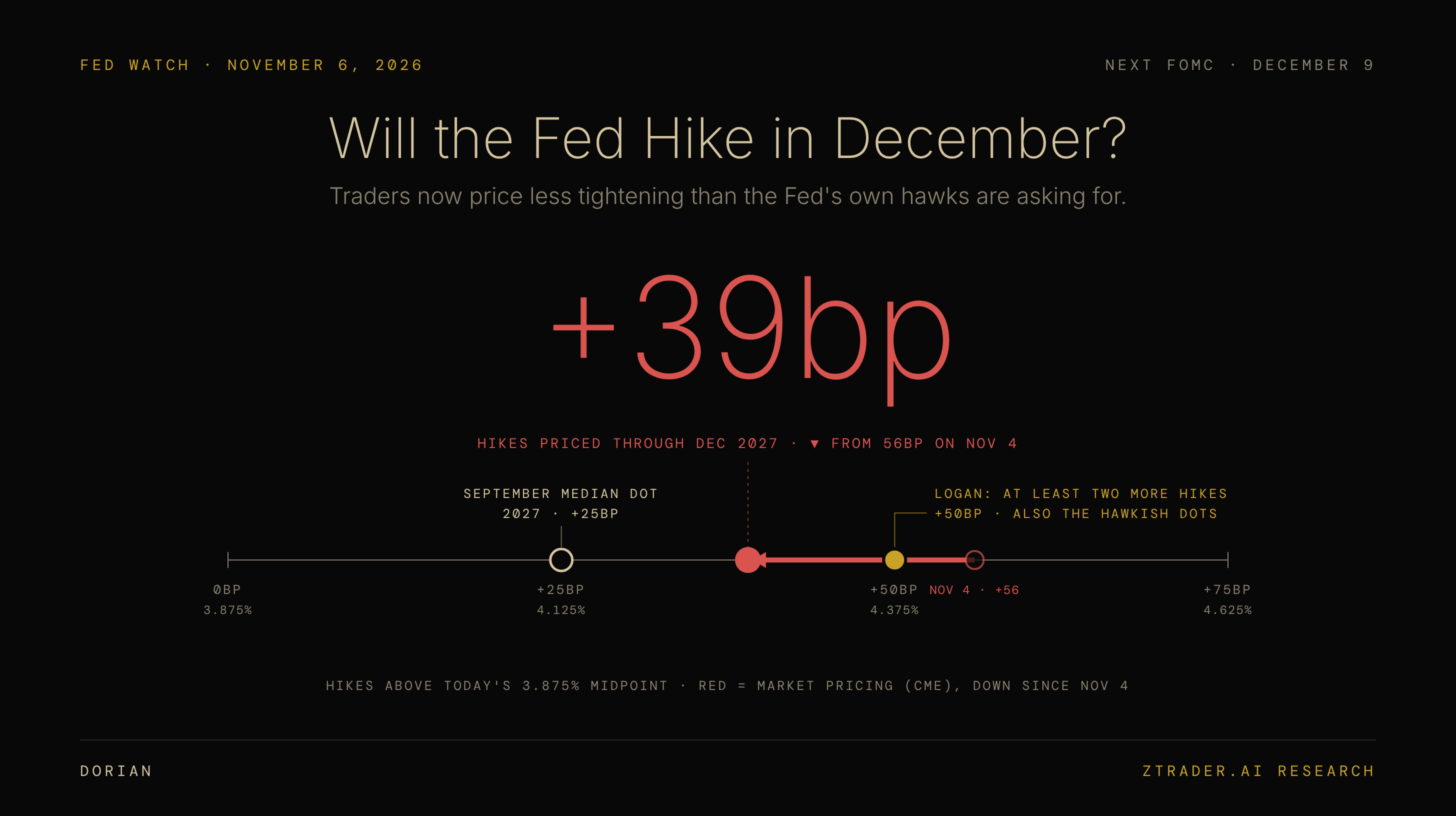
That night CME FedWatch priced an 82.6% chance of a hike on December 9, and Bloomberg data showed traders pricing the policy rate near 4.7% by September 2027, well above every cluster on the Fed’s own dot plot. Since then, Democrats won both chambers of Congress, Brent crude fell 8.7% in a single session, the S&P 500 had its worst day since April 2025, and the 2-year Treasury yield fell about 20 basis points from its Fed-day close.
By Thursday’s close the December odds had fallen to 67%, and the market was pricing only 39 basis points of hikes through December 2027. Over the same stretch, four Fed officials said publicly that more hikes are coming.
This issue works through what the October meeting set up, who on the committee is pushing for more, how the midterms and the AI selloff changed the inflation and growth picture, and whether the market has now moved below the Fed it was running ahead of a week ago.
I. WHAT CHANGED AT THE OCTOBER MEETING
Before the market makes its move, the Fed changed its own message in three ways, and each one explains why this week’s repricing was so violent.
[TABLE 1 — September vs October FOMC Statement]
The Statement: Stronger Growth, No Promise
The Committee upgraded its description of activity from “expanding at a solid pace” to “expanding at a strong pace,” and it kept inflation “elevated.” It then deleted September’s line that the hike “will support a timelier return to the Committee’s 2 percent goal” and replaced it with “the accumulation of more information will help the Committee determine the policy stance appropriate.”
That edit turned the next decision into a pure function of the data, with no commitment in either direction.
The Chair: No Guidance, No Dot
Chair Kevin Warsh said he does not believe in forward guidance outside a crisis, and he again declined to submit a dot. He described financial conditions as “tighter,” but said he was “unwilling and unable to call them tight,” and he said the “overwhelming judgement” in the room was that “monetary medicine is starting to work.” In the meanwhile, he also admitted that interest rates do affect AI investment, a point he had once doubted.
The Calendar: Fewer Decisions Ahead
Warsh announced that one of the eight meetings in 2027 will discuss strategy only, with no rate vote and no statement, and that 2028 will have two such meetings. Each strategy meeting leaves a gap of roughly 12 weeks between rate decisions.
When the Fed stops guiding and starts meeting less often, the market has to price the next move from oil, stocks and data, and that is exactly what it did this week.
II. WHY COOK AND HAMMACK VOTED TO HIKE, AND WHO FOLLOWED
The 10-2 vote situation tells the strong hawks in the FED room, and the speeches that followed the end of the blackout showed the hawks outside it.
Beth Hammack: Smaller Steps, More Often
Hammack also dissented in July, so her October vote continued a pattern she set over the summer. In a speech prepared for an event in Zurich on Thursday, she said “monetary policy will need to move to a restrictive stance” to bring inflation back to 2% in a timely manner. She said she favors “getting to that stance through more frequent smaller adjustments when possible,” and she argued that current financial conditions are not restraining the economy enough.
Lisa Cook: First Dissent, Open Removal Case
Cook had never dissented in four years on the Board, and in early October she had warned that “AI is causing pockets of inflation.”
Her dissent arrives while a three-member White House Committee of Inquiry, created by a presidential memorandum on October 7, reviews mortgage allegations against her that she denies.
On October 30, National Economic Council Director Kevin Hassett confirmed that her hearing, originally set for November 5, has been moved to December. Her lawyer, Abbe Lowell, said December after the FOMC meeting is the earliest realistic date. That means one of the two officials who voted to hike in October will cast her December vote before the White House rules on whether it can remove her.
Lorie Logan: At Least Two More Hikes
Dallas Fed President Lorie Logan said on October 30 that the Committee “needs to implement at least two more 25-basis-point rate increases” if the outlook holds. She said it would then “make sense in my view to pause and examine economic and financial developments.”
Alberto Musalem: Soon
St. Louis Fed President Alberto Musalem said “additional firming of monetary policy will be necessary, and soon.” He added that “incremental adjustments made earlier are usually less disruptive than larger and abrupt actions taken later.”
Tom Barkin: The Direction Is Settled
Richmond Fed President Tom Barkin, who becomes a voter in 2027, said in a radio interview on October 30 that “inflation’s high, demand is solid, unemployment is relatively low,” so the only open question is pace. He said businesses in his district report rising costs in diesel, computer chips and skilled labor, and that they are willing to pass those costs on.
Five officials have now argued for more hikes in public, and all five favor the same method of small, steady moves, which means the committee’s hawks are arguing about timing while the market has started to question the destination.
— PAYWALL —
