

ZTrader.AI Research · Geopolitical Intelligence · May 2026
§ 01 · THE REAL QUESTION
Not “How Could They Know Nothing?” — What Did They Think They Knew?
“It took a while for them to understand how big that risk is, which they understand now.”
— Netanyahu on 60 Minutes, May 2026 — on Israel underestimating Iran’s Hormuz closure capability
Read that sentence carefully.
This is not a minor diplomatic hedge from a politician managing optics.
This is the prime minister of a state whose intelligence apparatus penetrated Iran for decades — running assets inside the IRGC, recruiting nuclear scientists, executing precision assassinations on Iranian soil — publicly admitting they got the strategic picture wrong.
Mossad did not fail because it lacked information. It may have failed precisely because it had too much of it. Saturated with tactical intelligence, planners confused the map for the territory. They knew where every missile launcher was. They did not know how the system would behave when you started destroying them.
That is the distinction this article is about. And it is the most dangerous kind of failure there is — because it is invisible until the moment it isn’t.
§ 02 · THE CORE DISTINCTION
Tactical Access vs. Strategic Control
What they could do:
▸ Identify targets
▸ Penetrate networks
▸ Map facilities
▸ Execute decapitation strikes
▸ Compromise communications
▸ Disrupt logistics
▸ Assassinate key figures
What they could not predict:
▸ How the system reacts under existential stress
▸ Network resilience and redundancy depth
▸ Second-order economic cascades
▸ Hormuz closure as a financial weapon
▸ Proxy activation sequence across five theaters
A successful penetration operation can create the illusion of total understanding. That illusion is deadly — because once a state repeatedly succeeds at tactical operations, it begins to assume: “If we can enter the system, we can control the system.”
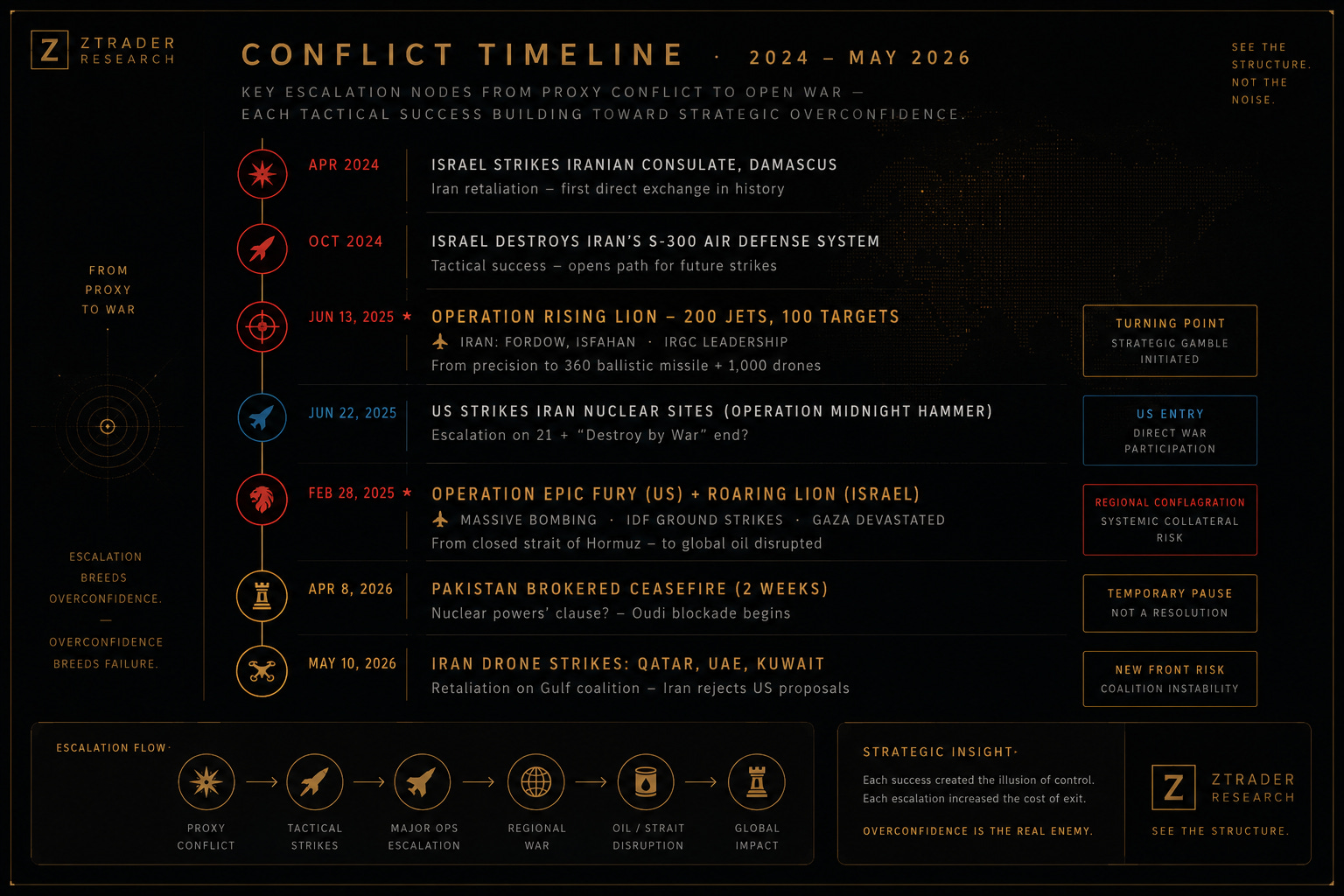
Entering a system is not the same thing as controlling how that system reacts under stress. Disrupting nodes does not collapse the network. And this is precisely where the 2025–2026 Iran campaign became structurally miscalculated.
§ 03 · THE HORMUZ VARIABLE
Why Hormuz Is a Systems-Layer Variable, Not a Military One
Most military planners conceptualize the Strait of Hormuz as a geographic chokepoint. A place on a map. A military problem with military solutions.
This framing is precisely what Netanyahu now admits was miscalculated.
Hormuz is not a military-layer variable. It is a systems-layer variable. Its disruption does not flow through battlefield logic — it flows through financial markets, insurance pricing, inflation expectations, and dollar liquidity stress simultaneously.
What Hormuz actually is:
▸ ~20M barrels/day oil · 20% of global seaborne oil trade
▸ LNG from Qatar and UAE — both US allies
▸ Insurance premiums spiked from 0.125% to 0.4% per transit
▸ Tanker routing forced around the Cape — weeks of delay, billions in cost
▸ Inflation expectations reset across EM economies
▸ Dollar liquidity stress through energy derivatives volatility
▸ Iran converts military defeat into a negotiating chokepoint
This is why Netanyahu’s admission matters far beyond its surface diplomatic meaning. It suggests planners may have correctly mapped tactical opportunities while systematically underestimating second-order systemic reactions — the hallmark of high-level strategic overconfidence.
§ 04 · THE INTELLIGENCE TRAP
When Partial Success Becomes Strategic Arrogance
Iran is not merely a collection of military targets. It is a multi-layered adaptive system:
▸ A political structure with deep legitimacy reserves
▸ A religious structure that converts loss into martyrdom
▸ A proxy network spanning Lebanon, Iraq, Yemen, Gaza
▸ An energy chokepoint actor with global financial leverage
▸ 30+ underground missile bases buried 400–1,500ft in granite
▸ A redundancy architecture hardened over four decades of sanctions
The post-strike numbers tell the story directly: ~50% of Iran’s missile launchers survived Operation Epic Fury. The IRGC Navy retained roughly 50% of pre-war assets. Nuclear strikes set the program back by less than six months — not eliminated.
The two-month campaign cost the United States approximately $25 billion and depleted munition stockpiles analysts assessed would take three to five years to rebuild.
But the most devastating unintended consequence is the one nobody planned for: Khamenei’s death voided his fatwa prohibiting nuclear weapons.
The new IRGC-dominated successor leadership now faces a strategic choice that Khamenei had foreclosed for two decades. The Arms Control Association assessed the strikes may have strengthened the political case within Iran for weaponization rather than weakened it.
The operation designed to eliminate the nuclear threat may have removed the last institutional barrier against it.
This is the classic high-level intelligence trap: decapitating the node activated the system.
§ 05 · THE ASSUMPTION COLLAPSE
They Killed Nodes. They Did Not Kill the System.
The original assumption chain that drove the entire operation:
Decapitation → command paralysis
command paralysis → missile degradation
missile degradation → nuclear delay
nuclear delay → Hormuz containment
The logic was clean. It was also wrong — not at one node, but at every node simultaneously.
Post-strike reality:
Decapitation ≠ paralysis command chain survived
Missile capacity ≠ eliminated strikes continued post-Feb 28
Mining threat ≠ removed IRGC Navy still operational
Nuclear pathway ≠ erased uranium stockpile pre-moved
Hormuz risk ≠ contained strait closed · still blocked
This is not a story of missed targets. It is a story of a strategic model that confused node destruction with system paralysis. Every tactical operation succeeded on its own terms. The system adapted, rerouted, and activated its redundancies at every layer.
They killed nodes.
They did not kill the system.
If the post-strike reality still contains mines, missiles, and nuclear escalation pathways, then the intelligence failure was not marginal. It suggests one of three possibilities: source contamination, strategic deception at scale, or a severe and systemic confusion between penetration and control.
None of these is a “tactical miss.” All three point to the same root problem.
CONCLUSION
A failure this large does not look like ignorance.
It looks like contaminated confidence.
History repeatedly shows that systems are most fragile precisely when powerful actors begin believing they fully understand them. The most dangerous intelligence failure is not the one that comes from blindness. It is the one that comes from having seen too much — and having mistaken visibility for control.
🔒 ZTrader.AI subscribers continue below, ALL KEY Charts Are Included:
