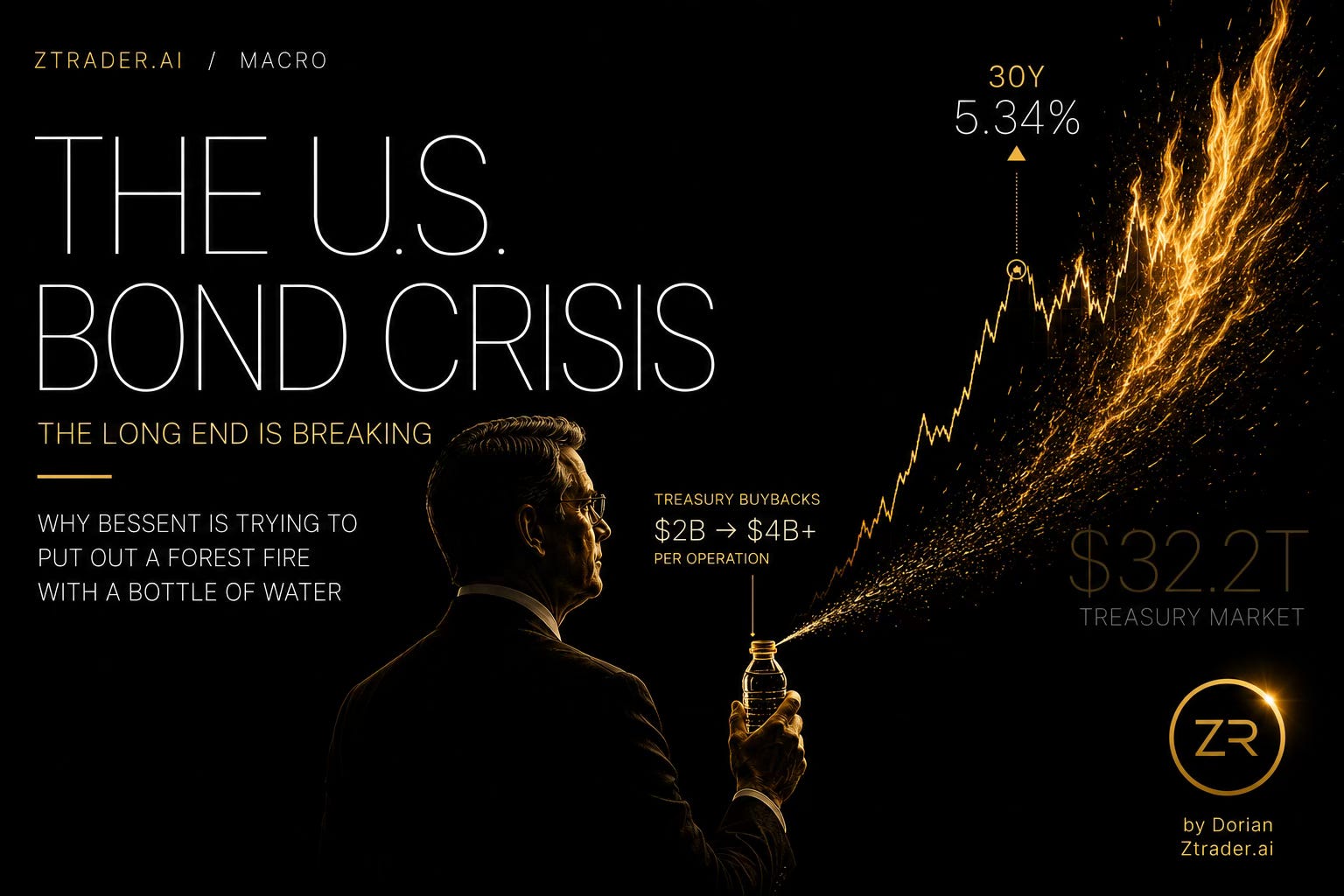
Yesterday, Bessent said US treasury would increase its buybacks of long-term Treasury debt, raising the maximum it will buy from $2 billion to at least $4 billion.
US bond has a treasury yield problem, not only BOJ is dumping US treasury notes and the continuous selloff is forcing the yield spiked, hence the bond prices are down.
After Bessent’s word, the treasury yield has plummeted.
So the treasury yield finally drops.
but does this mean the problem is solved?
I don’t think so.
The Treasury note selloff problem is a forest fire.
That 2 billion buyback announcement is the bottle of water.
You can not solve the ENTIRE FOREST FIRE WITH A BOTTLE OF WATER.
Yes, Bessent can move the entire 32 trillion Treasury market only by sending a strong message for now, but it does NOT automatically SOLVE the Bond selling issues.
The FOREST FIRE:
Why Central Banks Are Selling US Treasury Notes and Who Are Selling Them?
The Drivers Behind the Sell-Off
Central banks and foreign monetary authorities are reallocating away from US Treasury Notes due to a mix of currency defense, weaponized financial risks, and rising interest rate burdens.
When local currencies weaken against the US dollar, central banks sell their dollar-denominated reserves—primarily Treasuries—to buy back their own currencies and defend exchange rates.
Furthermore, geopolitical shifts and the post-2022 freezing of Russian foreign reserves spurred several nations to de-risk from US-administered assets in favor of gold and physical, non-sanctionable alternatives.
Finally, as global bond yields spiked and US debt exploded, holding long-duration paper exposed reserves to substantial unrealized losses, driving institutions into short-dated instruments or domestic sovereign debt.
SO Who Is Selling US Debt?
The primary institutional and foreign entities leading the reduction in US Treasury holdings include:
The Federal Reserve:
Through Quantitative Tightening (QT), the Fed itself has been a major driver by allowing massive tranches of Treasuries to roll off its balance sheet without reinvesting the proceeds, steadily shrinking its holdings.
China:
China has continually trimmed its Treasury portfolio down from historic peaks well over $1 trillion to under $770 billion, shifting official reserves into physical gold and hard assets.
Japan:
While remaining the largest individual foreign holder of US debt (holding over $1.1 trillion), Japan’s central bank periodically liquidates Treasuries to raise USD cash reserves for intervention to prop up the yen.
THE FIMA REPO FACILITY:
The Dollar Pool or Hedge of Selling Treasury Notes
The Foreign and International Monetary Authorities (FIMA) Repo Facility is a standing liquidity tool operated by the Federal Reserve Bank of New York. It serves as a financial safety net designed to give foreign central banks immediate access to US dollar cash without forcing them to sell their US Treasury holdings outright in the open market.
FIMA functions as a central bank liquidity safety valve engineered to prevent chaotic fire sales of US sovereign debt.
In other words, FIMA is operating as the systematic hedge of Treasury Note FIRE SELL.
Historically, during acute global dollar shortages, foreign central banks had no choice but to outright liquidate their US Treasuries to raise cash, driving yields higher and destabilizing the broader bond market in their attempt to support domestic banks or defend falling exchange rates.
So who is the largest Treasury Note fire seller and needs tons of dollar for now?
JAPAN
There were multiple market intervention attempt but yen is still weak despite of the multiple attempts to intervene even the FED has provided the FIMA as the collateral pool for US liquidity funding.
FIMA may be able to protect the US bond market for only a short while even FIMA managed to provide repo with short-term interest rate for quick dollar liquidity. The problem is still imminent and vast.
In order to buy back yen and maintained its strength, BOJ is demanding massive amount of dollar liquidity and they need it now. However, FIMA provides short-term dollar loans with interest rate, that means dollar liquidity can be expensive.
Here is the core issue:
The whole point of why FIMA is structured in 2020 is to provide a way for global central banks to gain dollar liquidity without hurting the treasury note market.
If countries like Japan want to defend their own currency, the government needs to sell US treasury note for dollar, and use that dollar to buy back their own currency.
In this way it’s going to be cheaper compared to FIMA method, faster and quantity is assured with one downside:
US Government must be willing to pay for the bill.
To pay for its long time interest when sacrificing short term benefits.
To pay for its global CREDIBILITY & INTEGRITY OF DOLLAR SYSTEM
But the question is,
Is US willing to pay for the price when the time comes?
or US will keep forcing Japan pay for more expensive dollars?
It’s getting increasingly obvious the whole YEN-SAVING operation won’t work if US is not willing to pay for the price.
The Math is simple:
IF US allows Japan to sell US notes directly = cheaper & more dollars for Japan but hurting US Treasury note market in short run.
IF US insists Japan should go through FIMA for dollars = more expensive & less dollars available, may protect US Treasury note market in the short run and damaging US credibility & long-term interest in the long run.
IF SELLING USD IS FAR TOO RISKY, CONTINUE TO SELL EUROS INSTEAD OF USD
Logic is simple, to use euro as a proxy of USD since they are tied in one basket, a quiet way to absorb risks, but definitely not curing the root problem, but works well as quick and fine symptom fix.
THE JAPAN Dilemma & YEN situation
As global investors, speculators and hedge funds are actively selling yen for the grim outlook of Japan fiscal situations, BOJ is now running out of time and bullets.
THE STATUS QUO:
YEN’S 3 Intervention Failure Waves
Japan’s Ministry of Finance (MoF) and the BOJ have engaged in repeated, massive capital-burning operations to defend the yen, but market mechanics continue to overpower their balance sheet:
Wave 1 (Fall 2022):
The first YEN defense. The MoF burned over $60 billion in USD reserves to pull USD/JPY back from the 152 level. While it triggered a temporary short-squeeze, the yield differential quickly asserted itself, and short-yen carry trades re-established momentum within months.
Wave 2 (Spring 2024):
This is the $62+ billion record deployment.
As USD/JPY broke above 160, Japanese authorities executed massive stealth interventions during thin holiday trading windows.
The move succeeded in temporarily forcing the pair down to 152, but speculators treated every dip as a high-conviction buying opportunity, completely erasing the interventions as long-term macro divergence remained untouched.
Wave 3 (2025– now Shift to Joint Operations & FIMA):
JAPAN DOLLAR MAX OUT= need external support
Japan was dumping an estimated $52.8 billion in FX reserves over two days, straight out of the traditional playbook:
sell dollars, buy yen.
Washington did something nobody expected. Instead of joining with dollars, the Treasury sold euros.
Through the New York Fed, executed via Goldman Sachs and Morgan Stanley, roughly $5–10 billion in euro reserves went out the door to buy yen — the first US intervention to support the yen since 1998, and the first time since the 2011 Fukushima operation that Washington showed up at all.
Now the third options kicked right in: SELL EURO.
Why euros and not dollars? Because dollars would have meant touching the Treasury market — either directly, or by signaling the kind of dollar-selling that raises the same uncomfortable question everyone in this piece has been asking: who eventually has to eat the cost of defending the yen.
Japan’s Deteriorating Fiscal and Balance Sheet Problem
Japan’s fundamental crisis is not a temporary speculative run; it is an unsustainable structural trap built on debt, demographics, and fiscal dominance:
1) Debt-to-GDP Reality:
With national debt hovering above 260% of GDP, Japan cannot afford normal global interest rates. Every 100-basis-point rise in JGB yields adds tens of trillions of yen in annual interest service costs directly to the government’s budget, accelerating a sovereign debt spiral.
2)BOJ Balance Sheet Bloat:
Having purchased over 50% of the entire Japanese Government Bond (JGB) market during decades of Quantitative Easing (QE), the BOJ’s balance sheet sits deeply under water on a mark-to-market basis. Any meaningful rise in yields imposes severe unrealized capital losses on the central bank itself, severely undermining the credibility of Japan’s institutional balance sheet.
3)Demographic Drain & Current Account Erosion:
The aging population drags down potential GDP growth while driving domestic healthcare and social spending higher. Meanwhile, long-standing primary trade deficits mean Japan can no longer automatically rely on trade surpluses to naturally support the yen, making the currency hyper-sensitive to capital outflows.
The BOJ Rate Hike Cycle ~ JGB ~ Yen Strength Impossible Trinity
The policy dilemma constraining Governor Ueda and the BOJ can be summarized as a monetary Impossible Trinity, where the central bank can pick at most two out of three objectives, but never all three simultaneously:
1) Normal Rate Hike Cycle(BOJ Normalization) :
Aggressively hiking interest rates to narrow the yield differential against the Fed and ECB, thereby restoring intrinsic demand for the Japanese currency.
2) JGB Market Stability:
Capping domestic borrowing costs and protecting the national treasury from fiscal collapse by keeping 10-year, 20-year, and 40-year JGB yields from spiking uncontrollably.
3) Sovereign Yen Strength:
Defending the yen from rapid devaluation, domestic inflation imported through raw material costs, and severe purchasing-power erosion.
The YEN Trap:
If the BOJ chooses Rate Hikes + Yen Strength, JGB yields spike, interest costs explode, and the Japanese government faces immediate debt service insolvency.
If the BOJ chooses JGB Stability + Yen Strength, it must commit infinite FX reserves to defend the currency while keeping interest rates artificially suppressed—a math equation that leads directly to reserve depletion.
If the BOJ chooses JGB Stability + Rate Hike Restraint, it is forced to print yen to absorb JGB sales, directly abandoning the currency and allowing the yen to sink into an uncontrolled inflationary spiral.
WHY THIS IS TRYING TO STOP THE FOREST FIRE WITH A BOTTLE OF WATER
Here’s why Bessent is trying to stop the forest fire with a bottle of water:
First, feel the Thimble and the Inferno
Bessent’s billion-dollar liquidity limits are a thimble of water tossed into a multi-trillion-dollar wildfire.
You cannot extinguish a structural macro collapse with fine-tuned expectation management. Wall Street sees the parlor trick for what it is—a hollow power play designed to buy time, not solve the crisis.
Every anxious clarification from Washington only confirms the existential panic within. The market operates on blunt physics, not policy fluff, and it smells smoke.
Now begins the negative reinforcing loop, the more you say to ‘bailout’ the market, the worse it will become.
Second, know the Financial Handcuffs and constraints
Japan’s options have narrowed to a pair of sovereign handcuffs, and the keys are held in Washington. The Federal Reserve is trapped in its own institutional straightjacket, reluctant to open unrestricted dollar valves that would reignite domestic inflation. Meanwhile, the Bank of Japan sits atop a volatility bomb. If the Fed refuses to submerge Tokyo in fresh greenbacks, the domestic strain inside Japan reaches critical mass.
Third, you do not try to stop the Sovereign Liquidation
Denied a painless USD conduit, the Bank of Japan will be forced to draw blood directly from the US market. Selling massive tranches of US Treasury Notes isn’t a surgical procedure—it’s an economic demolition charge. Flooding the market with liquidated American paper forces US yields to spike uncontrollably, fracturing the core foundation of Washington’s federal balance sheet and crushing global bond markets.
LASTLY, prepared for the YEN CARRY TRADE Unwinding Avalanche
The true nightmare is the swift collapse of the yen carry trade.
Decades of free Japanese money created the ultimate global liquidity engine, fueling the asset prices of Wall Street.
And the CARRY TRADE ERA is over.
Forced BOJ rate hikes pull the rug out from under this massive leveraged tower.
As carry trades unwind, trillions in cheap capital evaporate overnight, sparking an inescapable liquidating avalanche that will drag US equities directly down with it.
I will sum up everything above with this,
the situation is quiet clear:
If BOJ and US NOT WILLING TO PUT ALL BETS ON THE TABLE,
THE SPECULATORS AND HEDGE FUNDS WILL CONTINUE TO PUSH BOTH THE YEN AND US TREASURY NOTES TO THE CORNER.
Therefore,


