

ZTrader.AI · Research Series · Issue 01
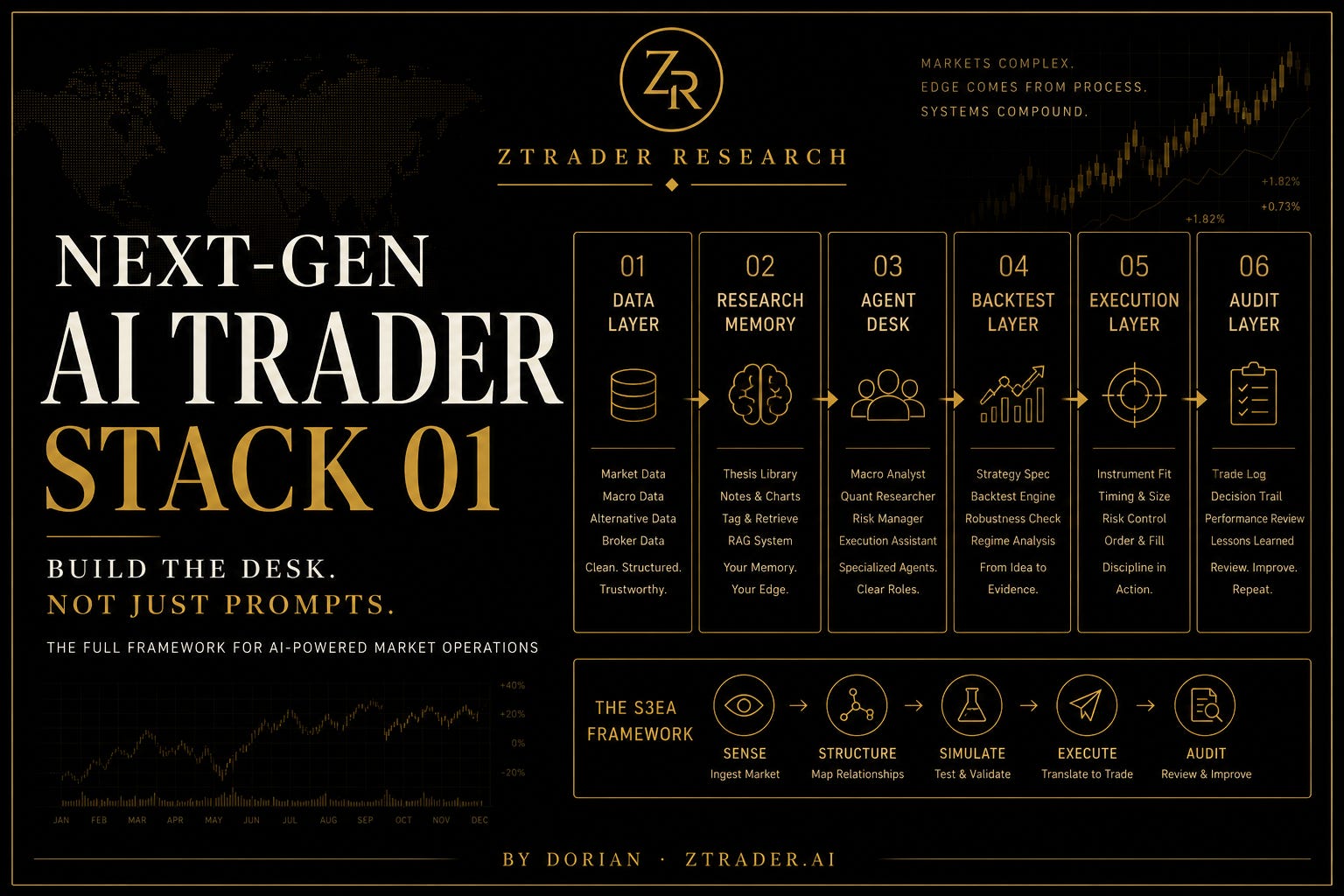
The first generation of AI traders used ChatGPT like prompting a magic mirror.
The second generation AI users will use GPT like their own trading desk — research, quant, risk, execution, and audit running in parallel.
The prompt alone is not the edge.
The Entire stack is.
By Dorian
ZTrader.AI
The question that killed the first wave was deceptively simple: "Should I buy NVDA?"
Traders typed it into ChatGPT, got a confident paragraph, and called it research.
What they had was autocomplete wrapped in financial vocabulary — an expensive magic eight ball that could write in complete sentences. It was not AI trading. It was only AI-flavored market simulations.
The second generation will not make that mistake. Not because they are smarter, but because the model does not care how confident you sound when the position goes against you. Process is what survives that moment. The prompt is gone by then. The stack is what remains.
"The next-generation AI trader is not the person with the best prompt. It is the person who can connect data, memory, agents, backtests, execution, and review into one operating system."
I. GITHUB IS THE NEW TRADING FLOOR
If you want to understand where AI trading is going, stop reading generic AI threads.
Read GitHub.
Not because every repo is production-ready — most are not. Most are research toys. Some are beautifully overbuilt. Some are demo projects with institutional wraps. But GitHub reveals the direction faster than any corporate white paper, and the direction is already clear.
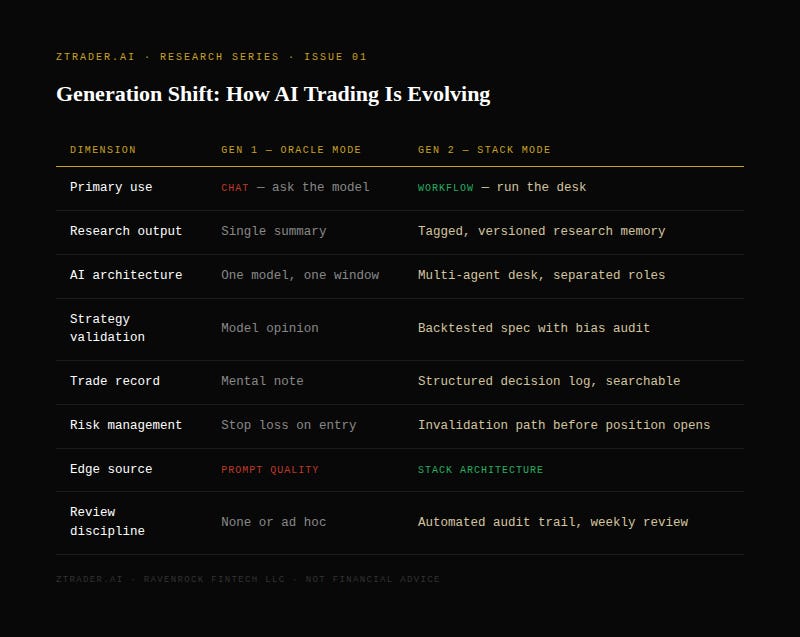
AI trading is moving from chat to workflow, from summary to research memory, from single model to multi-agent desk, from chart opinion to testable strategy, from manual notebook to structured audit trail.
Most people miss this entirely.
They think AI trading means asking the model for market direction. That is the lowest layer of a six-layer machine.
The serious question is not "what can the model tell me?" It is "what part of my trading process can become a repeatable system?" Those are different questions. The first one outsources judgment. The second one builds it.
[TABLE — Generation Shift: How AI Trading Is Evolving]
II. THE CORE STACK: SIX LAYERS
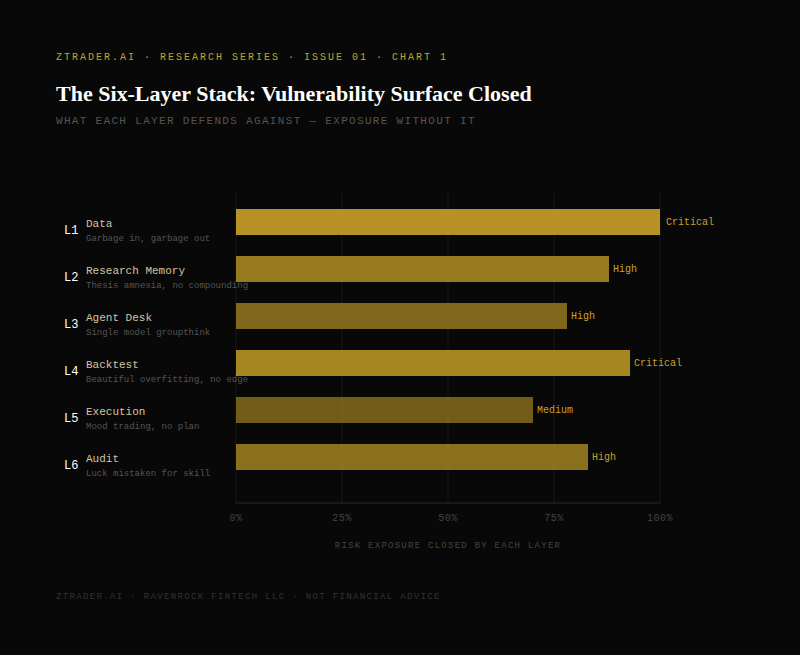
Remove any one of these six layers and the whole structure collapses into something that looks like a Reddit trading strategy with better typography.
Layer 1 — Data
This is the floor.
Prices, volume, options chains, macro data, earnings, rates, FX, commodities, news, flows, positioning, broker exports.
If the data is messy, the model is not intelligent — it is confidently wrong with better grammar. The data must be structured with canonical schemas, timestamped, source-labeled, and agent-queryable. A next-gen AI trader does not only collect data. He makes it usable by machines.
Layer 2 — Research Memory
Most traders do not have a research system. They have scattered notes, screenshots, half-finished ideas, and a graveyard of open tabs.
That is cognitive hoarding, not research.
Market thesis must be stored.
Live charts must connect to a dataset.
Every trade must connect to a thesis.
Trade thesis must carry invalidation conditions.
The model should not only answer today's question. It should remember what you believed last Tuesday and why you were wrong.
Layer 3 — Agent Desk
A single chatbot is not a desk. A real desk separates roles. Research agent finds evidence. Strategy agent forms the thesis. Quant agent turns it into testable conditions. Risk agent attacks the position. Execution agent checks instrument, timing, and sizing. Audit agent reviews the outcome. The point is forced separation of duties — one agent should not both generate the trade and approve the risk. That is how humans blow up funds. Teaching machines to repeat the same organizational stupidity is touching in the worst possible way.
Layer 4 — Backtest
Thesis alone does not make good trades
A working strategy is not a backtest. A backtest is not proof. That distinction alone would save half the internet from financial embarrassment.
The backtest layer exists to kill lazy ideas early — before they become real positions with real P&L. AI is useful here precisely because it can translate vague trading language into testable structure. But the human must stay awake.
Ask AI to "make it profitable" and it will do exactly what junior quants and desperate founders have done for decades: overfit beautifully.
Layer 5 — Execution
Execution is where pretty research meets ugly reality. "I'm bullish" is not a trade plan. It is a mood. The execution layer forces the trader to define the position before emotion arrives: instrument, sizing, stop, take profit, invalidating event, and review trigger — each as a separate, explicit decision.
What instrument expresses the thesis?
If timing is uncertain, should the trade be staged?
If volatility is expensive, should the position avoid long options?
These are engineering questions, not opinion questions. The stack exists to make the trader harder to fool.
Layer 6 — Audit
The old trading journal is dead. Nobody wants to write poetic diary entries after taking a loss. The next-gen journal should be automatic — every prompt, dataset, thesis, agent debate, backtest, trade, override, and exit stored, tagged, and searchable.
Some trades can even make money for the wrong reason.
Without an audit layer, you cannot distinguish skill from luck from overfitting from a temporary hallucination wearing a Bloomberg terminal costume.
[CHART 1 — Stack Layer: What Each Layer Defends Against]
III. THE GITHUB WATCHLIST
This is a pattern map, not a holy list. The goal is not to find a repo to deploy. It is to find a design pattern to steal.
AI Trading Agents
Start with TradingAgents, FinRobot, AI Hedge Fund, Vibe-Trading, Lumibot, and investor-harness.
Do not copy them blindly.
Read them like architecture.
Ask:
How do they split roles?
How do they retrieve data?
How do they pass state?
How does the model handle risk?
Serious builder don’t read GitHub as normal consumer.
You should become a predator extracting the working market patterns.
Data and Research Layer
OpenBB is useful because it points toward a data access layer that can feed notebooks, dashboards, APIs, and AI agents simultaneously.
The AI trader should not manually copy-paste market data into chat.
The data must be callable, scalable and precise.
The model must know what tools exist and how to utilize them.
This is where MCP-style thinking becomes solid infra— the future is not one giant AI window, it is AI connected to many small, controlled tools.
Quant Research and Backtesting
Qlib, vectorbt, Freqtrade, Lumibot, NautilusTrader — these are different animals.
Qlib is closer to AI quant research and model experimentation. vectorbt is excellent for fast strategy testing at scale.
Freqtrade is practical for crypto strategy development and live bot workflows. NautilusTrader is more serious execution-engine territory where backtest and live consistency actually matters.
The lesson is obvious: a research path and an execution path must remain separate.
Notebook app is not a trading engine. Repo demo is far from a solid quant fund.
Apparently this still needs saying because the internet continues to be the world's largest leverage accident.
"If your data is dirty, your model is drunk. No prompt can fix broken data. It can only hide the smell."
IV. THE REQUIRED ABILITY STACK
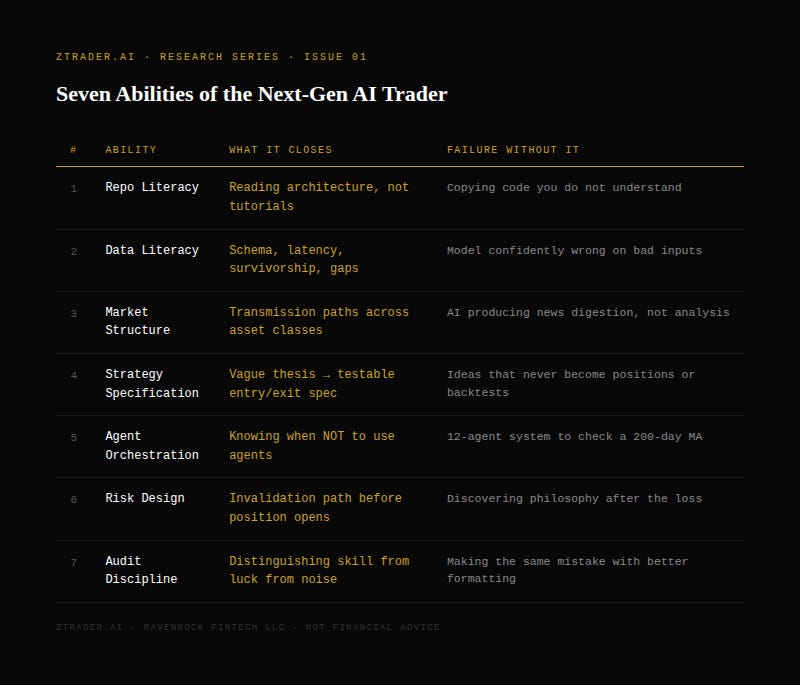
[TABLE — Seven Abilities of the Next-Gen AI Trader]
On agent orchestration specifically:
not every workflow needs agents.
Sometimes one script and one chart are enough. Building a 12-agent system to determine whether the S&P 500 is above its 200-day moving average is not sophistication. It is software cosplay.
The ability stack is a judgment layer sitting above the technical stack — knowing when to engage the machine and when to step back and think without it.
V. ESSENTIAL PROMPTS FOR THE AI TRADER STACK
These are not magic spells. They are operating commands — reusable modules for a research machine. Use them as starting points. Rewrite them for your own stack. The goal is not clever prompting. It is operational language design: repeatable instructions that produce consistent, structured outputs from your research workflow.
PROMPT 01 — GitHub Repo Extraction
You are my quant engineering analyst. Analyze this GitHub repository as an architecture source, not a user tutorial.
Extract:
1. What problem this repo solves
2. Core modules and data flow
3. Agent roles or workflow roles if any
4. Data inputs and outputs
5. Backtesting or execution assumptions
6. Risk management logic
7. Logging, evaluation, and audit design
8. What can be reused in my own AI trading stack
9. What should NOT be copied
10. The minimum prototype I can build from its design pattern
Output: 10-line executive summary · Architecture map · Reusable patterns · Failure risks · Implementation checklist
PROMPT 02 — Market Data Schema Builder
You are my market data architect. Design a canonical schema for the following trading dataset: [PASTE DATA DESCRIPTION]
I need the schema to support agent retrieval, backtesting, charting, signal generation, portfolio review, and audit trail.
Return: Table schema · Required fields · Optional fields · Metadata fields · Validation rules · Common data errors · Example JSON · How this dataset connects to thesis, signal, and trade records
PROMPT 03 — Macro Thesis Decomposer
You are my macro trading analyst. Decompose this market thesis: [PASTE THESIS]. Do not give a generic opinion.
Break into: Core claim · Transmission mechanism · Assets affected · Leading indicators · Confirming data · Disconfirming data · Time horizon · Best instruments · Main risks · Invalidation condition
End with: Bullish case · Bearish case · Neutral case · Tradeability score 1 to 10
PROMPT 04 — Cross-Asset Map
You are my cross-asset strategist. Build a relationship map for: [ASSET / EVENT / MACRO THEME]
Cover: Rates · FX · Equities · Commodities · Credit · Volatility · Liquidity · Positioning
For each link: Direction of influence · Strength · Lead/lag behavior · Data needed · What breaks the relationship
Return as: Causal chain · Table · Watchlist · Chart ideas
