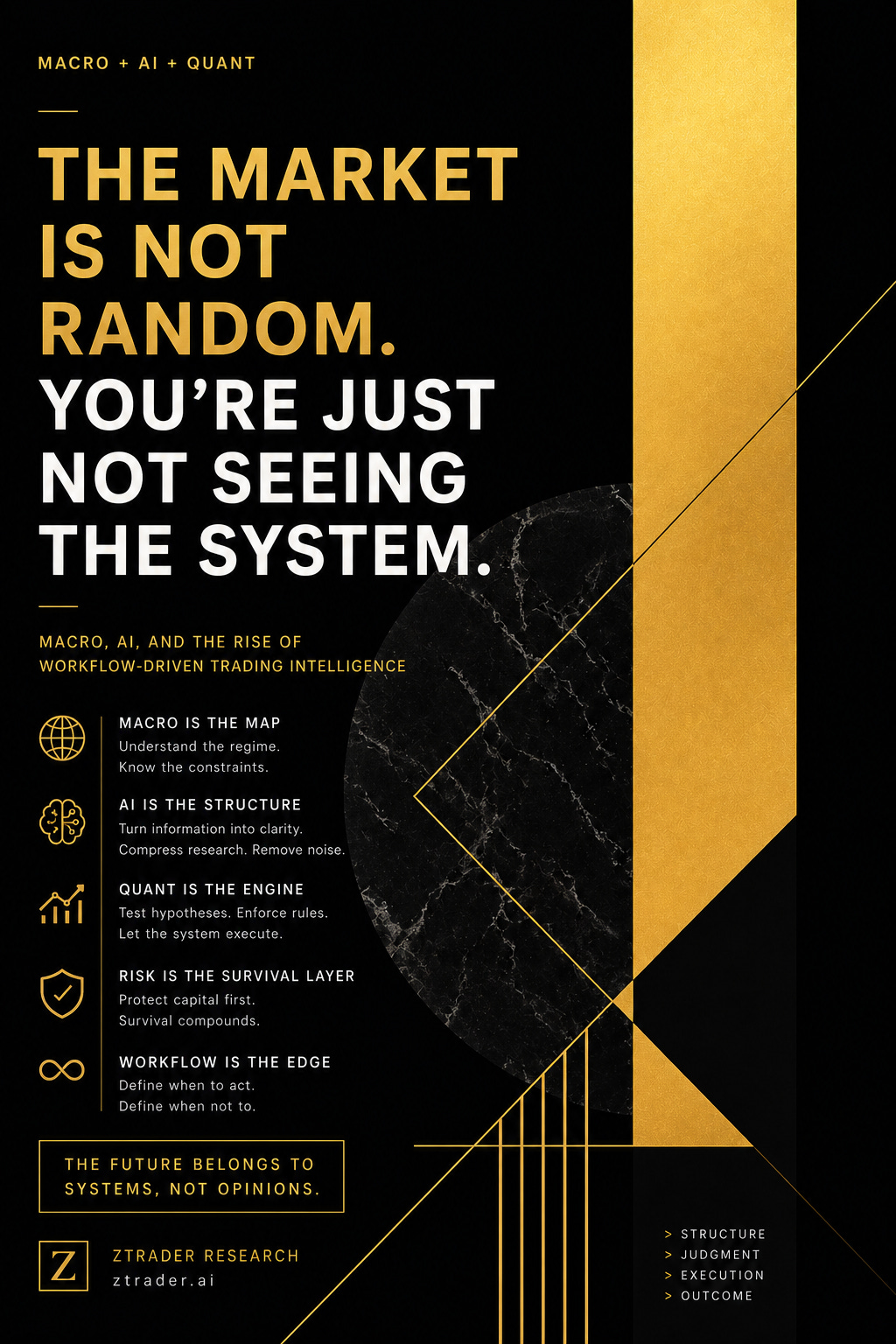
THE MARKET IS NOT RANDOM. YOU’RE JUST NOT SEEING THE SYSTEM.
Macro, AI, and the rise of workflow-driven trading intelligence
Thesis
Most people think markets are noisy.
They’re not.
They’re structured systems operating across multiple time horizons, constrained by liquidity, policy, and human behavior.
What is random is the way most people interact with them.
They chase signals.
They react to headlines.
They outsource thinking to tools that don’t actually think.
And then they call the outcome “volatility.”
It isn’t.
It’s the cost of operating without a system.
I. The Real Problem Is Not Alpha. It’s Structure.
There is no shortage of information.
You have:
Real-time macro data
Central bank signaling
Cross-asset correlations
AI-generated insights
And yet most participants are still:
Late
Wrong
Overexposed
Emotionally reactive
Why?
Because information is not the bottleneck.
Structure is.
Without structure:
Data becomes noise
Signals become traps
AI becomes a hallucination engine
II. Macro Today: A System Under Tension
We are not in a “normal cycle.”
We are in a constraint-driven regime where multiple systems are colliding:
Rates are structurally high relative to the post-2008 regime
Energy remains a geopolitical variable, not just a commodity
Liquidity is selective, not abundant
Volatility is episodic, not continuous
This creates a market that behaves like this:
Calm → Shock → Forced Repricing → False Stability → Repeat
If you’re trading it like a smooth trend environment, you’re already behind.
III. AI Won’t Save You. It Will Expose You.
There’s a quiet misunderstanding happening right now.
People think AI gives them an edge.
What AI actually does is:
Expose whether you have a framework or not.
If you don’t:
You ask bad questions
You get confident answers
You make worse decisions
If you do:
You compress research time
You test scenarios faster
You build systems instead of opinions
AI is not intelligence.
It’s a multiplier of whatever you already are.
IV. Quant Without Judgment Is Just Automation of Mistakes
The quant world has its own illusion.
They believe:
More data → better models
More signals → better decisions
More backtests → more confidence
But in unstable regimes, this breaks.
Because:
Correlations shift
Regimes flip
Tail events dominate
So what happens?
You don’t get better outcomes.
You get faster losses.
Quant without a macro-aware constraint layer is just:
High-speed error propagation.
V. The Missing Layer: Workflow
This is where almost everyone fails.
They have:
Data
Models
Tools
Dashboards
But they don’t have:
A decision workflow
A real workflow looks like this:
Macro State → Regime Classification → Constraint Layer → Trade Selection → Execution Window → Risk Control
Notice what’s missing?
No “gut feeling”
No random signal chasing
No overfitting
Instead, it does three critical things:
Filters what not to do
Defines when to act
Controls how much to risk
VI. Where Most Traders Actually Lose Money
Not on entries.
Not on exits.
They lose money on:
Timing mismatch (right idea, wrong window)
Size misallocation (correct trade, wrong exposure)
Regime misread (trend logic in a shock environment)
These are not signal problems.
They are workflow failures.
VII. The Future: From Traders to Systems
The next generation of edge is not:
Better indicators
Faster execution
More signals
It’s:
System-level thinking
Meaning:
You don’t “take trades”
You run a system
That system:
Filters inputs
Classifies reality
Executes only under constraints
Learns from outcomes
This is the difference between:
A trader
And a decision engine
VIII. What I’m Building (And Why It Matters)
I’m not building another tool.
I’m building:
A workflow-driven decision system
Where:
Macro is not commentary, but state detection
AI is not chat, but structuring
Quant is not prediction, but constraint enforcement
The goal is simple:
Reduce error before trying to increase returns
Because in real markets:
Survival compounds faster than brilliance.
IX. Final Thought
Most people are still asking:
“What should I buy?”
Wrong question.
The real question is:
“Under what conditions should I be allowed to act?”
If you can’t answer that, no model, no AI, no signal will save you.
The market is not random.
Your process is.
Fix the process, and the noise disappears.
For full market tool stacks/researches,


