

By Dorian | October 15, 2026
Korea’s stock market more than doubled in the first half of 2026, carried by two memory chip companies.
Now this is the payback time.
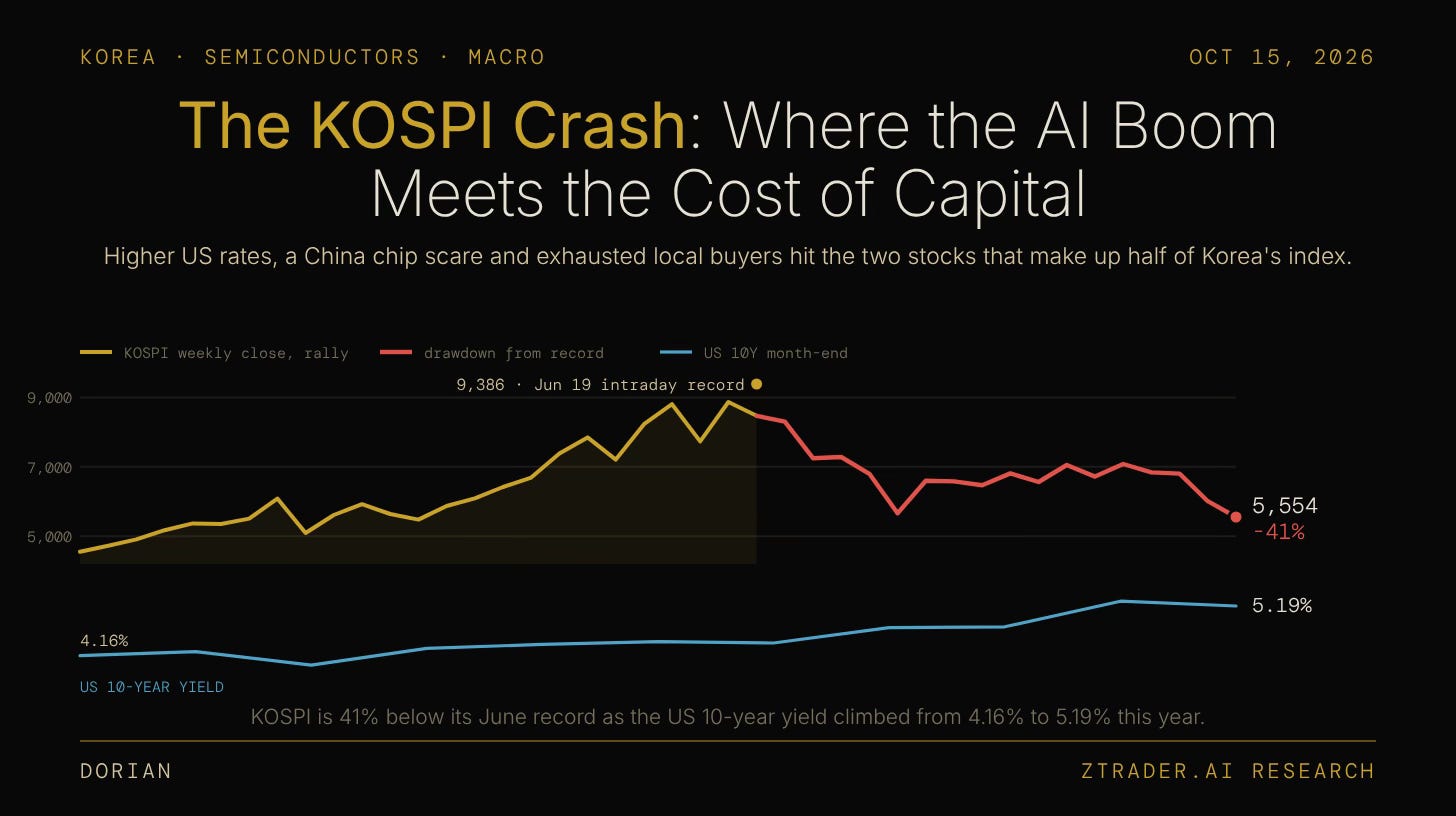
On Thursday, October 15, the KOSPI closed down 7.57% at 5,554.22, after trading as low as 5,465. SK hynix closed down 11.1% at 1,262K won. Samsung Electronics closed down 9.5% at 210K won.
Foreign investors sold a net 4.82 trillion won of KOSPI shares.
At 12:38 p.m. the exchange stopped all trading for 20 minutes.
What is a circuit breaker in Korea?
When the KOSPI falls 8% or more from the previous close and stays there for one minute, every trade on the main board stops for 20 minutes. Thursday was the first time since July 29 that it fired on both the KOSPI and the KOSDAQ on the same day.
If you trade US chips, AI infrastructure or Asian equities, this matters to you.
Every market got the same news this week. US inflation came in hot. Broadcom’s CEO warned that money could become a bigger limit on AI than chips. China’s largest memory maker claimed a breakthrough. The Philadelphia Semiconductor Index fell. Taiwan fell. Nothing fell like Korea.
That gap tells you where the AI trade is most exposed.
Korea is the most concentrated, the most tied to memory prices and the most dependent on foreign money.
When the cost of financing AI rises, Korean stocks reprice first and hardest. Read Korea correctly and you get an early read on what the rest of the AI supply chain may price next.
I. SEVEN SESSIONS DOWN AND A HALT BY LUNCHTIME
Here’s the Quick Market Summary:
1. Monday, October 12.
Broadcom CEO Hock Tan told a DBS conference in Singapore that access to capital may become the biggest constraint on AI buildout, ahead of chips and power. He said some AI investors act like gamblers, “almost like they are in a casino.”
2. Tuesday, October 13.
China’s CXMT said it had made key progress on a denser DRAM design. SK hynix closed down 10.09% and Samsung down 7.39%. The KOSPI fell 5.46% to 6,035.35, and foreigners sold a net 4.51 trillion won of Korean shares.
3. Wednesday, October 14.
The KOSPI rallied in the morning, then gave it all back and closed down 0.44% at 6,008.81. That night, US September CPI printed 3.7% year on year against 3.6% expected, with core at 2.6% against 2.5%. The semiconductor index fell 4.3%, leaving it down roughly 12% in a week. CoreWeave dropped 15.5% and Oracle almost 9% on worries about their debt.
4. Thursday, October 15.
The KOSPI opened down 5.59% at 5,673.01. Program selling was suspended within eight minutes.
By lunchtime the circuit breaker was activated.
When KOSPI 200 futures drop 5% and stay there for one minute, program sell orders are paused for five minutes. Thursday’s sidecar was the second on the main board in three sessions.
The loss was the KOSPI’s seventh straight, its longest losing streak since September 2024.
We have seen this movie once already
On July 28 and 29, the KOSPI triggered circuit breakers on back-to-back days for the first time in its history. By midday on July 29 the index had fallen 33.6% from its July 1 close of 8,303.41. Thursday’s close of 5,554 was below every close of the July sell-off.
So October is the second leg of the same unwind. The record high came in June, above 9,300. At 5,554 the index is roughly 41% below that peak, yet still about 32% above its 2025 close of 4,214.17.
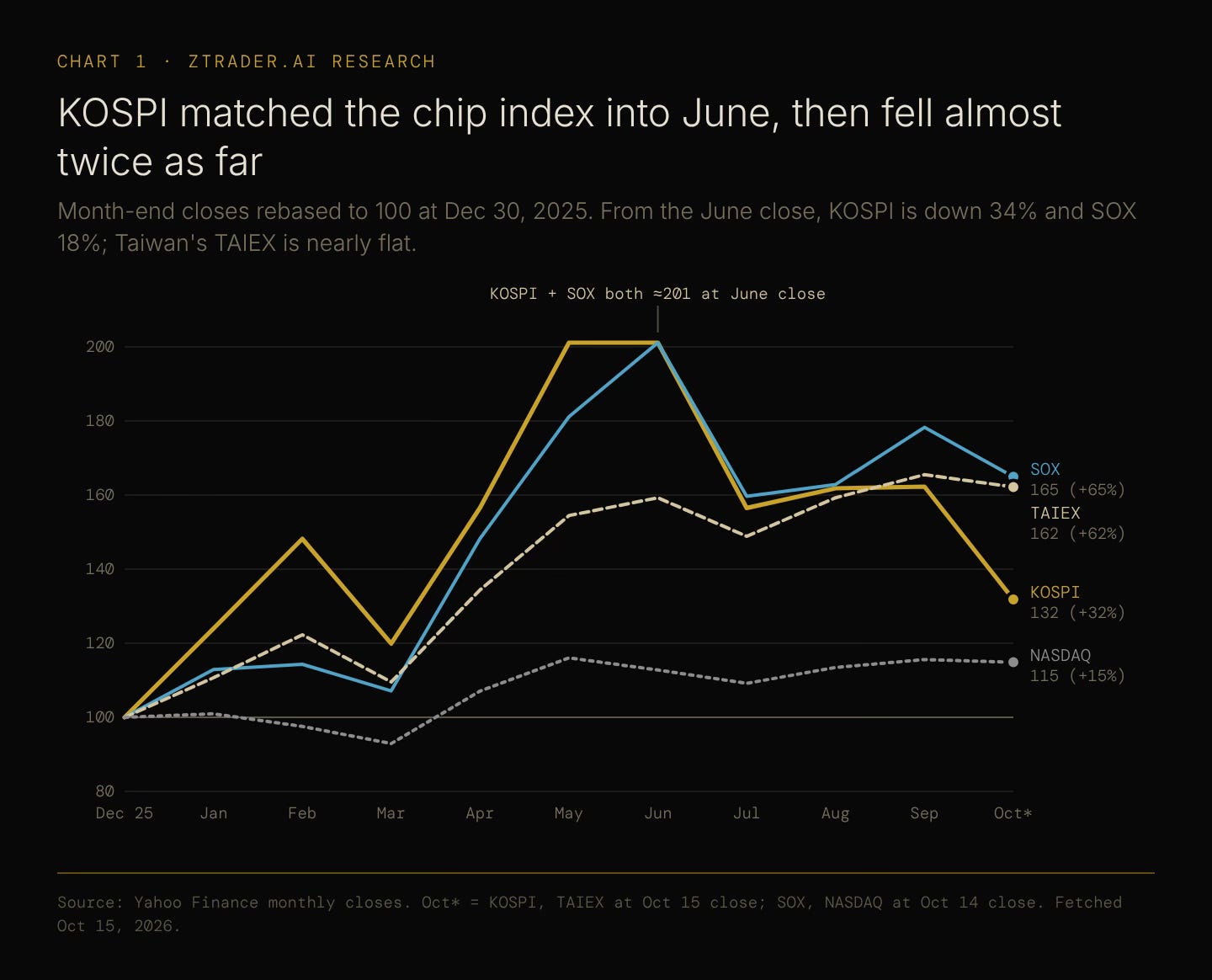
[CHART 1 — KOSPI matched the chip index into June, then fell almost twice as far]
Why this chart explains the key part.
This chart answers whether Korea simply moves with the AI trade or amplifies it. All four indexes are rebased to 100 at the end of 2025. KOSPI and the Philadelphia Semiconductor Index both closed June at about double their starting level. Since then KOSPI has fallen 34% and the chip index 18%. Taiwan’s TAIEX closed Thursday at 46,970, still up about 62% on the year, while KOSPI is up about 32%.
II. HOW MUCH OF KOSPI IS REALLY SAMSUNG AND SK HYNIX?
The weight problem
At the end of 2024, Samsung Electronics and SK hynix made up about 22.6% of KOSPI market value. By the end of 2025, 34%. By June 19 this year, 56.2%. After the sell-off they still sit around half the index.
So when you buy “Korea,” you are mostly buying a bet on memory chip prices. When a foreign fund sells Korea, it is mostly selling Samsung and SK hynix. And when anyone questions memory pricing power, the whole index takes the hit.
What the earnings say
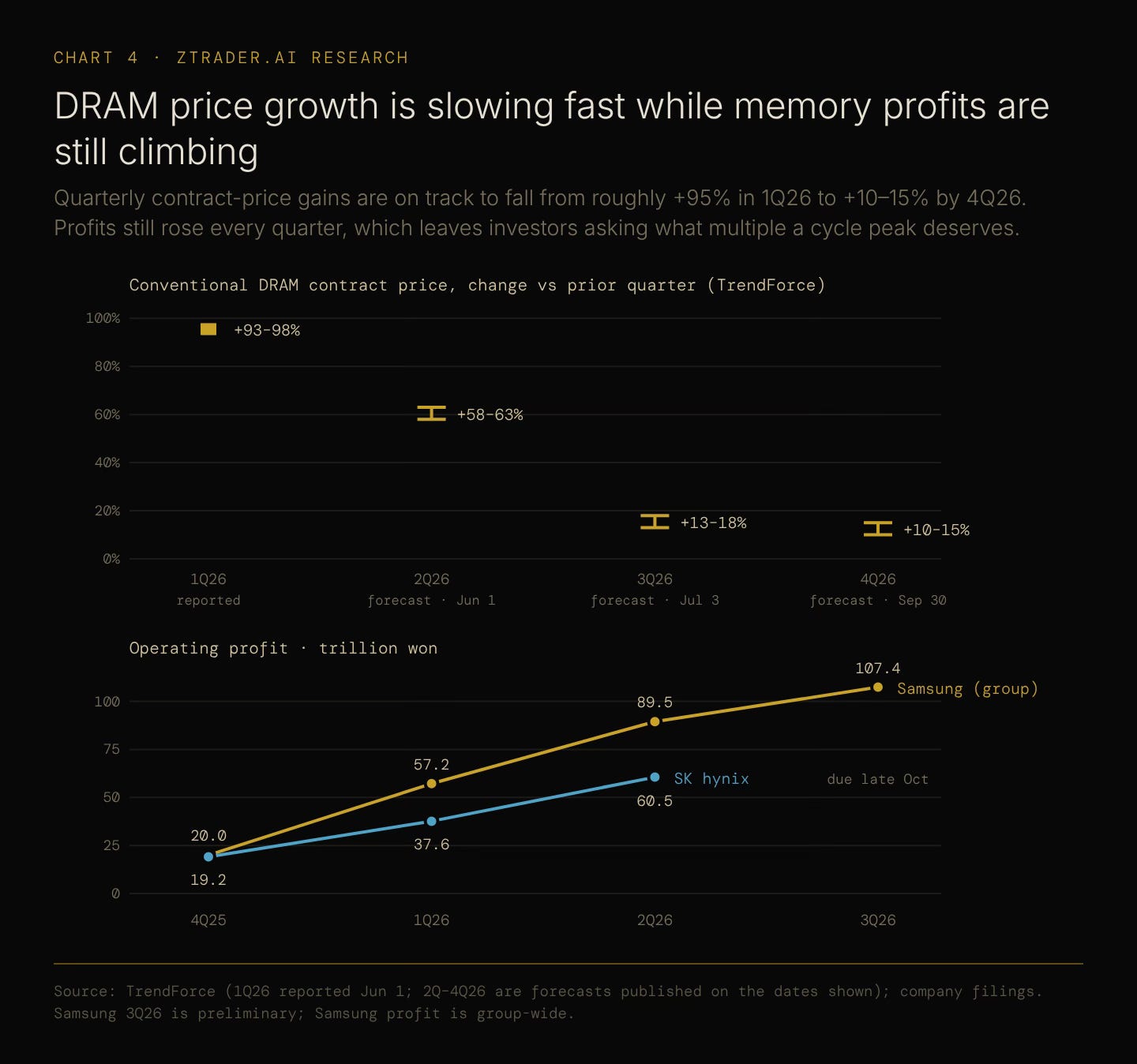
Samsung reported preliminary third-quarter operating profit of 107.4 trillion won on October 8. That is the first quarter above 100 trillion won for any Korean company, with a 55.1% operating margin. Analysts estimate memory alone earned around 110 trillion won, covering losses elsewhere in the group.
Investors sold anyway. So the repricing targets something else: how long memory prices stay this high, and what multiple anyone should pay for profits at a cycle peak.
Forced sellers on the way up
Part of the foreign selling started during the rally itself. In May, foreigners sold a then-record 44.71 trillion won of KOSPI shares, 82% of it in the two chipmakers. June topped it at 48.62 trillion won.
Nomura’s Asia strategist described much of it as forced selling. Funds that track a benchmark can only overweight a single stock by so much. When Samsung and SK hynix grew past those limits, managers had to trim.
That matters now.
The holders who stayed through the rally were not committed buyers.
Many were underweight to begin with, and they have no reason to step in on a dip.
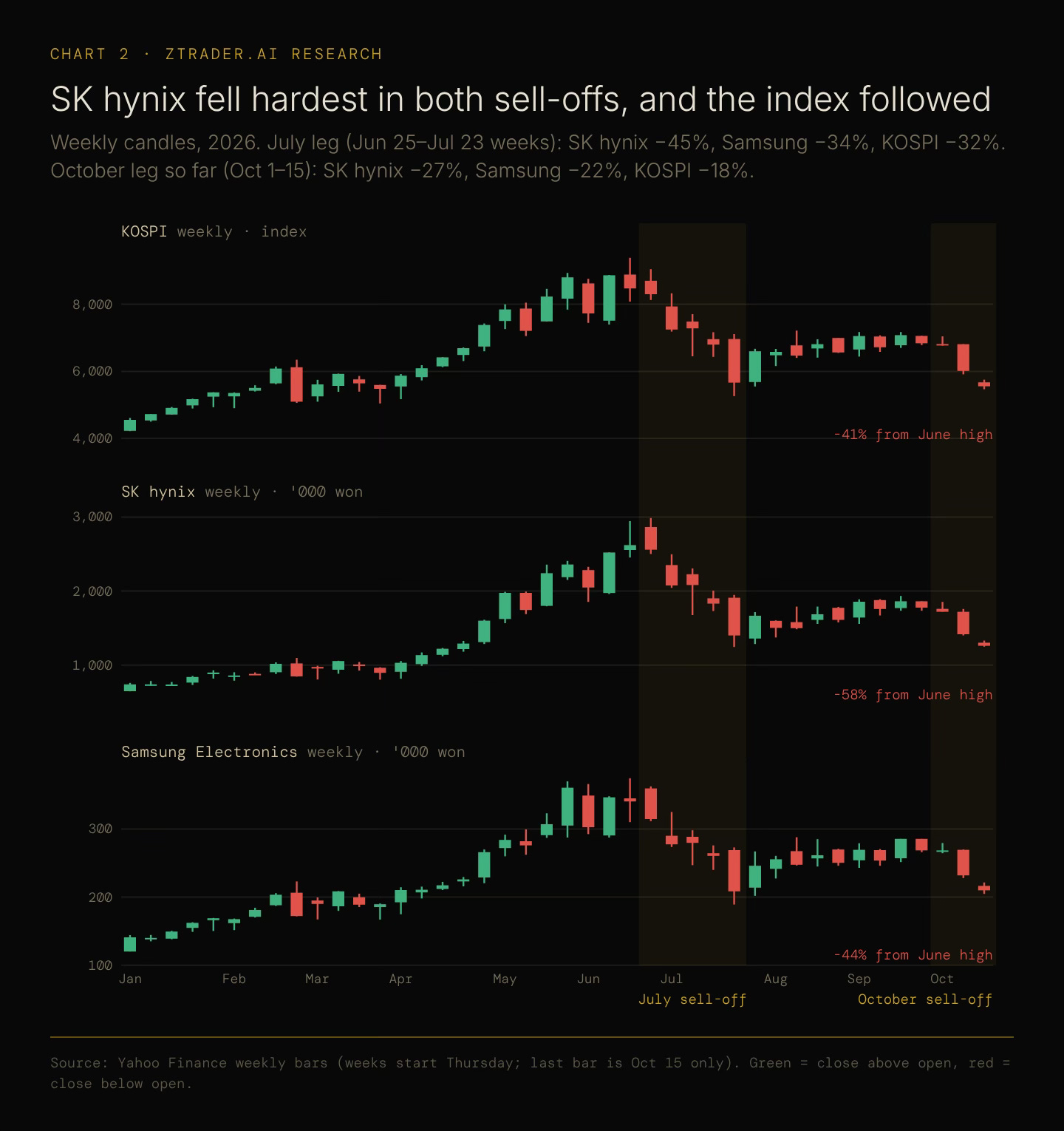
[CHART 2 — SK hynix fell hardest in both sell-offs, and the index followed]
III. FROM A HOT CPI PRINT TO A SEOUL TRADING HALT
Six links from Washington to Seoul
Concentration explains why Korea falls hard. It does not explain why this week. For that you need to follow the money behind the AI buildout.
Not every link below is proven, but each one has evidence from this week.
1. US inflation rises, so rate expectations rise. The Fed already hiked in September. September CPI came in hot, and the next decision is on October 28.
2. AI infrastructure financing gets more expensive. Data centers are built with debt, and that debt is priced off Treasury yields.
3. Investors start asking whether the spending pays back. Hyperscaler capex, neocloud borrowing and AI lab losses all face more scrutiny.
4. Expected demand for HBM and DRAM gets repriced, even without any lost orders.
5. Samsung and SK hynix valuations compress.
6. Foreign selling pushes the KOSPI lower.
What is a neocloud?
It is a company like CoreWeave that rents out GPU computing power and funds its data centers largely with borrowed money.
Where the stress showed up first
CoreWeave fell more than 15% on Wednesday after a chart of its rising bond yields spread online. Oracle, already carrying heavy debt from its data center build, dropped almost 9%. Australian data center operator Firmus pulled its IPO on October 9 after first cutting the price. Broadcom, meanwhile, is arranging roughly $60 billion of debt tied to chip leases for Anthropic, according to the Financial Times.
Notice the order.
The weakest balance sheets broke first. Then the chipmakers that sell into those balance sheets. Then the market where those chipmakers are half the index.
Why rates hit memory harder than software
Memory makers sit at the end of the spending chain.
They get paid only if hyperscalers and neoclouds keep building. If even one part of AI spending slows, the companies that sell the hardware feel it immediately. No orders have been cut. But in a market priced on how long the boom lasts, a higher cost of capital shortens the expected boom, and memory multiples come down.
Korean analysts say the same thing in plain terms. One told JoongAng Daily that US long-term rates need to fall before foreign investors stop selling.
[CHART 3 — AI chip demand kept growing in 2026, and so did the cost of financing it]
IV. WHAT CXMT ACTUALLY CLAIMED
Who CXMT is
ChangXin Memory Technologies is China’s largest DRAM maker. TrendForce put its second-quarter 2026 share of global DRAM revenue at 9.5%, fourth behind Samsung at 39.4%, SK hynix at 24.9% and Micron at 23.3%.
What they said
At a chip conference in Shanghai on October 10, CXMT president Cao Kanyu said the company had made key progress on a 4F² DRAM design and expects to launch server memory built on it by the end of 2026.
What is 4F²? It is a denser way to lay out each memory cell. In theory it fits about 50% more cells on the same chip. Samsung is not expected to produce 4F² parts until 2028, so on announced timelines alone, CXMT would be about two years ahead.
What they did not say
CXMT gave no specs, no yield data and no customer qualifications. Bloomberg’s reporting says the claim does not pose an immediate threat to Samsung and SK hynix in HBM, the stacked memory that sits inside Nvidia’s AI accelerators. Korean reporting says CXMT still struggles with HBM yields, while Samsung and SK hynix are already shipping HBM4E samples.
Why the market still cares
Split memory into three businesses and the risk gets clearer.
1. HBM. Korea dominates. CXMT is not close.
2. Server DRAM. This is the high-margin segment CXMT just targeted, and it already signed a five-year server memory deal with ByteDance worth more than $7 billion.
3. Commodity DRAM for phones and PCs. CXMT has already taken share here.
Memory prices are set at the margin. You do not need CXMT to beat SK hynix. You only need a credible fourth supplier in server DRAM to cap prices at the top of the cycle. That is a pricing-power question, and pricing power is what a 55% operating margin depends on.
[CHART 4 — DRAM price growth is slowing fast while memory profits are still climbing]
V. FOREIGN MONEY, THE KOREAN WON AND THE END OF THE BUYBACKS
THE 203.7 trillion won FIRE SELLING
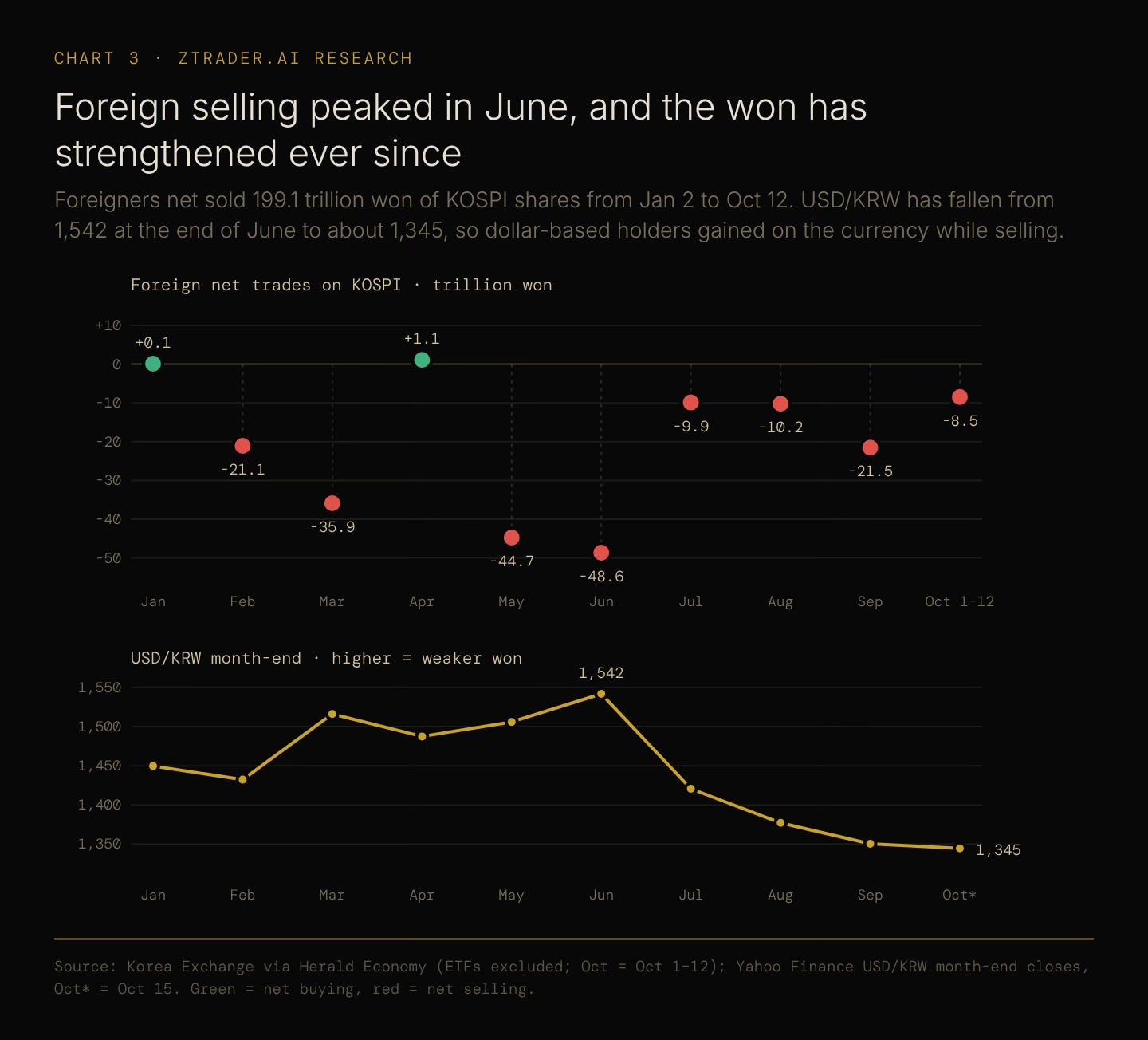
Foreign investors sold a net 203.7 trillion won of KOSPI stocks this year through October 13. About 176 trillion won of that, or 86%, came from Samsung and SK hynix. Foreign ownership of Samsung is at its lowest since 2008.
The timing matters. About 149 trillion won left in the first half, mostly as profit-taking into the rally, with June the heaviest month at 48.6 trillion won. Selling eased to about 10 trillion won in each of July and August. Then it came back: 21.5 trillion won in September and 8.5 trillion won from October 1 to 12.
What the won is doing
You might expect the usual emerging-market loop here. Foreigners sell stocks, the won weakens, dollar returns get worse, and foreigners sell more. The data does not show it in 2026.
USD/KRW closed June at 1,542. It closed Thursday at 1,344.6, close to the won’s strongest level since late 2024. For a dollar-based investor, the currency has added about 15% since the end of June.
On Thursday the won weakened by less than half a percent while the KOSPI fell more than 7%.
If anything, the strong won hurts from the other direction. Analysts cut their Samsung third-quarter forecasts in recent weeks because a stronger won shrinks exporters’ profits in won terms.
So the currency loop is a risk to watch rather than today’s driver. MUFG notes that demand for options protecting against a weaker won has jumped this week. If that hedging turns into real won selling, the loop switches on.
Who absorbed the selling until now
In August and September, foreigners sold a net 31.7 trillion won of Korean equities, yet the KOSPI rose 3.7%. Share buybacks at Samsung and SK hynix absorbed an average of 1.61 trillion won of selling per day. Samsung’s program has ended. SK hynix’s ends this week.
Retail and local institutions cannot fill the gap. On heavy foreign-selling days in May and June, they were net buyers of about 280 billion won a day. In September and October they flipped to net sellers of about 390 billion won a day. Average daily KOSPI turnover fell 57%, from 50.3 trillion won to 21.4 trillion won.
So the loop running today looks like this:
Foreign selling → no buyback bid → local buyers tapped out → index falls → more foreign selling as risk limits tighten
Since September, the KOSPI fell on 14 of the 15 days when foreigners sold more than 1 trillion won. That is what a market without a backstop looks like.
[CHART 5 — Foreign selling peaked in June, and the won has strengthened ever since]
VI. WHY KOREA, NOT TAIWAN
How hard each market got hit
Taiwan STOCK MARKET got hit HARD too.
On October 13 the TAIEX fell 1.95% and foreigners sold TWD 165 billion of Taiwanese stocks, the third-largest daily foreign sale on record. TSMC dropped 1.97%.
The same day, the KOSPI fell 5.46%.
Eugene Investment & Securities estimates foreign selling pressure in Korea is more than three times as intense as in Taiwan relative to market size.
What each market is really selling
Both indexes are HEAVILY concentrated.
TSMC alone is more than 40% of Taiwan’s market value.
The difference is what the concentrated stock sells.
1. Pricing. TSMC sells leading-edge manufacturing capacity that customers book years ahead. Memory is a commodity priced quarter to quarter, and a new supplier pushes the price down.
2. Product cycle. Foundry revenue grows with each new chip generation. Memory profits swing with the gap between supply and demand.
3. Competition. CXMT is a direct rival in DRAM. TSMC faces no comparable claim at its leading edge this week.
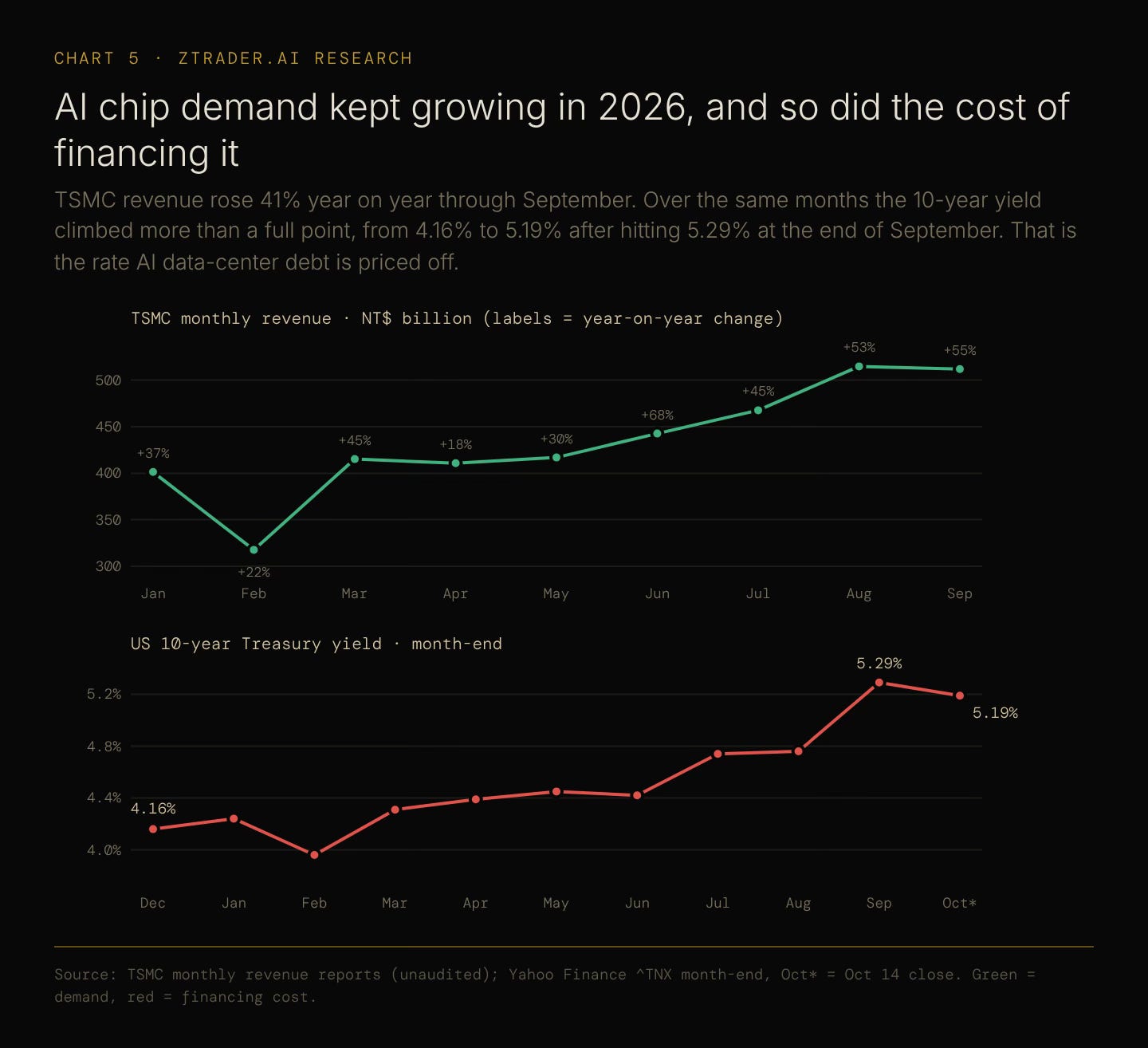
4. Delivery. TSMC’s September revenue rose 54.6% from a year earlier, and January to September revenue was up 41.1%. Its growth shows up monthly. Memory’s peak margins need to be defended every quarter.
Taiwan is not immune.
On July 17 the TAIEX fell 6.5% when TSMC dropped 7.3% on worries about heavy spending and weaker profitability. Capex doubts can hurt Taiwan as much as Korea. The CXMT supply threat lands on Korea alone.
TSMC reported third-quarter results on Thursday afternoon.
Net profit rose 68.7% from a year earlier to NT$763.1 billion, revenue rose 50.9%, and gross margin came in at 66.4%. Foundry demand is still backing up the AI spending story. Taiwan’s index fell 3.4% that day anyway, about half of Korea’s drop.
