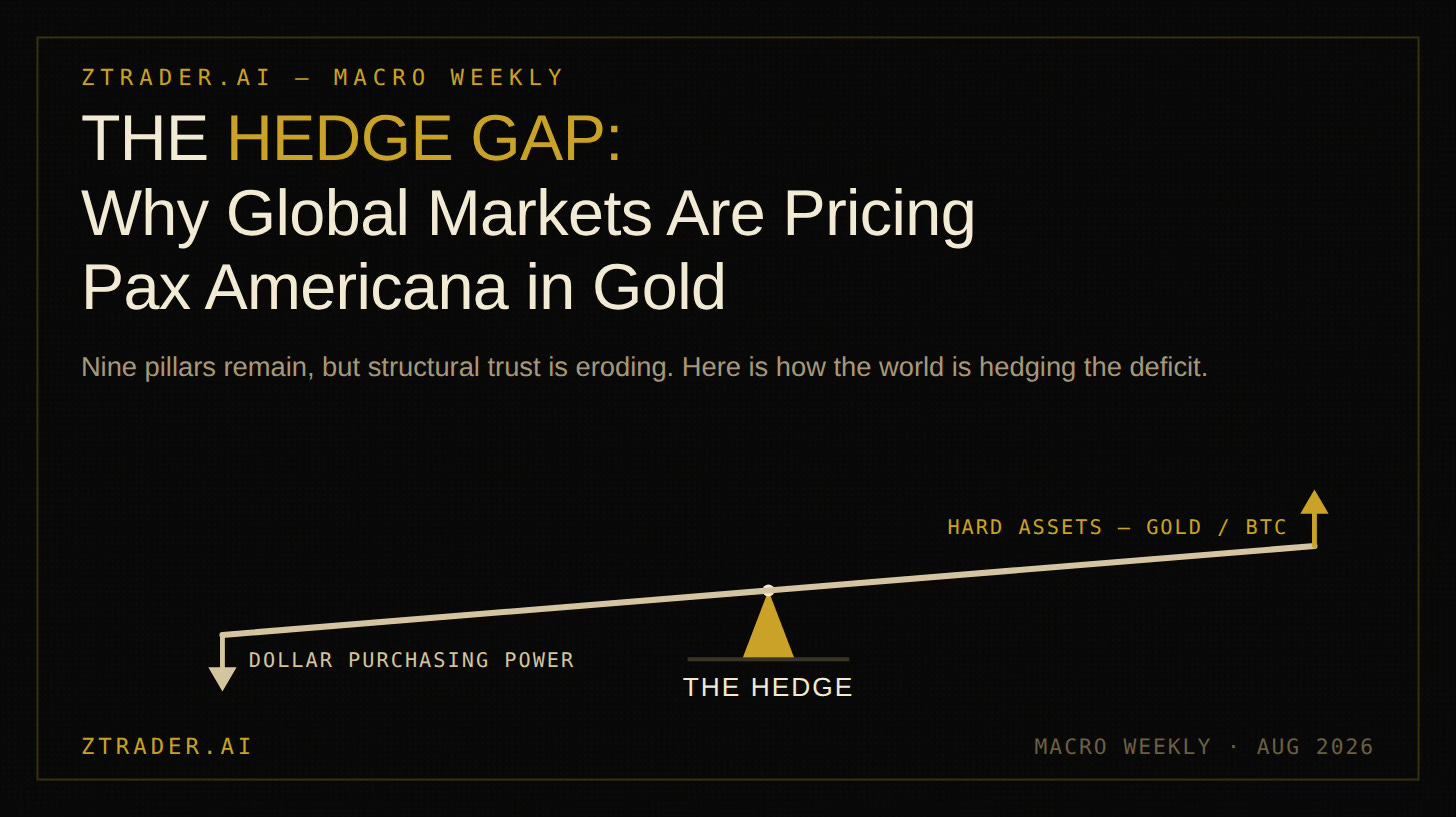
What is PAX AMERICANA REALLY?
Before you understand how dollar system really operates you must understand the PAX AMERICANA, for this is the very infra of the DOLLAR dominated universe that we are living in.
Pax Americana is an actual governing arrangement, not just a flashy latin word.
Since 1945 the United States has organized the security, financial and economic systems that most of the world operates inside, in the way Rome organized the Mediterranean and Britain organized global shipping and finance in the nineteenth century.
Strategist like Robert Kagan or John Ikenberry argue that this international order—often termed the 'Pax Americana'—is now facing its most severe crisis since its inception, as rising powers challenge the rules-based architecture that has underpinned global stability for nearly a century.
Understanding why that arrangement has lasted eighty years, and what would actually have to break for it to end, matters more in 2026 than at almost any point since the Cold War, because the arrangement is visibly under strain.
This piece sets out the architecture in full, then examines where the current stress is concentrated and what the bond and gold markets are telling us about it.
THE ARCHITECTURE OF PAX AMERICANA
Historians of hegemonic order generally identify the same features in any system that has organised the world economy for an extended period: a dominant security guarantor, a trusted reserve currency and financial center, control of critical trade routes, and an ideological or cultural pull that makes the arrangement self-reinforcing rather than merely coerced.
Pax Britannica had the Royal Navy, sterling, the Suez Canal and an empire on which the sun did not set. Pax Americana was built deliberately, in a five-year period between 1944 and 1949, through Bretton Woods, the Marshall Plan, NATO and the early Asian security treaties, largely by architects who had lived through the collapse of the previous order in the 1930s and were determined not to repeat it.
That architecture rests on nine specific, identifiable pillars.
THE NINE PILLARS
I did not invent the entire NINE PILLARS THESIS, and here are the references:
The 2022 Springer study of postwar hegemony describes US primacy as resting explicitly on
"Four pillars: military might and relevant diplomacy, mastering a very efficient productive paradigm, an emblematic role in the defense of democracy and multilateralism, and the autonomy in the design of monetary and budgetary policies given the centrality of the dollar."
The sociologist Michael Mann's influential four-source model of power, ideological, economic, military, political, covers the same ground from a different discipline.
What follows decomposes those same recognised categories into nine more specific, checkable components, because "military might" is not one thing when Asia-Pacific basing and Middle East basing run on entirely different treaties, guarantees and histories.
1. The Asia-Pacific security architecture.
What is now called the "San Francisco System," a network of bilateral treaties with Japan, South Korea, the Philippines and Australia rather than a single multilateral alliance, was built after the Korean War specifically to prevent the kind of collective bargaining power that might let any one Asian ally set terms with Washington.
The Seventh Fleet has patrolled the Western Pacific continuously since 1950.
2. Middle East basing and the petrodollar structure.
The relationship dates to Franklin Roosevelt's 1945 meeting with King Abdulaziz aboard the USS Quincy, and was formalised financially in 1974, when Washington and Riyadh agreed that Saudi oil would be priced in dollars and Saudi surpluses recycled into US Treasuries in exchange for security guarantees.
The Carter Doctrine of 1980 extended that guarantee into a standing commitment, and the Fifth Fleet has been headquartered in Bahrain since 1995.
3. NATO and the wider alliance network.
Article 5, invoked exactly once, after September 11, is a security guarantee that functions because members believe it will be honoured, not because they have no alternative.
This is the structural distinction Ikenberry's institutional-order thesis turns on:
the USSR maintained satellite states through the threat of Warsaw Pact tanks and lost every one within eighteen months of Moscow's weakness becoming apparent in 1989.
More than 40 countries maintain formal defence treaties with Washington today, and none has been abandoned despite considerable strain in 2026.
4. Treasury depth and the dollar payments system.
Bretton Woods made the dollar the reserve currency by treaty in 1944; Nixon's closure of the gold window in 1971 made it the reserve currency by inertia and network effect instead, an arrangement economists including Barry Eichengreen have described as America's "exorbitant privilege." At roughly $28tn outstanding, the Treasury market remains the deepest and most liquid government bond market on earth, which is precisely why central banks with every political reason to distrust Washington still hold the bulk of their reserves in it.
5. Residual dividends from the post-1945 economic order.
The US built the IMF, the World Bank and the GATT system that became the WTO, and wrote rules that favoured an economy which emerged from the Second World War as the only major industrial power with its infrastructure intact. This is the "public goods provision" mechanism at the center of Kindleberger's original hegemonic stability argument.
6. Narrative and soft power with durable pull.
Joseph Nye's concept of soft power, coined in 1990, understates how mechanical the effect actually is in practice:
the United States enrolled more international students than any other country in 2025, and immigration flows toward the US have stayed positive even through periods of considerable domestic hostility to immigrants.(yes, now US is doing the EXACT OPPOSITE)
States do not need to admire Washington's foreign policy to want their children educated at Stanford.
7. Capitalism, invention and comparative openness.
The US accounts for a share of global venture capital investment and science Nobel Prizes wildly disproportionate to its population, a pattern that has held for most of a century across dramatically different domestic political environments, which suggests the underlying driver is structural rather than partisan.
8. Political self-correction.
The US political system has absorbed the Civil War, the Great Depression, Watergate and two impeachments without a change of constitutional order, a 250-year record that compares favourably with almost every other major power over the same period.
This is the pillar most visibly under strain in domestic discourse, and the one whose historical track record is most consistently underestimated by people extrapolating from the last six months of headlines.
9. Two world wars made USA today.
The two global conflicts upended the international order. It was the crucible of these structural shifts, paired with a calculated series of strategic foresights, that shaped THE AMERICA we know today.
The US is the only super power to have emerged from both the First and Second World Wars wealthier and more industrially capable than it entered them, while every other major economy, including its closest allies, emerged either destroyed, indebted, or both.
That fact alone explains why the US started the postwar era holding roughly two-thirds of the world's monetary gold reserves and the only intact industrial base capable of rebuilding everyone else's.
[CHART 1 — The Ruling Nine Pillars, Still Standing]
Together these form a genuinely integrated system, not nine independent factors that happen to coincide.
The security guarantees make the dollar’s role as reserve currency credible;
the reserve currency role finances the military that underwrites the security guarantees;
the alliance network gives the narrative and soft-power advantages a delivery mechanism;
and the whole structure compounds, because none of it could be replicated quickly even by a state with the resources to try.
[CHART 2 — Pax Americana’s Physical Network]
THE FRAMEWORK UNDER STRESS, 2026
Each of these pillars has taken visible strain this year, and it is worth being specific about where, because the specificity is the difference between analysis and vibes.
In April, President Trump called NATO a “paper tiger” and floated withdrawing from the alliance after member states declined to join US action against Iran. In July, at the alliance’s Ankara summit, he criticised member states publicly even as they finalised a commitment to raise defence spending to 5 per cent of GDP by 2035, a target Washington itself had set. In June, Israel and Iran fought a direct war that drew in a US naval blockade of Iranian shipping and left the region on a fragile truce, testing the Middle East basing structure in the process.
In January, the Greenland dispute reopened at Davos, straining relations with Denmark and much of Europe.
In the Western Hemisphere, direct US military involvement in Venezuela culminated in the capture of Nicolás Maduro, a reminder that the hemispheric security pillar still operates by different rules than the transatlantic one.
What is notable is not that this strain exists but what has happened to each pillar under the strain. AUKUS underwent a skeptical “America First” Pentagon review and emerged intact. Japan has doubled its defence spending rather than distancing itself from the US security umbrella.
The Philippines ran its largest Balikatan exercise on record. India signed a new ten-year defence framework with Washington in October 2025, even while absorbing some of the highest tariffs the US has imposed on any trading partner, keeping the defence relationship insulated from the trade dispute. NATO is still on track for the 2035 spending target despite, or arguably because of, the public friction. The pattern across every pillar under stress is the same: allies absorbing pressure, renegotiating terms, and remaining inside the structure rather than leaving it.
That is a system undergoing a renegotiation of terms. It is not a system in collapse, and the distinction matters enormously for how the following section should be read.
THE DOLLAR SYSTEM PILLAR, SPECIFICALLY
Of the nine, the pillar showing the most visible current stress is the dollar system itself, and this is where the popular commentary has gone furthest astray.
Foreign holdings of Treasuries reached a record $9.3tn in early 2026, and net foreign flows have been positive through 2025. The dollar’s share of global reserves, adjusted for exchange-rate effects, has moved only marginally quarter on quarter. The claim that foreign investors are abandoning US government debt is not supported by the Treasury’s own TIC data. What the data does show is narrower and more interesting: gold trading near record highs, central bank gold purchases running at the fastest pace since the 1971 closure of the gold window, and a dollar index that posted its worst first half since 1973 even as Treasury demand stayed intact.
The mechanism is margin reallocation, not stock liquidation. Each year, a larger share of new reserve accumulation goes to gold and other hard assets than a decade ago, while the existing stock of roughly $9.3tn in Treasuries remains largely untouched, because no market on earth is deep enough to absorb a disorderly exit at that scale without collapsing the price the seller is trying to protect. The practical response instead is to slow the growth of new dollar exposure while building a parallel position in assets that answer to no central bank and no sanctions regime.
This is, if anything, a more consequential development for the dollar than an outright sell-off would be. A liquidation panic is visible and self-correcting: yields rise, buyers are compensated to step in, and the market clears within weeks. Reallocation at the margin is quiet and structural, does not self-correct, and accumulates one reserve committee’s decision at a time, over years, while the currency continues to function normally on any given Tuesday even as its exclusivity erodes.
[CHART 3 — Foreigners Are Still Buying. The Dollar Doesn’t Believe It.]
The freezing of Russia’s foreign-exchange reserves in 2022 remains the hinge event for this pillar specifically.
It demonstrated that a Treasury holding is not an unconditional property right but a claim contingent on a government’s standing with Washington.
The country won’t consider itself a rival of the United States to draw that lesson; it need only be able to imagine circumstances in which it might become one, and 2026 has supplied no shortage of reasons to imagine exactly that.
[CHART 4 — Central Banks Buy Gold Regardless of What Yields Do]
Gold accumulation decoupling from real rates since 2022 is the clearest evidence that this reassessment has taken hold.
This goes beyond chasing yield—it resembles an insurance policy, acquired almost regardless of cost.
[TABLE — Global Reserve Composition, 2015 → 2026]
WHAT THIS MEANS
None of the nine pillars is at structural risk from what is happening to the dollar system specifically.
The alliance network is growing increasingly transactional rather than shrinking, as the 2026 evidence demonstrates pillar by pillar.
While the U.S. dollar maintains its dominance—accounting for roughly 88% of trade invoicing and FX turnover per BIS data, with no credible reserve substitute (the RMB lacks full convertibility, the euro lacks a unified fiscal backstop, and crypto has yet to achieve central-bank scale)—the true shift lies in the diminishing trust multiplier applied by the rest of the world.
The system remains operational, but on noticeably harsher terms than a decade ago. This friction is now being repaid not through diplomatic protests, but in the harder currency of gold and digital assets—a form of pressure far more durable than political rhetoric.
For readers positioning around this:
long gold and bitcoin as structural reserve-diversification hedges, sized as insurance rather than as a bet on dollar collapse, since the existing stock of Treasuries is not leaving and only the margin is.
Long the term premium at the long end, where steepeners across the 10s/30s remain attractive as fiscal issuance meets a buyer base that is more price-sensitive at the margin while staying net positive in aggregate.
Fade “de-dollarization now” as a short-term trading signal; this is a decade-scale trend being mispriced as a quarter-scale panic, and position sizing should not assume a change of reserve currency within this cycle.
We can continue to observe the allied reserve data, not adversary reserve data, for the clearest signal:
quiet accumulation of hard assets by Japan, South Korea, the Gulf states and NATO members is more informative than anything Beijing does, because these are the governments with the most to lose and no credible alternative bloc to join.
To read the future, look past the adversary and watch the allies. The silent, steady hoarding of hard assets by Tokyo, Seoul, Riyadh, and the West tells the true story:
these are the regimes tethered to the system, with the most to forfeit and no alternative harbor.
The nine pillars have anchored global order for eighty years, and the 2026 metrics prove the architecture is not falling.
What is passing is the illusion of a free lunch—and gold is the ultimate arbiter pricing the difference.
ZTrader.AI


