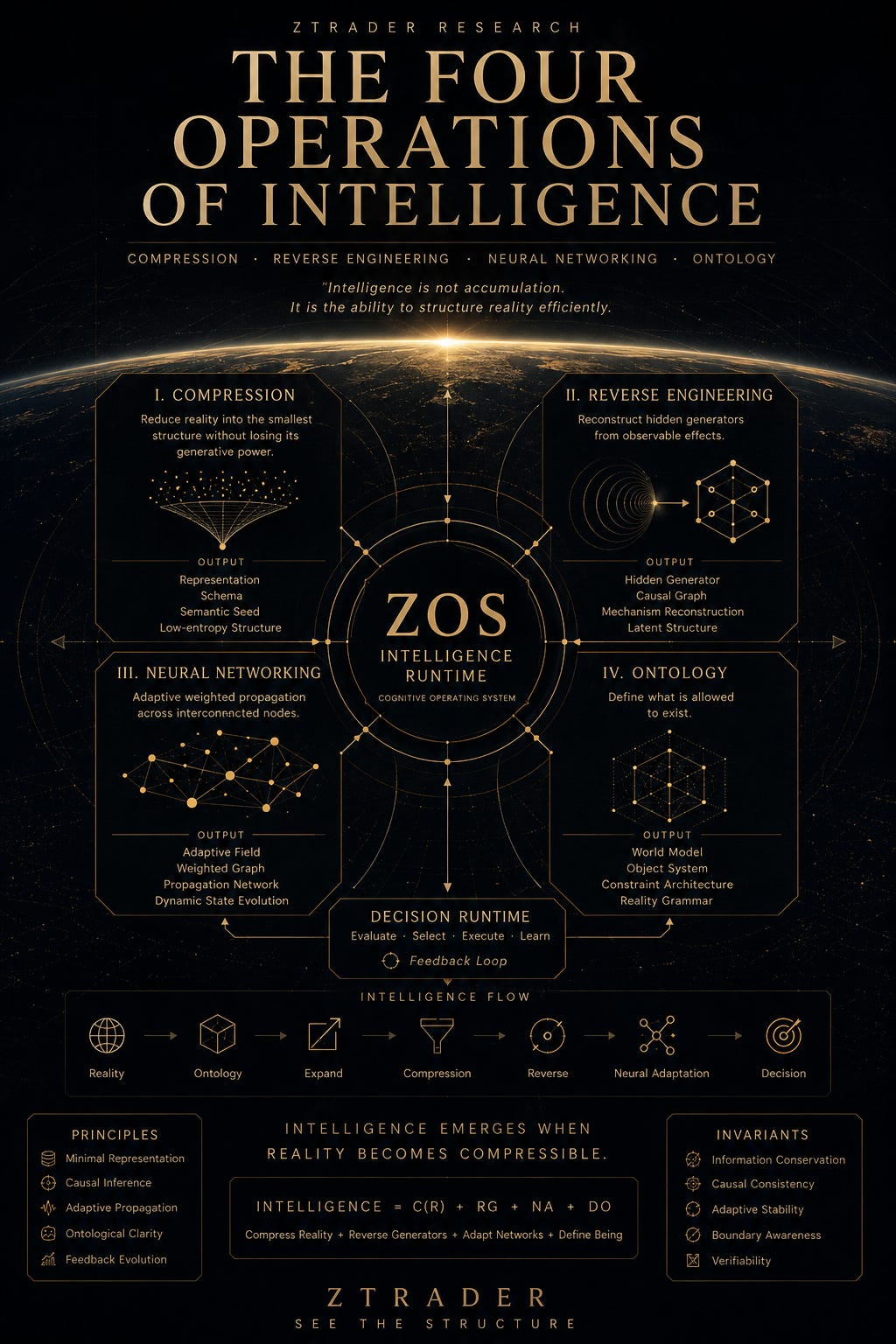
The Four Operations of Intelligence
Most people think AI is about models.
Bigger models. More parameters. More agents. More automation.
But after spending enough time inside systems, markets, code, and information flow, I started realizing something else:
AI is not just a tool.
It is a new way to operate reality itself.
And beneath almost every intelligent system, four fundamental operations keep appearing again and again:
Compression
Reverse Engineering
Neural Networking
Ontology
Not as features.
As primitives.
The deeper I went into markets, AI systems, macro structures, and cognition itself, the more everything started collapsing into these four operations. Civilization repeatedly rediscovered them under different names:
Mathematics. Language. Markets. Science. Code. Institutions. Even human memory.
Different surfaces. Same mechanics.
I. Compression
Compression is the foundation of intelligence.
A highly intelligent system is not the one storing the most information.
It is the one capable of preserving the most meaning with the smallest possible structure.
Language is compression. Mathematics is compression. Code is compression. Prices are compression.
Even money itself is compressed trust.
At some point I realized:
intelligence is not accumulation. intelligence is efficient representation.
This is why advanced systems increasingly move toward:
schemas
embeddings
abstractions
latent structures
symbolic compression
Reality is too dense to process directly.
So intelligence continuously compresses the world into lower-entropy representations.
The better the compression, the more powerful the reasoning becomes.
II. Reverse Engineering
Most people observe effects.
Intelligence attempts to reconstruct generators.
This changes everything.
Instead of asking:
“What happened?”
you begin asking:
“What produced this reality?”
Markets stop looking like charts.
They start looking like:
liquidity fields
incentive structures
propagation systems
hidden leverage networks
Human behavior becomes:
feedback expression
adaptive optimization
recursive survival logic
The same thing happens in AI.
A model output is not the intelligence itself.
It is only the surface residue of a hidden generation process.
Reverse engineering is the operation that turns observation into understanding.
Without it, systems become memorization engines.
With it, they become world simulators.
III. Neural Networking
Most people misunderstand neural networks.
They are not “digital brains.”
They are adaptive weighted propagation systems.
Signals move. Weights shift. Paths reinforce. Structures evolve.
Civilization itself behaves like a giant neural network.
Markets do too.
So does the internet.
So does attention.
At scale, intelligence emerges not from isolated nodes, but from:
connectivity
propagation
adaptation
feedback loops
This is why modern systems increasingly revolve around:
networks
graphs
recursive feedback
distributed cognition
The future is not static intelligence.
It is adaptive intelligence.
IV. Ontology
Ontology may be the deepest operation of all.
Before intelligence can reason, it must first define:
what exists
what matters
what relationships are valid
what counts as reality
Ontology determines the boundaries of perception itself.
Traditional finance sees:
stocks
bonds
commodities
Structural systems see:
liquidity stress
volatility propagation
systemic fragility
narrative fields
hidden leverage
Different ontologies create different realities.
And eventually I realized:
the most powerful systems are not those with the most data. They are the ones with the strongest ontology.
Because intelligence begins the moment reality becomes structurally understandable.
The Singularity of Density
This eventually led me to a strange realization:
When knowledge density crosses a critical threshold, patterns emerge.
And when patterns become sufficiently efficient, they compress into intelligence.
At low density: knowledge feels fragmented.
At high density: systems begin self-organizing.
Connections appear. Abstractions stabilize. Structures compress. Reality becomes navigable.
Intelligence may simply be:
the compression residue of sufficiently dense knowledge fields.
Which also explains why markets, civilizations, and AI systems all eventually converge toward similar architectures.
Not because they are identical.
But because reality itself rewards efficient structure.
Final Thought
Most AI discussions today still focus on:
tools
prompts
workflows
automation
But I increasingly suspect the real shift is much larger.
AI is not merely creating smarter software.
It is forcing humanity to rediscover:
representation
structure
cognition
ontology
compression itself
The future may not belong to the systems with the most information.
It may belong to the systems capable of:
compressing reality
reconstructing generators
adapting dynamically
defining existence coherently
Because eventually:
intelligence is not knowledge.
It is the ability to structure reality efficiently.
ZTRADER RESEARCH See the Structure


