

By Dorian
France has survived revolutions, foreign occupations, five republics, and relentless wars. Yet today, what truly threatens its foundation is a crushing debt crisis, relentless inflation, and soaring energy prices.
As citizens lose faith in a government unable to deliver on its promises, accumulated despair has boiled over into open revolt on the streets. Above all, this unrest is driven neither by abstract idealism nor blind hatred; it is fundamentally about economic survival. The public can no longer bear the status quo.
This month, the real test begins—unfolding block by block across the streets of Paris.
On Thursday, October 22, the yield on France’s 10-year government bond touched 5.14%, its highest level since July 2002. Five days earlier, around 550,000 people had marched across the country against the cost of living, and by nightfall the city hall in Limoges was on fire. In Paris, the National Assembly could not even finish debating the tax half of next year’s budget, so the vote slipped by two weeks.
Investors now charge France more to borrow than they charge Italy or Greece, the two countries at the center of the 2011–2012 euro crisis. That fact would have sounded absurd ten years ago, and it raises the question this article sets out to answer:
how did one of the founding members of the euro, with the second-largest economy in the currency union, end up here?
The answer starts fifty years ago, with the last French budget that ever balanced.
I. FIFTY YEARS OF COMPOUNDING DEBT
France’s solvency crisis is a monument built slowly over fifty years—compounded year after year of unchecked fiscal deficits, through every administration, without a single party ever balancing the ledge.
1974: The Turning Point
The last time France ran a budget surplus was 1974, under President Valéry Giscard d’Estaing. It was the exact moment the 1973 oil crisis shattered the thirty-year postwar golden era—the Trente Glorieuses. In the five decades that followed,whether governed by the left, right, or center, every single French administration has operated at a deficit.
The historical trajectory tells a story of compounding decay:
IMF figures show public debt at just 22.6% of GDP in 1981,creeping to 36.8% in 1990, and piercing the 61.4% mark in 1999 as France entered the eurozone. It reached 65.5% in 2007, breached 98.1% in 2019, and ballooned to 114.8% in 2020 amidst global lockdown spending.
Fast forward to June 2026: official INSEE data now pegs total government debt at €3,595.5 billion, representing 119% of GDP.
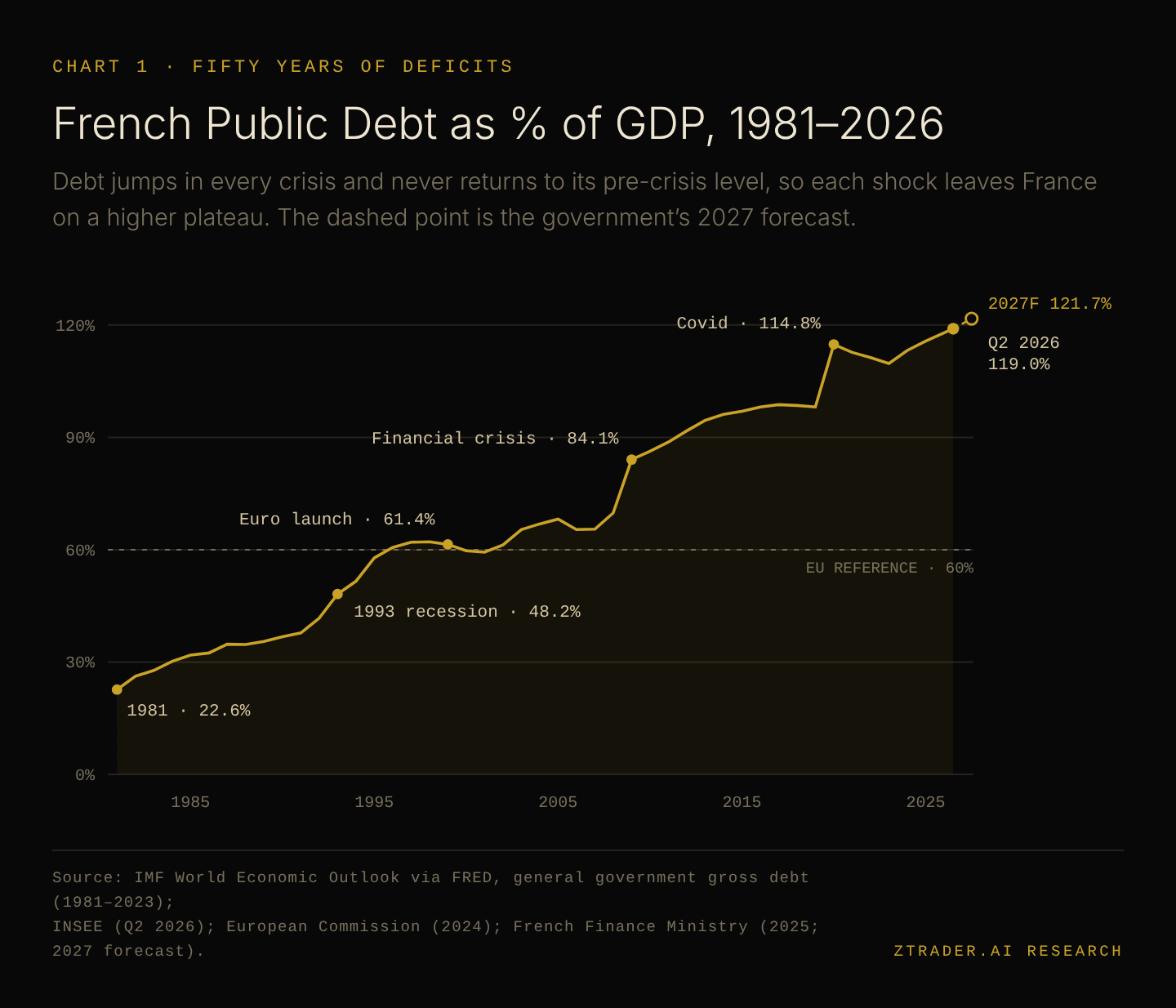
[CHART 1 — French Public Debt as % of GDP, 1981–2026]
The pattern in that series matters as much as the debt level. The debt ratio rises sharply in every crisis, from the early 1990s recession to 2008 and 2020, and never returns to its pre-crisis level when growth comes back. Each crisis therefore leaves France on a permanently higher plateau, and the next crisis starts from there.
The Expensive Promise and failed Social model
Behind the deficits sits one of the most generous public sectors in the developed world. According to the Banque de France, French public spending reached 57.2% of GDP in 2024, the second highest in the euro area after Finland.
In 2023, France spent 7.5 percentage points of GDP more than the euro area average, a gap that had been 5.5 points in 2001. The largest single item is pensions, which cost about €436 billion a year, roughly 14% of GDP.
The retirement age explains much of that bill.
In 1982, President François Mitterrand lowered the legal retirement age from 65 to 60, one of the signature measures of the first socialist government of the Fifth Republic. Every attempt since then to raise it back has been fought in the streets, and that fight is central to everything that follows.
Half a century of deficits made the debt large, but it took the euro to make it cheap enough to ignore.
II. HOW THE EURO HID THE BILL
For most of its first two decades, the single currency allowed France to borrow almost as cheaply as Germany, and that cheap money removed the pressure that would otherwise have forced a choice.
Borrowing on Germany’s Credit
French government bonds are called OATs. The standard gauge of French risk is the OAT-Bund spread, which is the extra yield investors demand to hold a 10-year French bond instead of a 10-year German Bund. Germany is the euro area’s benchmark borrower, so the spread isolates the risk that belongs to France alone. One basis point equals 0.01 percentage point.
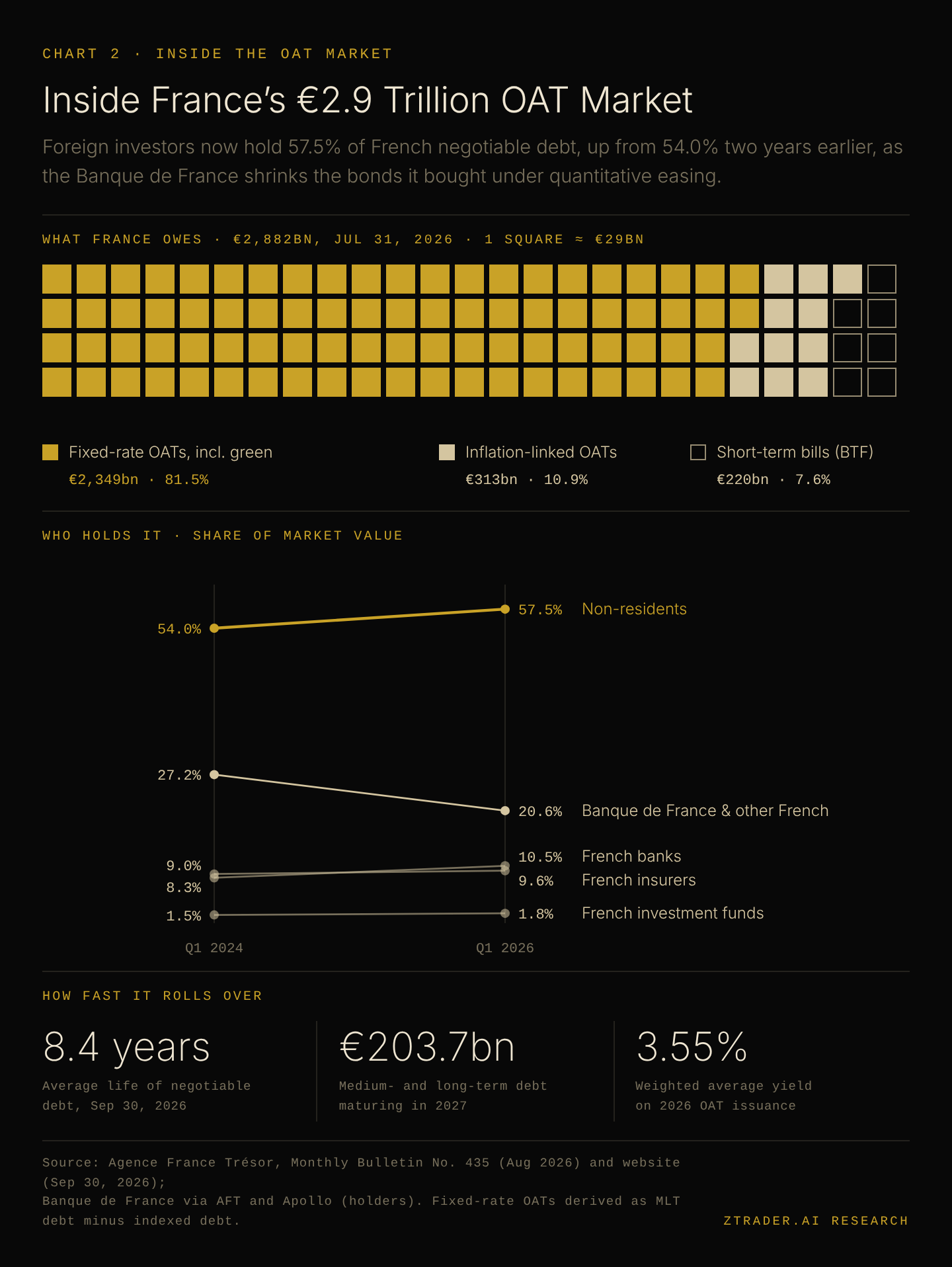
[CHART 2 — Inside France's €2.9 Trillion OAT Market]
The above shows the deep mechanism sits behind the OAT-Bund spread, and it can be breakdown in three steps.
The grid at the top breaks down France's €2,882 billion of negotiable state debt at the end of July 2026, which is the part of the debt that trades in the market and is repriced every day.
FOR Each square stands for about €29 billion: 81.5% of the total is fixed-rate OATs, 10.9% is inflation-linked OATs, whose payments rise with consumer prices, and the remaining 7.6% is short-term Treasury bills, known as BTFs, which mature within a year.
The slope lines in the middle show who owns that debt, and the change over the past two years is central to this story.
Foreign investors raised their share of the market value from 54.0% in the first quarter of 2024 to 57.5% in the first quarter of 2026, while the share held by the Banque de France and other French holders fell from 27.2% to 20.6%, because the central bank is letting the bonds it bought under quantitative easing mature without replacing them.
As a result, the marginal buyer of French debt is now a private investor, more often than not based abroad, who can sell when the political news from Paris turns bad, whereas the central bank kept its bonds whoever was in government.
The three figures at the bottom show how quickly higher yields reach the budget.
The debt has an average life of about 8.4 years, €203.7 billion of medium- and long-term bonds fall due in 2027 alone, and the OATs France sold this year carried a weighted average yield of 3.55%, while the 10-year benchmark now yields about 5%, so most bonds refinanced from here will cost the state more than the ones they replace.
In the years after the euro’s launch, that spread was close to zero. Investors treated France as part of the euro area’s core, and the market did not penalize French deficits that breached the EU’s 3% limit. After 2015, the ECB’s bond purchases pushed French borrowing costs even lower, and at times France was paid to borrow, because some of its bonds traded at negative yields.
Under those conditions, a deficit was almost free to finance, and successive governments treated it that way.
Every Crisis ENDS WITH MORE Debt
Cheap money IS SHAPING how France responded to each shock AND FRANCE IS RELYING ON CHEAP FINANCING TO SOLVE THE PROBLEM.
In 2008 and 2009, debt rose from about 65% to more than 80% of GDP as the state absorbed the financial crisis. In March 2020, President Emmanuel Macron promised to protect the economy from Covid “whatever it costs,” and the debt ratio jumped by more than 16 points in a single year. From late 2021, the government froze regulated gas prices and capped electricity price rises for households with a “tariff shield,” and it kept the shield in place after Russia’s invasion of Ukraine sent energy prices soaring. Each of these decisions was defensible on its own, and each was financed by borrowing. None of them was followed by a period of surpluses that paid the debt back down.
Now the Bill Is Arriving
The cost of this approach was hidden as long as rates stayed low, and it became visible the moment they rose.
France borrowed heavily at near-zero rates, and that debt is now maturing and being refinanced at close to 5%.
As a result, France’s total interest bill is expected to rise from €79.2 billion in 2026 to €91.2 billion in 2027. Economy Minister Roland Lescure confirmed in September that debt service has become the largest item of state spending, well ahead of education at about €63 billion and defence at about €53 billion.
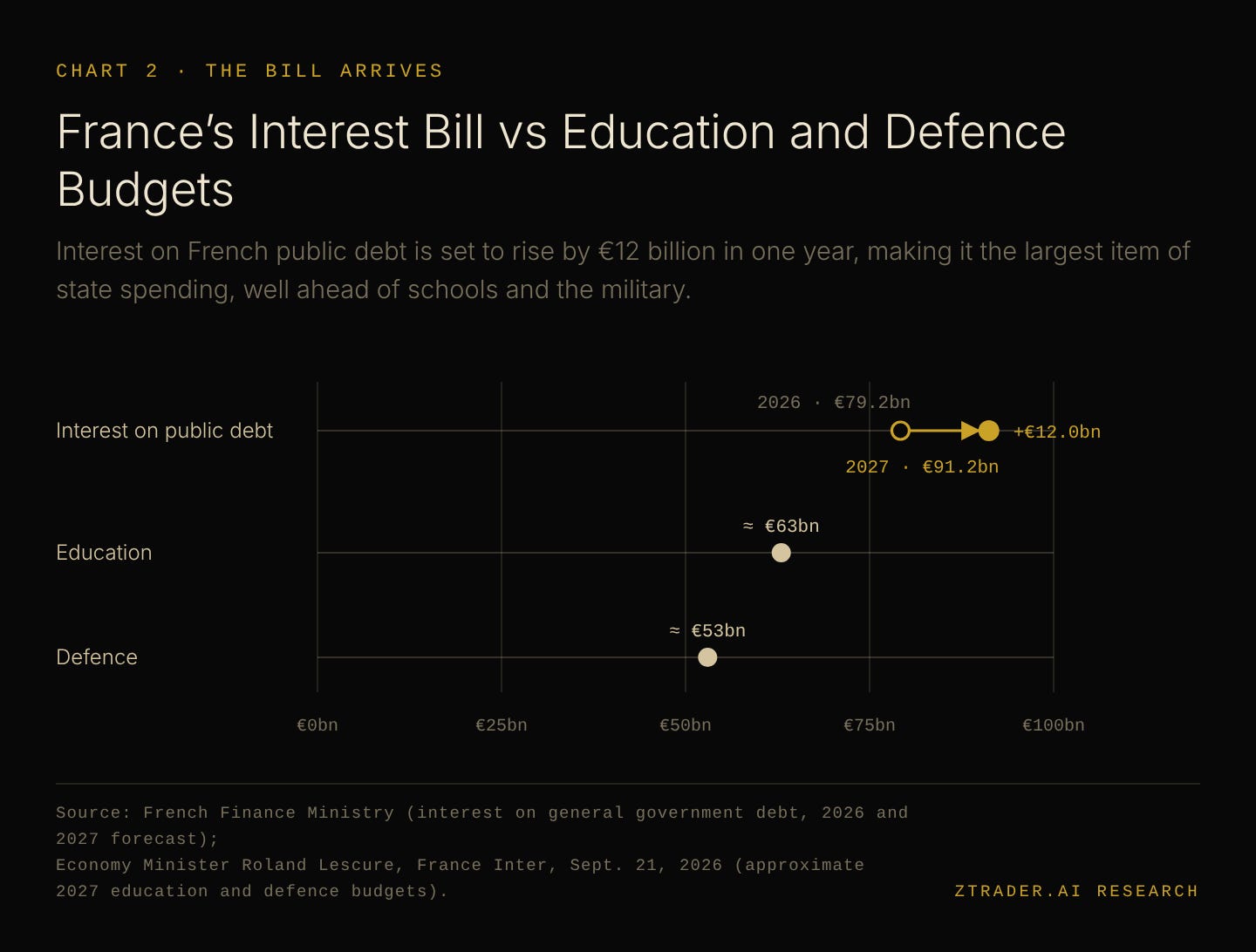
[CHART France’s Interest Bill vs Education and Defence Budgets]
The euro postponed the moment when anyone in France had to pay for fifty years of deficits.
III. THE FOREVER PENDING REFORM
If the problem has been visible for decades, the natural question is why France never fixed it, and the answer lies in a cycle of reform and retreat that has repeated for thirty years.
1995 to 2025: The Cycle of Reform and Retreat
Each major attempt to curb spending or raise revenue has met the same response from the street:
1995 (The Juppé Plan): Prime Minister Alain Juppé proposed to reform the special pension schemes of public-sector workers. Weeks of transport strikes paralysed the country in November and December, and the government withdrew the pension reform.
2010 (The Sarkozy Reform): President Nicolas Sarkozy raised the legal retirement age from 60 to 62 despite months of mass protests, one of the few reforms that survived.
2018 (The Yellow Vests): Macron’s increase in fuel taxes triggered the “yellow vest” (gilets jaunes) movement, whose weekly protests turned violent in Paris.
In December 2018, he cancelled the tax increases and announced measures for low-wage workers and pensioners that cost about €10 billion.
2023 (Retirement at 64): The government raised the retirement age from 62 to 64 by forcing the bill through parliament without a vote, using Article 49.3 of the Constitution, after months of strikes and protests.
2025 (The Suspension): To secure Socialist support for the 2026 budget, Prime Minister Sébastien Lecornu suspended the 2023 reform until 2028, so the retirement age is once again an open question.
The lesson that every French government has drawn from this record is that structural reform carries a high political cost, and that the cost is paid immediately while the benefit arrives years later.
Who Should Pay: Spending or Taxes
The debate over the deficit is also a debate about its cause, and the two camps in French politics tell different stories.
The first camp points to spending:
France has the second-highest public spending in the euro area, its tax burden is already among the highest in Europe at around 44% of GDP, and so, in this view, the only lasting fix is to cut spending, starting with pensions.
The second camp points to revenue:
After 2017, Macron replaced the wealth tax with a tax on real estate only, cut the corporate tax rate from 33.3% to 25% and abolished the residence tax (taxe d’habitation) on primary homes. Critics on the left argue that these tax cuts were never matched by equivalent spending cuts, so they widened the deficit, and that the fairest fix is to ask more of the wealthy and large companies.
Both camps have a point, and that is exactly the problem.
Each side can block the other’s solution, but neither side has the votes to impose its own. As a result, the deficit has remained the one outcome that every majority, and every minority, has been willing to accept.
France has known the answer to its debt problem for thirty years, but it has never found a majority willing to bear the cost of it.
IV. FROM MACRON’S MAJORITY TO A HUNG PARLIAMENT
For most of Macron’s first term, at least the political machinery worked, but since 2022 the institutions that are supposed to settle the question of who pays have stopped functioning.
The Collapse of the Centrists
In 2017, Macron’s new centrist party won an outright majority in the National Assembly, which gave him the power to pass budgets and reforms on his own.
In 2022, he lost that majority and had to govern through minority governments that relied on Article 49.3.
In June 2024, after his party’s defeat in the European elections, Macron called a snap legislative election.
The result was a parliament split into three blocs of similar weight: a left-wing alliance, Macron’s center and the far-right National Rally, none of them close to a majority and none willing to govern with the others.
Three Prime Ministers in One Year
The hung parliament made budgets the main source of political instability:
December 2024 (Barnier): Prime Minister Michel Barnier was toppled by a no-confidence vote over his budget after just 91 days in office, the first time the National Assembly had brought down a government in this way since 1962.
September 2025 (Bayrou): His successor, François Bayrou, called a confidence vote on his deficit-cutting plan and lost it by 364 votes to 194 on September 8, 2025.
October 2025 (Lecornu): Sébastien Lecornu was appointed the next day, resigned on October 6 after barely forming a cabinet, and was reappointed by Macron on October 10.
February 2026 (The 2026 Budget): Lecornu used Article 49.3 three times to pass the 2026 budget, which was finally adopted on February 2 after a process that lasted about 200 days.
The 2027 Budget: The Same Fight Again
Lecornu presented the 2027 budget on October 1.
It contains a savings effort of €54 billion, including the ramp-up of measures already decided, and targets a deficit of 5.0% of GDP in 2027, down from an expected 5.4% this year. France’s independent fiscal watchdog, the High Council of Public Finances, called the growth assumptions behind it optimistic.
In parliament, the record of the past three weeks shows how fragile the plan is. The vote on the revenue half of the budget, scheduled for October 20, was postponed to November 3 because about 2,800 amendments were still waiting to be examined.
Last week, the Assembly rejected the 2027 social security budget by 115 votes to 1 in first reading.
France entered this autumn with a government that could not pass a budget, a debt that kept rising and a public that had already rejected the main reform on offer.
V. THE OCTOBER COLLAPSE
Every structural flaw in the French model was visible a year ago.
The real question is:
why did a slow-motion fiscal trainwreck suddenly transform into a violent financial meltdown in October 2026?
The Dual Shock: War and Rates
The spark was ignited outside France. Escalating war with Iran drove Brent crude past $111 on October 22, pushing eurozone inflation to 3.8% in September. Trapped by rising prices, the ECB delivered back-to-back rate hikes in June and September, pushing its deposit rate to 2.50% and unleashing a sell-off across global debt markets.
France’s 10-year yield—which stood at 3.6% in January—rocketed up 135 basis points by October 20. For a government already suffocating under a debt burden of 119% of GDP and a 5.4% deficit, this sudden spike wasn’t just an academic exercise; it was an explosive expansion of its interest expense.
Fire on the Streets
As energy prices exploded, the pain reached French living rooms.
What began in September as student protests over school conditions and rising costs rapidly snowballed. By October 6, up to 1,800 high schools were blockaded.
Soaring pump prices resurrected the Yellow Vests. On October 17, over 550,000 citizens marched nationwide, with 110,000 flooding Paris.
As dusk fell, peaceful protest gave way to chaos: city halls were set ablaze in Limoges and stormed in Marseille, while Lyon’s tourist office burned. With 2,400 arrests recorded, night curfews were slapped onto Paris, Lyon, Lille, and Nice.
By Saturday, October 24, a massive mobilization of 70,000 security forces managed to contain the worst looting during a second wave of protests (410,000 to 800,000 marchers), but nearly 1,000 more arrestswere made. With new demonstrations set for October 31 and a general strike looming on November 5, France is entering a political pressure cooker.
The street has pushed French politics into a fatal deadlock: Paris is attempting to force through €54 billion in austerity, while its citizens demand lower prices and higher public spending.
The Verdict of the Bond Market
As the streets burned, global capital rendered its judgment:
October 21 (The 5% Wall): The 10-year OAT yield broke above 5.00%—a 24-year high.
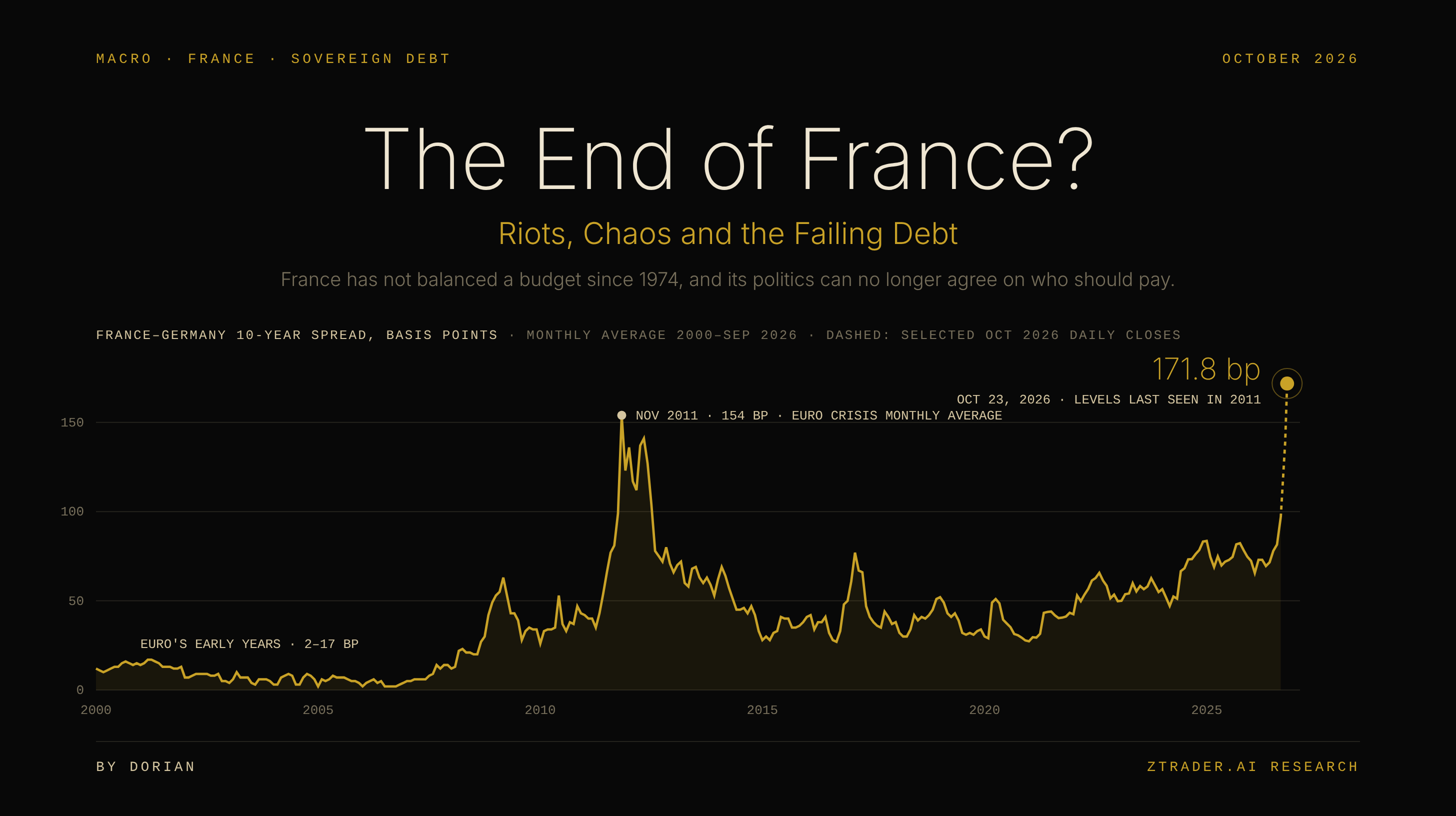
October 22 (The Climax): Yields peaked at 5.14%, driving the spread against German Bunds to 15-year highs. At its wildest moment, French sovereign risk was priced at 5.08%—virtually identical to the US Treasury (5.09%).
October 23 (The Reckoning): France closed the week with its 10-year OAT at 5.05% versus Germany’s 3.33%—a vast, chasm-like spread of 171.8 basis points.
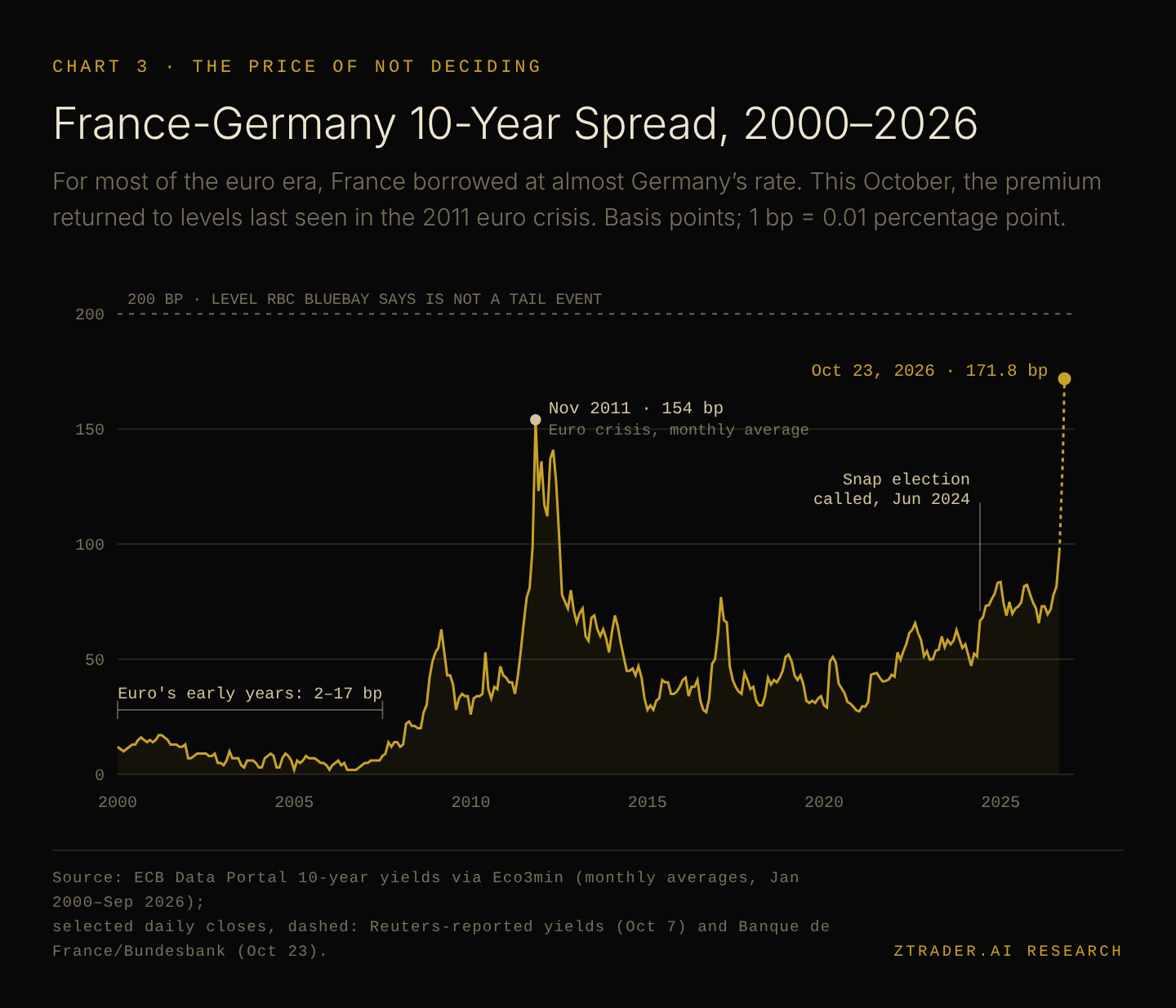
[CHART 3 — France-Germany 10-Year Spread, 2000–2026]
The shape of the premium shows what investors fear.
On October 2, the France-Germany spread on 2-year bonds stood at about 65 basis points, while the 10-year spread was around 140. Short-dated French debt still trades close to German debt, so investors see little risk of a near-term default. The extra yield sits in what bond traders call a term premium: the extra return demanded for holding long-dated debt through a period of uncertainty.
In France’s case, that uncertainty is pure political, because it covers the 2027 budget, the 2027 election and who will control fiscal policy afterward.
The energy shock lit the fuse, but fifty years of deficits and a broken parliament supplied the explosive.
VI. 2027: THE ELECTION THAT DECIDES WHO PAYS
The presidential election in six months will decide which of France’s two stories about its deficit prevails, and investors are already pricing the answer.
The Candidates and the Pension Question
The first round of the presidential election is set for April 18, 2027, with a runoff on May 2, and Macron is barred from running again. The National Rally leads the polls: a recent RTL survey put Marine Le Pen at 35% to 37% in the first round, after a court ruling cleared her to stand, and Jordan Bardella is expected to be the party’s candidate for prime minister.
Because the 2023 reform is suspended until 2028, the next president inherits the retirement age decision.
Mike Bell, head of market strategy at RBC BlueBay Asset Management, has argued that if the leading candidates show no intention of touching the retirement age, a France-Germany spread of 200 basis points in the coming months is not a tail event.
The Ratings Agencies
Fitch cut France to A+ in September 2025, and S&P followed in October 2025.
On Friday, October 23, Moody’s surprised most analysts by keeping France at Aa3 with a negative outlook, and it said the key risk remains political fragmentation that keeps parliament from functioning. Lecornu said the decision proved wrong the “declinist narrative” of those betting against French bonds, but S&P’s next scheduled review is November 27, and Bell has warned that cuts by all three agencies to the BBB range after the election could force sales by investors with rating limits.
The Limits of the ECB
In 2012, the ECB ended the euro crisis with Mario Draghi’s promise to do “whatever it takes,” and France’s situation raises the question of whether the same backstop applies. The ECB’s crisis tool for this situation is the Transmission Protection Instrument (TPI), created in 2022, which allows it to buy a country’s bonds when yields rise in ways not justified by fundamentals. It has never been used, and access depends on a country’s debt sustainability and its compliance with EU fiscal rules. ECB President Christine Lagarde said on October 14 that France’s solution lies at home, in its own fiscal policy.
The comparison with Greece also needs perspective:
in April 2010, weeks before its first bailout, Greece’s spread over Germany had already passed 460 basis points, and it climbed far above 1,000 in 2011, compared with around 170 for France today.
The ECB can stop a panic, but it cannot decide who in France should pay for the deficit.
VII. ALAS, IS THIS THE END OF FRANCE?
The answer depends entirely on how one defines the “end.”
France will not suffer a sudden debt auction failure next month; its sovereign issuances will continue to clear, anchored by a deep and liquid market in its own currency.
What has truly ended, alas, is the half-century illusion—the comfortable regime that allowed Paris to run structural deficits for fifty years while borrowing on Germany’s credit rating.
How France Got Here: The Five-Stage Trajectory
The road to a 5% yield was built across five distinct phases, with each step making the eventual exit progressively harder:
Fifty Years of Structural Deficits: France has not balanced a budget since 1974. Every economic shock since has permanently elevated its debt trajectory, ratchet-locking the fiscal baseline higher.
The Euro’s Cheap Money Anesthetic: For two decades, the single currency allowed France to borrow on Germany’s balance sheet, effectively shielding politicians from the painful trade-offs between public spending and taxation.
Reform and Retreat: From Alain Juppé’s concessions in 1995 to the Gilets Jaunes in 2018 and the retreat on pension reforms in 2025, street resistance has repeatedly blocked, neutered, or unwound structural fiscal adjustments.
The Collapse of the Political Center: Since 2024, a deeply fragmented parliament divided across three hostile blocs has toppled two prime ministers, leaving executive budgetary approval dependent entirely on emergency constitutional maneuvers.
The External Shock: The 2026 energy crisis forced the ECB to tighten monetary policy just as soaring living costs drove citizens back onto the streets—transforming a chronic fiscal decay into a violent, acute market event.
What to Watch Next
Three upcoming catalysts will indicate whether Paris can regain control of its financial destiny before the next election cycle:
November 3: The crucial revenue vote in the National Assembly.
November 17: The statutory deadline for passing the complete budget bill.
November 27: S&P’s sovereign credit rating review.
A widening of the OAT-Bund spread toward the 200 basis point threshold—as flagged by RBC BlueBay—would signal that global financial markets have officially run out of patience for French political indecision.
France’s debt crisis is, at its core, a governance crisis over a single question: