

I wrote about this in my previous pieces, and I will probably have to keep writing about it because the market is still trying to interpret a physical supply problem through the language of monetary policy.
The Federal Reserve has now raised rates by 25 basis points, inflation remains elevated, and another hiking cycle is increasingly being discussed as though the central question were simply how far rates need to rise. I think that framing starts too late in the causal chain.
The Fed is responding to inflation, but a large part of the inflationary pressure now confronting it is being transmitted through a war, an impaired energy system and one of the most important maritime chokepoints in the world.
The distinction matters because monetary policy can suppress demand, but it cannot directly repair the physical system producing the supply shock.
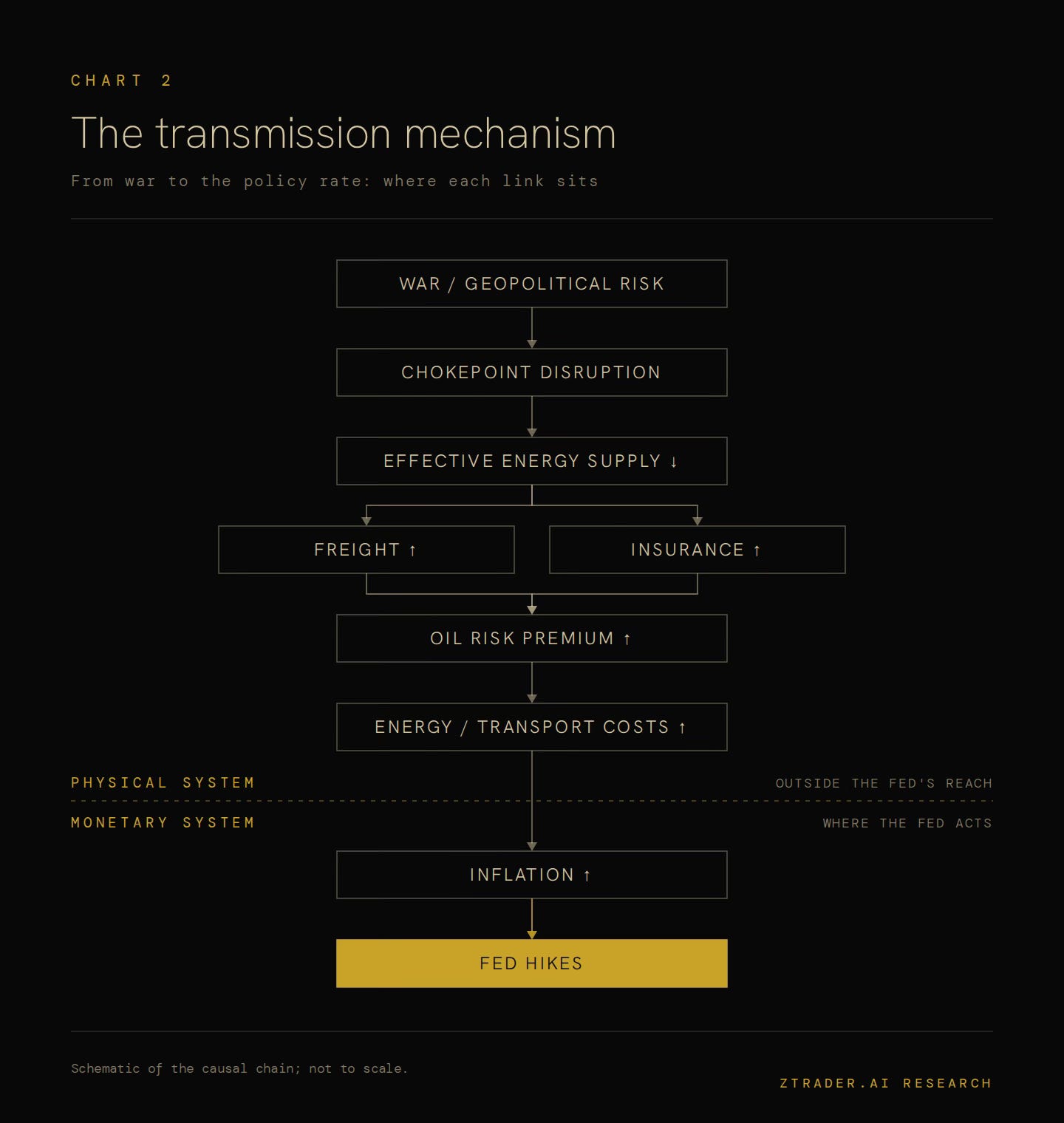
The central bank can make mortgages more expensive, tighten credit, weaken consumption and compress asset prices. None of those things increases tanker traffic through the Strait of Hormuz. If the disruption to energy supply remains unresolved, the Fed is effectively being asked to absorb the economic consequences of a geopolitical problem that lies outside its institutional reach.
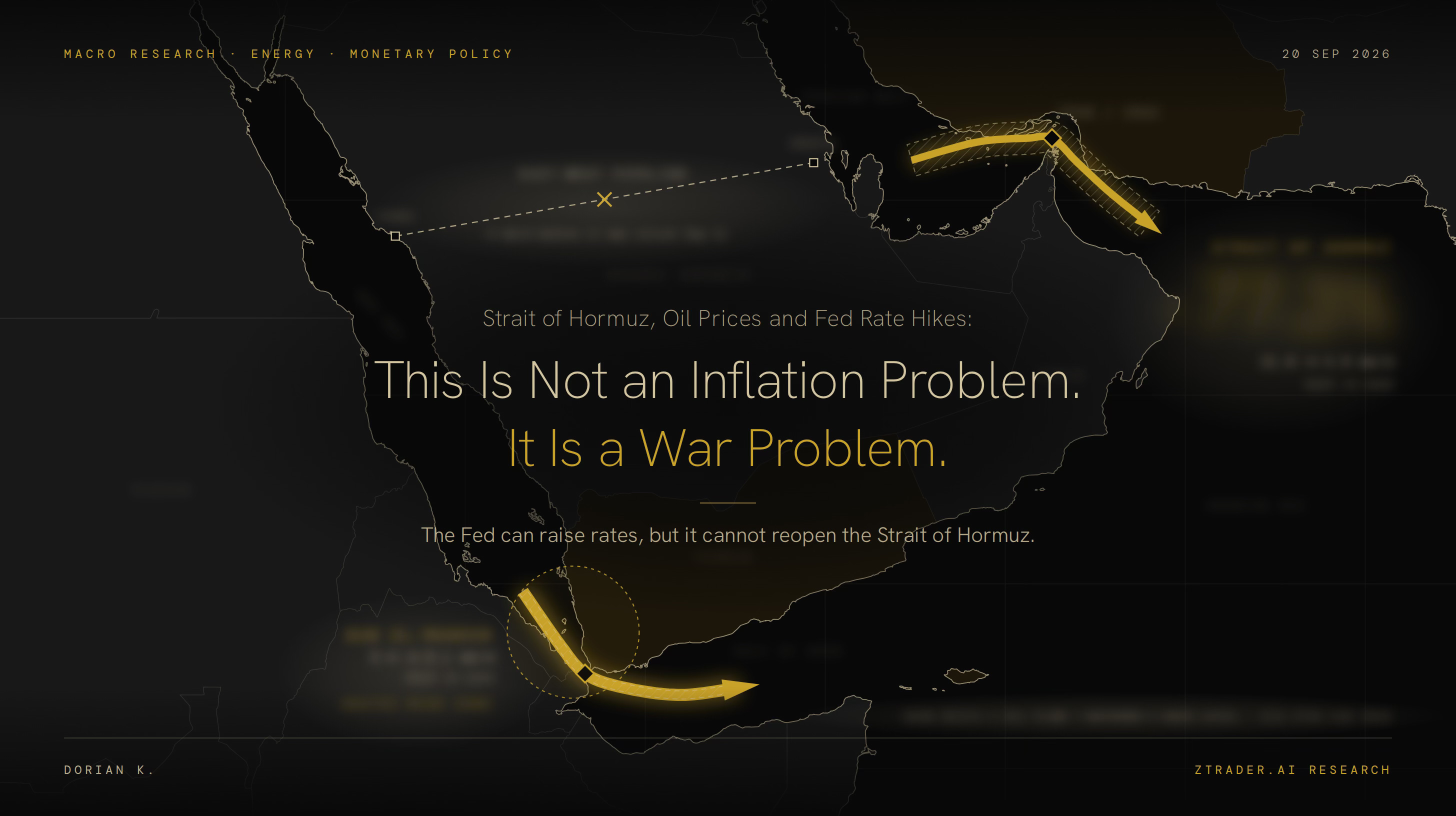
That is why I increasingly think of the present situation not simply as an inflation problem, but as a war problem whose consequences are appearing in the inflation data.
The Oil Shock Is Physical
The most useful place to begin is not CPI, the dot plot or another argument about whether the next move should be 25 or 50 basis points. It is the physical flow of energy through Hormuz.
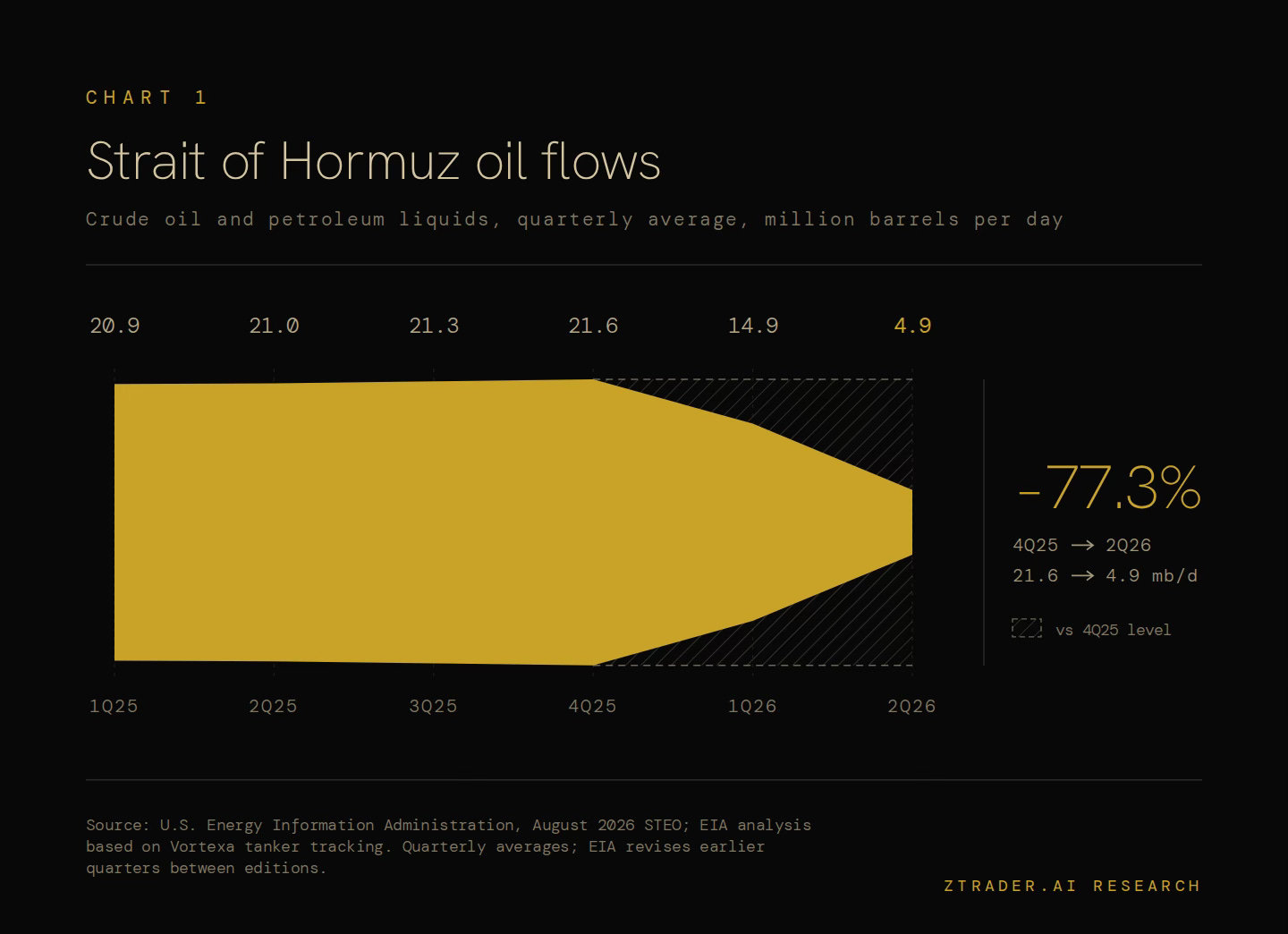
EIA estimates that crude oil and petroleum liquids moving through Hormuz averaged 21.6 million barrels per day in the fourth quarter of 2025.
By the second quarter of 2026, that figure had collapsed to 4.9 million barrels per day.
This is not a theoretical geopolitical premium invented by commodity traders looking for another excuse to buy oil. It represents an enormous reduction in the amount of physical petroleum moving through a route that, before the conflict, handled roughly one-fifth of global petroleum liquids consumption.
The significance of Hormuz comes not merely from the volume that normally passes through it, but from how difficult that volume is to replace. Oil production can exist on paper and still be economically irrelevant if it cannot reach the market. Pipelines, ports, tankers, insurance and navigable sea lanes are part of supply just as much as the wellhead itself.
Once a chokepoint of this scale becomes unreliable, the market does not merely price fewer barrels; it begins pricing the probability that future barrels will also fail to arrive.
This is where the inflation mechanism begins.
You Cannot Hike a Tanker Through Hormuz
The transmission from war to inflation is straightforward, but it is being obscured by the enormous attention paid to the Fed.
War disrupts a chokepoint;
disruption reduces effective supply and raises the cost of transporting what remains; freight, insurance, inventories and precautionary demand begin carrying larger risk premiums;
those costs appear in crude oil, refined products and eventually transportation and production costs across the economy.
By the time those pressures appear in PCE or CPI, the Federal Reserve is already standing near the end of the transmission mechanism rather than at its origin.
The September FOMC decision illustrates the problem unusually clearly.
On September 16, the Committee unanimously raised the federal funds target range by 25 basis points to 3.75–4.00%, explicitly noting that uncertainty remained elevated partly because of geopolitical developments and that inflation remained above target.
The new Summary of Economic Projections put median 2026 PCE inflation at 3.7%, up from 3.6% in June, while core PCE is projected at 3.4%.
Even more revealing, 17 of the 18 participants judged the risks to their PCE inflation forecasts to be weighted to the upside.
I do not think the Fed is wrong to respond. Once an external supply shock begins spreading into inflation expectations, wages, pricing behaviour and broader domestic inflation, refusing to tighten simply because the original shock came from abroad would create another problem. The point is different: the Fed is treating the monetary consequences of the shock, not removing the physical cause of it.
There is no interest rate at which a damaged pipeline repairs itself. There is no point on the dot plot at which shipping insurance suddenly becomes cheap because the FOMC wishes it so. A sufficiently restrictive policy can eventually destroy enough demand to reduce the price consumers are capable of paying for energy, but that is a very different mechanism from restoring the missing supply. In one case, the physical constraint disappears. In the other, the economy is weakened until demand falls far enough to accommodate it.
That difference is the foundation of the stagflation risk.
The Tankers Matter More Than the Talking
The latest shipping data make the same point in a much more primitive language.
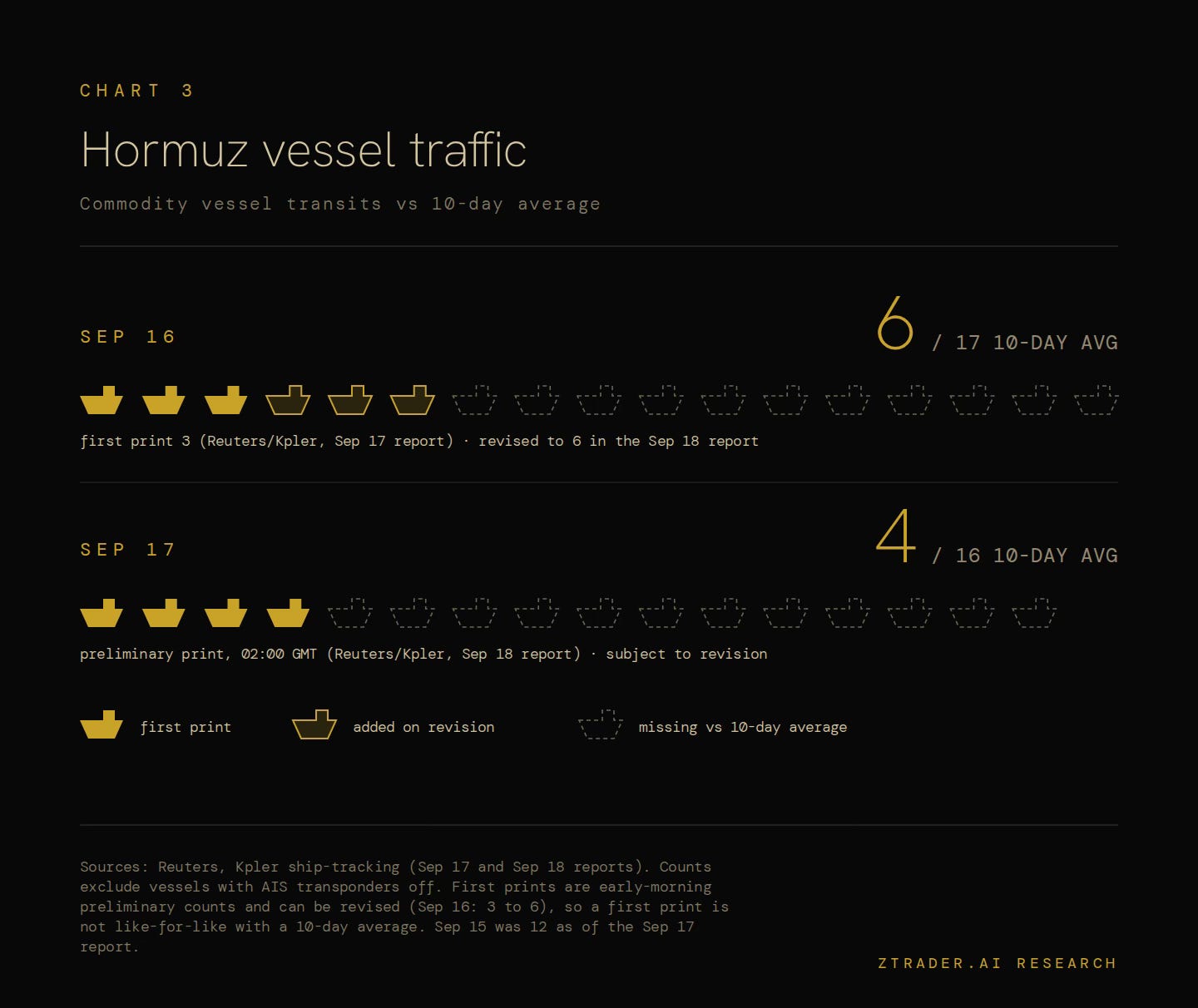
On September 16, preliminary ship-tracking data cited by Reuters showed only three commercial vessels transiting the Strait of Hormuz, compared with 12 the previous day and a ten-day average of 17.
On September 17, Kpler data showed only four commodity vessels transiting the strait, still far below a ten-day average of 16. AIS data have obvious limitations because some vessels deliberately turn off their transponders, but the direction of the signal is difficult to mistake: traffic through one of the world’s critical energy arteries remains severely depressed.
This is why I am increasingly uninterested in the endless cycle of headlines announcing talks, negotiations, proposed agreements and temporary diplomatic breakthroughs. Markets can trade those headlines for hours or days, but the physical energy system eventually imposes its own accounting.
This is easy, its not some rocket science:
Barrel reaches the market, or it doesn’t; tanker clears the strait, or it doesn’t; pipeline flows, or it runs dry.
Diplomacy matters enormously when it changes one of those variables; until then, the market is largely trading expectations about a future physical outcome that has not yet occurred.
The question I care about, therefore, is not whether the parties are talking. It is whether the barrels are moving.
The Problem Is No Longer Just Hormuz
There is another correction worth making because it changes the thesis materially. The Houthis are not the force controlling the Strait of Hormuz; the strategic threat there is centered on Iran and the IRGC. Houthi leverage is concentrated around Yemen, the Red Sea and Bab el-Mandeb. Treating the two as interchangeable would be geographically wrong, but separating them reveals something considerably more important: the energy system is facing pressure around two different chokepoints at the same time.
When Hormuz became unreliable, Saudi Arabia’s East-West pipeline became one of the critical mechanisms for moving crude toward Yanbu on the Red Sea and bypassing the strait. Reuters reported that roughly 4 million barrels per day had been moving through that route before drone attacks forced the pipeline offline in September, threatening supply equivalent to roughly 4% of the global market.
At the same time, Houthi expansion along Yemen’s Red Sea coast and around Bab el-Mandeb has increased the security risk surrounding the very corridor that becomes more important when Hormuz is impaired.
That is much more dangerous than a simple reduction in one shipping lane because it attacks redundancy. Energy systems survive disruption through alternative routes, inventories, spare production and spare logistical capacity.
If the primary route becomes unreliable while the bypass route is simultaneously threatened, the value of redundancy rises precisely as the available redundancy falls.
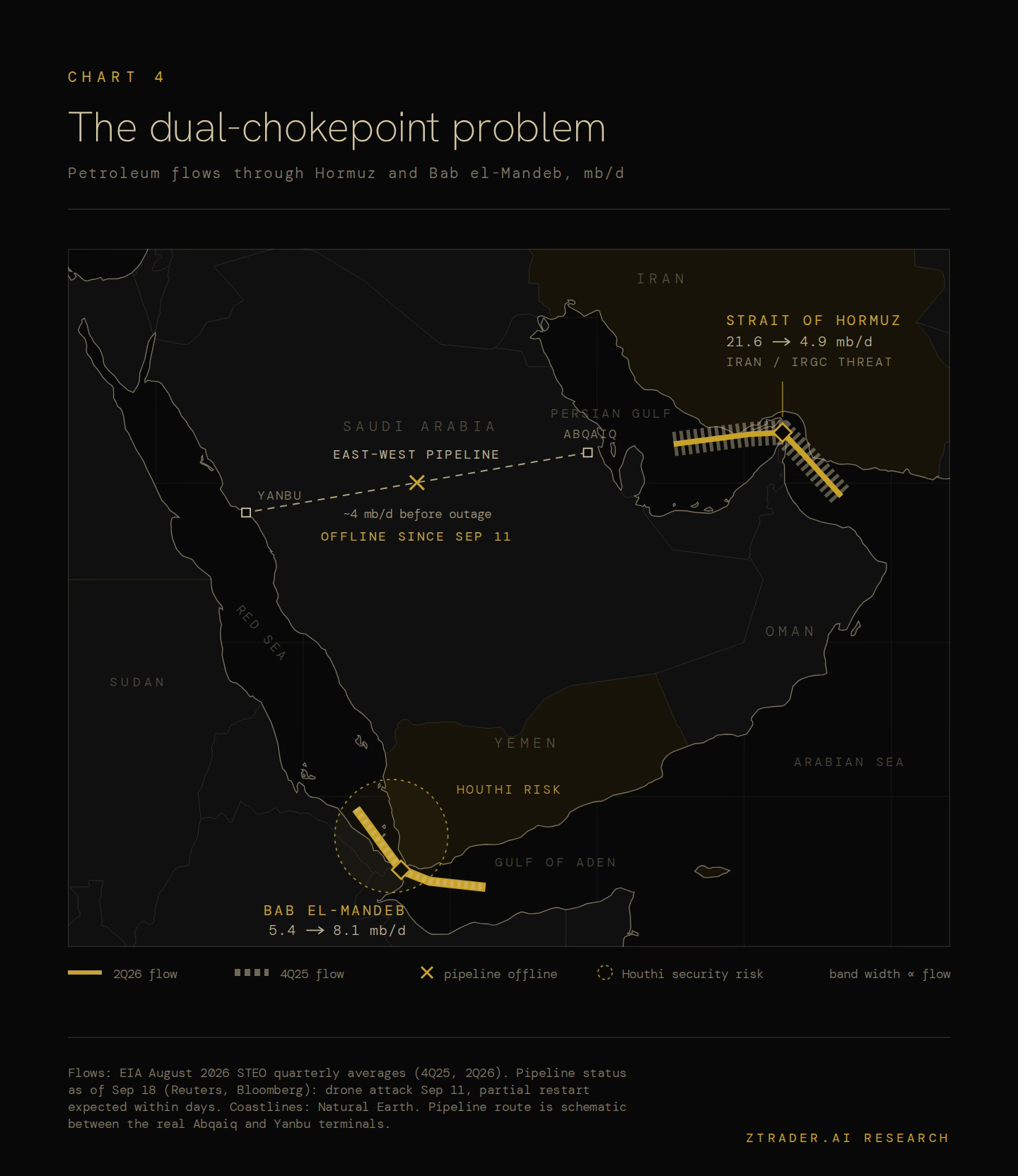
The EIA numbers make the rerouting visible. While Hormuz petroleum flows collapsed from 21.6 million barrels per day in 4Q25 to 4.9 million in 2Q26, flows through Bab el-Mandeb increased from 5.4 to 8.1 million barrels per day over the same period.
In other words, part of the system’s response to one chokepoint was to place greater weight on another. That is exactly why the deterioration of security around the Red Sea matters so much.
Oil Is Pricing the Physical Reality
Brent settled at $104.87 per barrel on September 18, while WTI finished at $100.30.
Those prices have moved violently with every development affecting supply, infrastructure and diplomacy because oil is trying to price not only the barrels available today, but also the distribution of possible supply outcomes tomorrow.
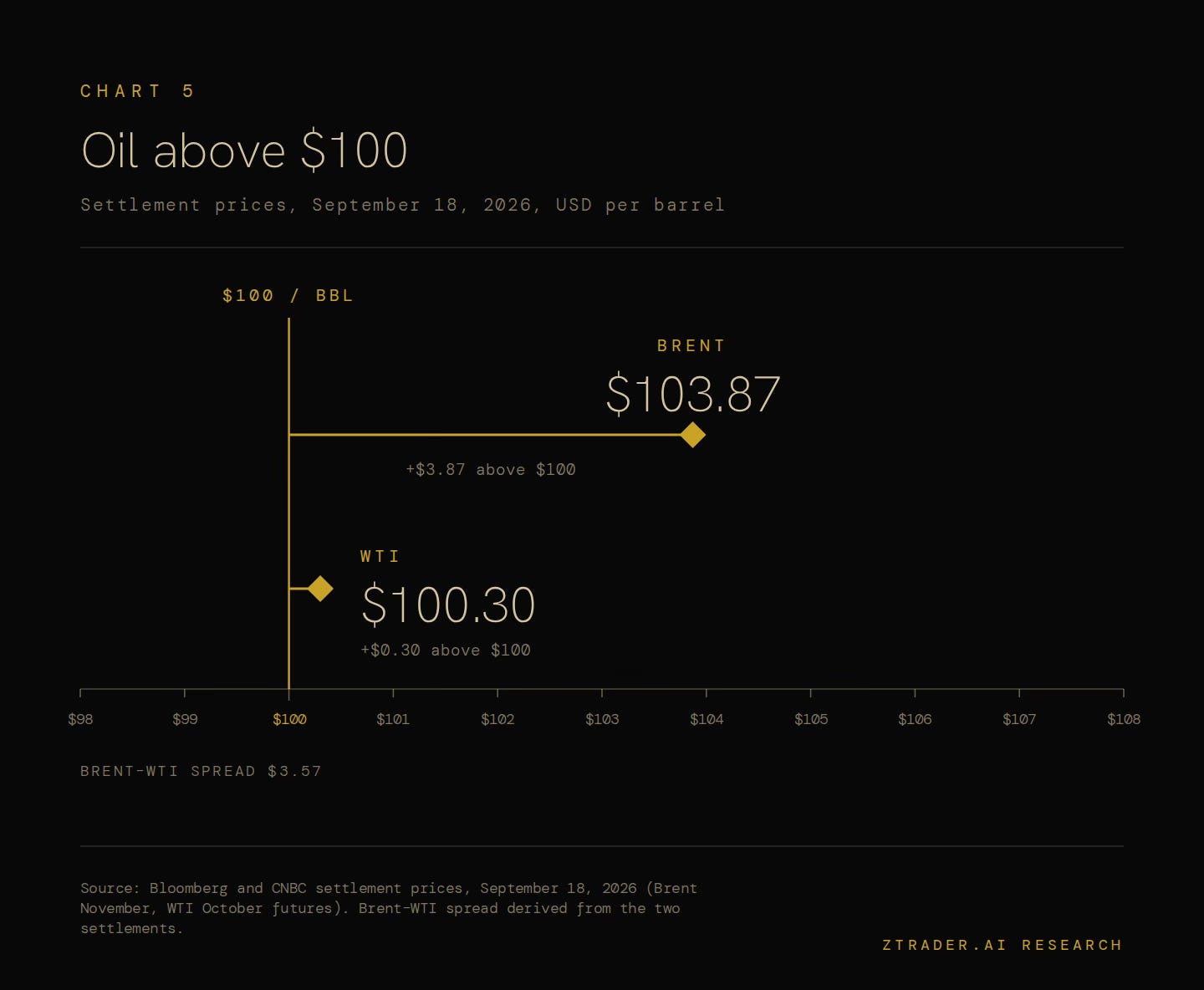
Calling all of this simply “inflation” compresses too much information into one word. The oil price now contains a geopolitical risk premium, but that premium is not imaginary.
It is the market price of uncertainty around physical supply, tanker access, pipeline capacity, shipping insurance, infrastructure damage and the possibility that another part of the export system becomes unavailable.
The distinction between a “fundamental” price and a “war premium” becomes almost meaningless when war itself is changing the fundamentals.
This is also why a peace headline can produce an immediate oil selloff even before another barrel reaches the market. The market is discounting future flows. But if the negotiations fail and the tankers remain absent, the premium returns because the physical constraint never disappeared. The ultimate arbiter is not the language in the communiqué; it is the flow data that follow it.
The Fed Is Fighting the Second-Round Shock
This is where I think the market’s obsession with the exact size of the next Fed move becomes too narrow. The Fed can influence the second-round effects of the shock. It can prevent households and firms from concluding that 4% inflation is simply the new normal. It can suppress credit creation, weaken nominal demand and make it harder for businesses to pass every increase in input costs through to consumers.
Those are powerful tools, and they are precisely why the September hike makes sense.
But those tools operate downstream.
The first-round problem is still energy. If oil remains structurally expensive because a major portion of Middle Eastern export capacity is physically constrained or exposed to repeated disruption, tighter monetary policy eventually forces the rest of the economy to adjust around that higher energy bill. Households lose purchasing power, corporate margins come under pressure, financing becomes more expensive and investment becomes harder to justify. Inflation may eventually weaken, but part of the disinflation is achieved by weakening demand rather than restoring supply.
That is the ugly version of the adjustment because the economy pays twice: once through the higher price of energy and again through the higher price of money.
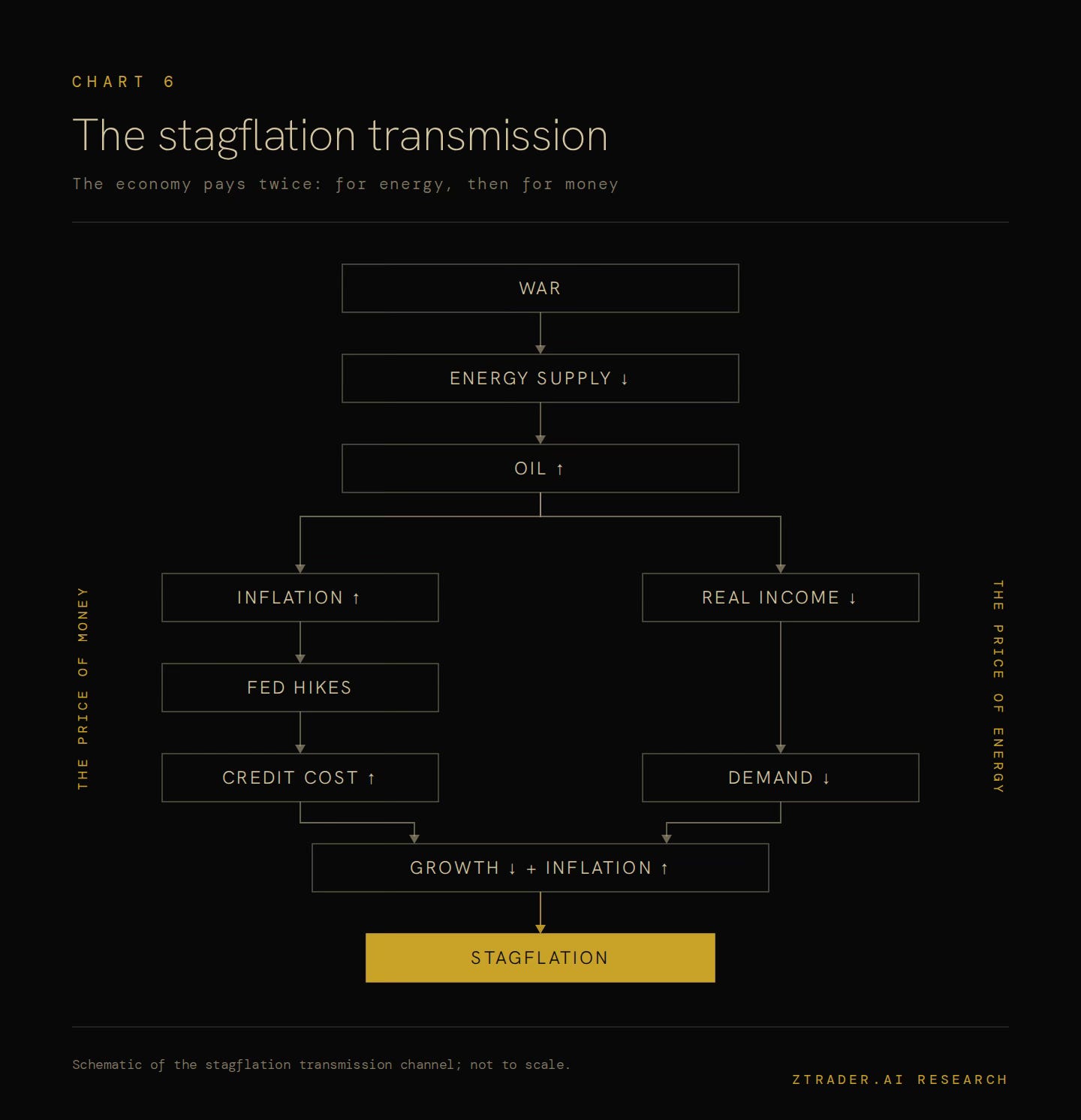
This is the macro configuration I would worry about most.
If the supply shock fades quickly, the Fed can tighten against the temporary inflationary impulse and then normalize as the energy premium disappears. If the physical constraint persists, however, monetary policy becomes increasingly unpleasant. Leaving policy loose risks allowing the shock to propagate into expectations and domestic inflation; tightening aggressively attacks an economy already losing real income to energy.
The central bank is then choosing how the economy absorbs the shock rather than eliminating the shock itself.
There Are Only Three Ways Out
Once the problem is framed physically rather than rhetorically, the number of possible outcomes becomes surprisingly small.
The first is that the security risk surrounding the relevant infrastructure and shipping routes falls materially, allowing tanker traffic and insurance conditions to normalize.
The second is that alternative production, pipelines, ports, inventories and shipping routes become sufficient to replace enough of the impaired supply that Hormuz ceases to be the marginal constraint.
The third is that neither happens quickly enough, in which case the global economy simply has to clear the available supply at a higher energy price until demand destruction or new supply restores equilibrium.
The political and military decisions that determine which path emerges belong to governments, not central banks. From the market’s perspective, however, the equation is less ideological. Security risk must fall, the physical constraint must be bypassed, or somebody must pay the premium.
This is why I remain skeptical of treating every new round of negotiations as though the existence of negotiations itself resolves the macro problem.
The genuine settlement that restores durable freedom of navigation would obviously matter enormously. A temporary agreement that changes headlines without changing the probability distribution of future physical flows matters much less. The relevant evidence will appear in tanker counts, export volumes, insurance rates, inventories, pipeline utilization and ultimately the forward curve.
The market does not need another promise of normality. It needs evidence that normality has returned.
This Is a War Problem Before It Is a Fed Problem
The Federal Reserve is doing what a central bank is supposed to do.
Inflation remains too high, its own September projections put 2026 PCE inflation at 3.7%, and almost the entire Committee sees the risks around that forecast tilted upward.
Under those conditions, another tightening cycle is not difficult to understand. What is dangerous is expecting monetary policy to solve a problem whose origin sits outside the monetary system.
The Fed controls the price of money; it does not control the physical security of global energy supply. It can restrain the demand for oil by making the economy weaker, but it cannot create the missing barrels. It can prevent an external shock from becoming permanently embedded in domestic inflation, but it cannot remove the external shock. That distinction will determine how painful this cycle becomes.
If Hormuz normalizes and the wider regional security problem recedes, a substantial part of the energy premium can disappear and the Fed’s job becomes much easier. If the physical constraint persists while the Fed continues tightening, the economy moves deeper into the uncomfortable territory where inflation and restrictive monetary policy coexist with deteriorating real growth.
That is why I do not think the most important question today is whether the next Fed move is another 25 basis points. The more important question is what happens to the physical energy system before the next meeting.
You cannot reopen Hormuz with the federal funds rate, repair a pipeline with a dot plot or escort a tanker with forward guidance. Monetary policy can contain the economic consequences of a war, but it cannot substitute for the restoration of physical supply.