

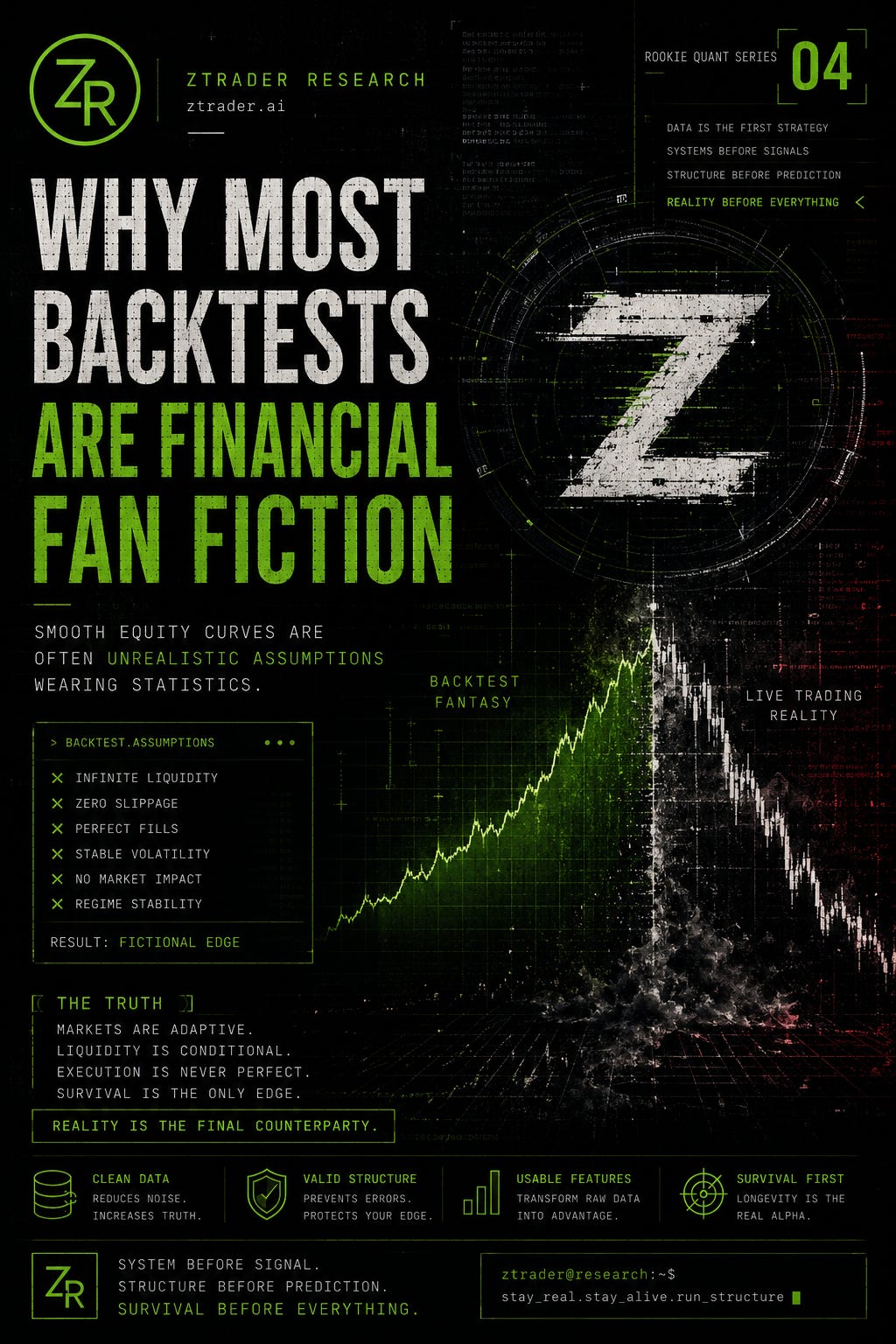
Smooth equity curves are among the most dangerous visual objects in finance.
Because smooth backtests often hide fragile assumptions.
Most beginner traders do not fall in love with the strategy itself.
They fall in love with the curve.
The equity line rises steadily. Drawdowns remain shallow. The Sharpe ratio looks elegant. The returns appear stable and intelligent.
For a brief moment, it feels like discovering hidden truth inside the market.
Then live trading begins.
And reality arrives like a lawsuit from physics.
The Core Problem
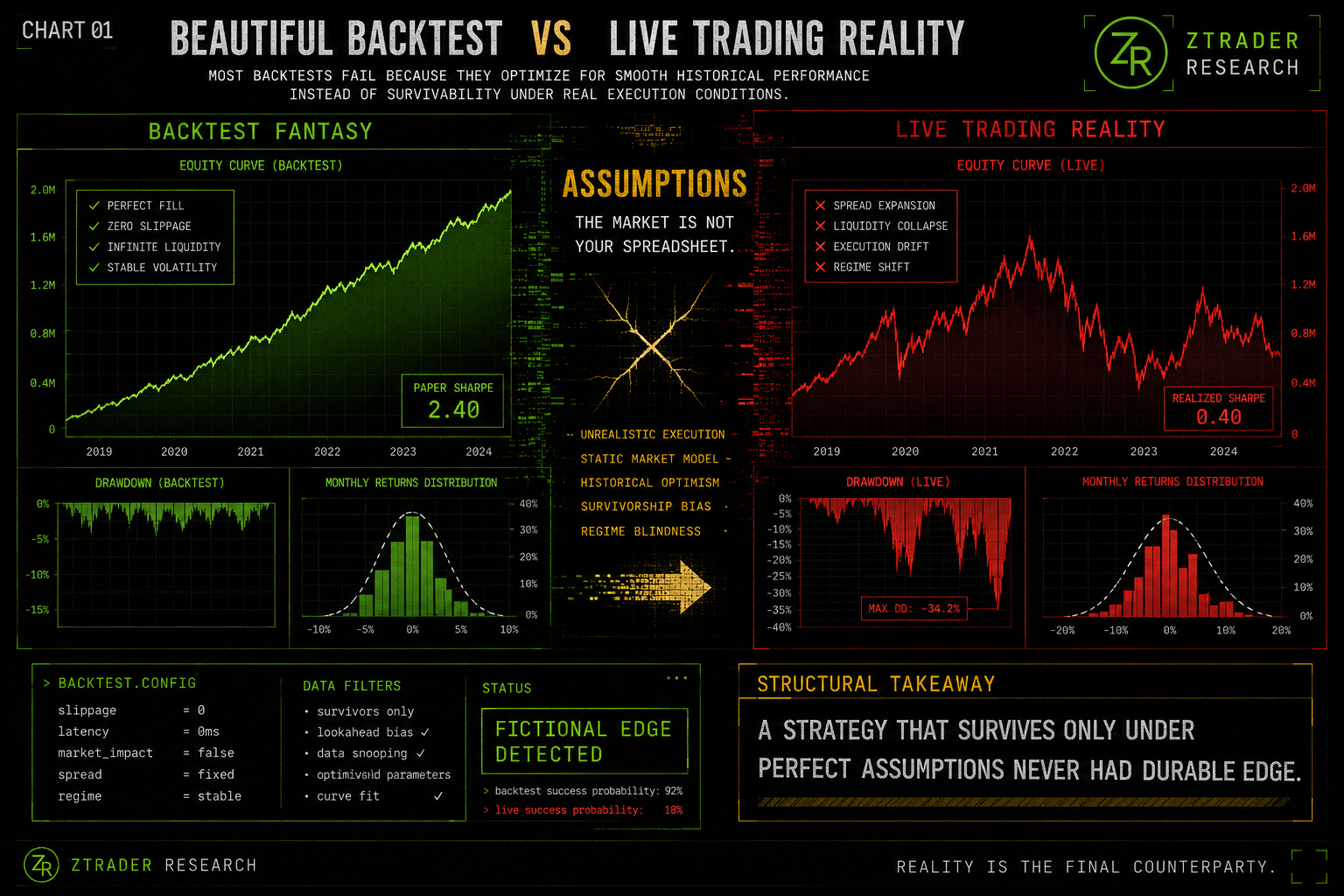
Most people think a backtest tests reality.
It does not.
A backtest tests assumptions about reality.
Every backtest silently assumes things like:
liquidity exists
spreads remain stable
fills are achievable
volatility behaves normally
execution happens instantly
market structure stays compatible
The problem is that markets are adaptive systems.
Reality does not care about your spreadsheet.
This is why many retail strategies perform beautifully historically and collapse immediately once deployed live.
The strategy was never detecting durable market structure.
It was detecting a fragile set of assumptions.
The Seduction of Smooth Curves
Humans are biologically vulnerable to smooth upward lines.
Smoothness creates emotional trust.
The cleaner the equity curve appears, the more believable the system feels.
This creates one of the largest psychological traps in modern quant culture:
visual stability gets mistaken for structural robustness.
But many smooth backtests are simply the result of unrealistic assumptions:
perfect fills
frictionless execution
infinite liquidity
stable volatility
no market impact
no regime instability
The more unrealistic the assumptions become, the more beautiful the backtest often looks.
Civilization itself is basically a multi-thousand-year attempt to emotionally stabilize around charts.
The Five Biggest Backtest Lies
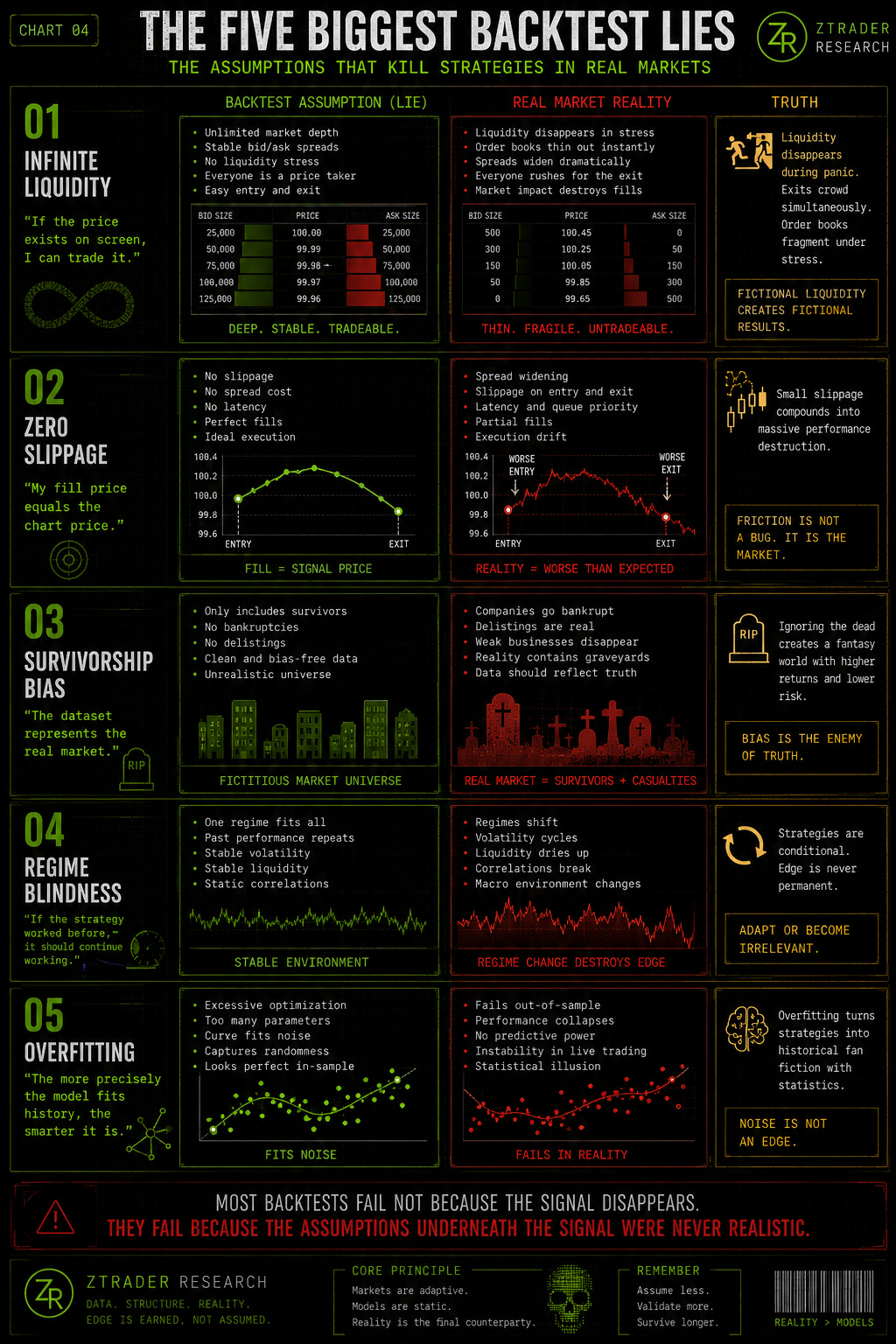
01. Infinite Liquidity
Most retail backtests assume you can always enter and exit positions at displayed prices.
Real markets disagree.
Liquidity is conditional.
Liquidity is emotional.
It disappears precisely when:
fear rises
volatility expands
exits become crowded
leverage unwinds
positioning becomes one-sided
A strategy requiring stable liquidity during unstable conditions is not robust.
It is conditional fantasy.
02. Zero Slippage
Most beginner systems treat execution friction as negligible.
Professional desks treat execution friction as survival-critical.
During fast markets:
spreads widen
fills deteriorate
latency matters
order books thin out
volatility distorts price discovery
Tiny slippage assumptions can destroy entire strategies.
Especially in:
options
crypto
small-cap equities
overnight sessions
earnings events
macro releases
A strategy that only survives under ideal execution conditions never had durable edge in the first place.
03. Survivorship Bias
Many datasets quietly remove dead companies.
This creates a fictional universe where weak businesses never existed.
Reality contains bankruptcy.
Reality contains collapse.
Reality contains graveyards.
Your dataset should too.
Otherwise the system is not studying markets.
It is studying historical winners selected by hindsight.
04. Regime Blindness
A strategy that worked during:
QE
low volatility
passive inflow expansion
strong liquidity
…may completely fail during:
tightening cycles
inflation shocks
volatility expansion
liquidity stress
macro uncertainty
Retail behavior tends to assume strategy permanence.
Market structure does not.
Every edge is conditional.
05. Overfitting
Overfitting is what happens when intelligence loses contact with reality.
The system stops identifying repeatable behavior.
Instead, it memorizes historical accidents.
At that point, the strategy is no longer a model.
It becomes:
historical cosplay with statistics.
The backtest looks intelligent because the system has already seen the answers.
Reality does not provide answer keys in advance.
The Retail Quant Illusion
Retail quant culture often optimizes for elegance instead of survivability.
Beginners obsess over:
indicators
entries
parameter optimization
AI buzzwords
model complexity
Professionals obsess over:
execution
exposure
liquidity
volatility
drawdown
stress behavior
regime dependency
Because professional trading is not primarily about prediction.
It is about surviving uncertainty.
A mediocre strategy with realistic assumptions often outperforms a mathematically beautiful strategy built on fantasy conditions.
This is why institutional systems frequently look:
slower
uglier
less profitable
more conservative
…and significantly more durable.
Professional research is not designed to create emotional excitement.
It is designed to survive contact with reality.
Why AI Makes This Worse
AI has dramatically lowered the barrier to strategy generation.
Now almost anyone can generate:
indicators
trading systems
optimization scripts
backtests
ML pipelines
This creates a dangerous illusion of sophistication.
Because generating signals is no longer difficult.
Structural honesty is difficult.
Many AI-generated systems quietly ignore:
execution degradation
liquidity instability
volatility clustering
regime shifts
market impact
position crowding
This creates entire ecosystems of synthetic intelligence.
Systems that appear intelligent until they encounter actual markets.
And actual markets are extremely hostile environments.
The Market Is Not Your Spreadsheet
Markets are not static equations.
They are adaptive systems driven by:
fear
leverage
positioning
liquidity stress
reflexivity
forced behavior
The moment enough participants discover the same edge, the environment changes.
This is why:
edges decay
strategies crowd
execution deteriorates
volatility regimes shift
Reality continuously updates itself.
Your system must survive those updates.
In the premium section we go deeper into:
how slippage silently destroys Sharpe ratios
why volatility regimes invalidate historical edge
the hidden mathematics of drawdown fragility
how professional desks stress-test systems
why execution quality matters more than most signals
how fake alpha is accidentally manufactured
what realistic institutional backtesting actually looks like
The difference between retail backtests and professional research is rarely mathematics.
It is usually contact with reality.
