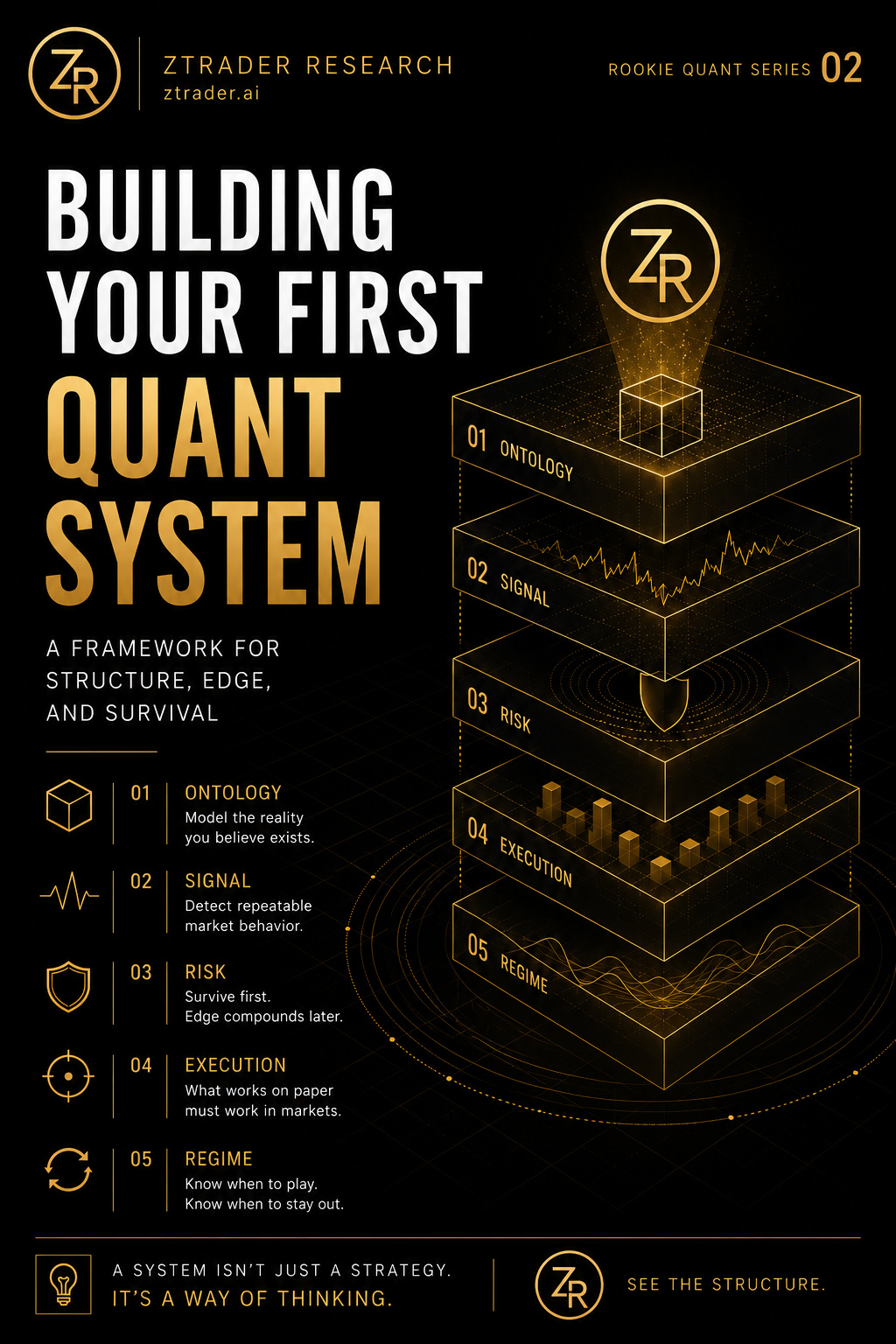
Rookie Quant Series 02: Building Your First Quant System (Without Lying to Yourself)
Most people think building a quant system means writing indicators and backtesting charts.
It doesn’t.
Most beginner quant systems are simply:
historical fan fiction with Python syntax.
Because hindsight is addictive.
Once humans see what already happened, the brain immediately starts constructing explanations that feel intelligent:
“This setup was obvious.”
“The breakout was clean.”
“The signal worked perfectly.”
But knowing the answer after the fact is not quant.
It is storytelling.
Real quantitative systems begin somewhere much less exciting:
defining reality.
And this is the step almost everyone skips.
The First Mistake: Indicators Are Not Systems
Most rookie quant traders begin the same way:
RSI
MACD
Bollinger Bands
moving average crossovers
Then they write something like:
if RSI < 30:
buy()
Next comes the backtest.
Suddenly:
Sharpe ratio: 3.4
annual return: 82%
max drawdown: 9%
For about fifteen minutes, they believe they’ve built Renaissance Technologies from a laptop and caffeine addiction.
Markets are generous.
They often allow beginners to feel like geniuses right before teaching them why execution exists.
The real problem is not the indicator.
The real problem is this:
You do not actually know what behavior you are trading.
Not the symbol.
The behavior.
Are you trading:
momentum?
panic?
liquidity imbalance?
volatility expansion?
forced positioning?
dealer hedging?
macro regime shifts?
mean reversion?
earnings drift?
Because a quant system is not a collection of indicators.
A quant system is:
a structured expression of repeatable market behavior.
A Real Quant System Has 5 Layers
Most beginner systems only contain signals.
Professional systems contain architecture.
At minimum, a real quant framework contains five layers.
01. Ontology Layer
“What Reality Are You Modeling?”
This is the foundation.
Before signals, before code, before backtests, you must answer:
What market behavior actually exists and repeats?
Every system makes an assumption about reality.
Trend Following Systems
Assume:
trends persist
capital flows have inertia
breakouts can cascade
Mean Reversion Systems
Assume:
deviations eventually normalize
liquidity repairs price dislocations
Volatility Systems
Assume:
volatility clusters
compression eventually expands
Flow-Based Systems
Assume:
positioning matters more than prediction
This is the true core of a strategy.
Indicators are secondary.
They are observation tools.
Not the ontology itself.
Most beginners confuse the thermometer with the weather system.
02. Signal Layer
“How Do You Detect It?”
Only now do indicators matter.
This layer includes things like:
RSI
VWAP
ATR
breadth
skew
volume imbalance
volatility metrics
But signals are only:
proxies for underlying market structure.
This distinction matters enormously.
Because when traders worship indicators without understanding the behavior beneath them, they inevitably overfit noise.
And markets punish noise worship with exceptional cruelty.
03. Risk Layer
“How Do You Survive?”
This is where most retail quant systems quietly die.
Beginner traders usually spend:
80% of effort on entries
5% on risk
Professional desks often invert that ratio.
Because even profitable systems can collapse under poor risk architecture.
Real risk management includes:
position sizing
exposure limits
correlation control
volatility adjustment
liquidity awareness
drawdown management
kill switches
Markets do not reward intelligence consistently.
They reward survivability.
A system with modest edge and disciplined exposure often outperforms brilliant systems with catastrophic downside behavior.
Because compounding only works if the account remains alive long enough for probabilities to matter.
04. Execution Layer
“Can This Actually Be Traded?”
This is one of the most misunderstood parts of quant trading.
Many beginner backtests assume fantasy conditions:
infinite liquidity
perfect fills
zero slippage
no latency
frictionless execution
Real markets are hostile environments.
Spreads widen.
Liquidity disappears.
Volatility distorts fills.
Execution quality collapses precisely when markets become most emotional.
This becomes especially dangerous in:
options
small-cap equities
crypto
earnings events
macro announcements
overnight gaps
A real system must ask:
“Can this strategy survive contact with actual markets?”
Because many beautiful backtests disintegrate the moment reality appears.
05. Regime Layer
“When Does This Stop Working?”
Every strategy has favorable environments.
And hostile ones.
Trend systems struggle during choppy conditions.
Mean reversion systems die during crashes.
Volatility selling strategies explode during volatility expansion.
The goal of professional trading is not finding a strategy that works forever.
Those do not exist.
The goal is understanding:
when not to play.
This is one of the largest differences between retail thinking and institutional thinking.
Retail traders seek constant action.
Professionals seek selective exposure.
Sometimes the highest-quality trade is no trade at all.
A concept humans continue resisting despite thousands of years of financial destruction.
The Truth About Quant Trading
Real quant trading is not:
fancy math
AI buzzwords
random indicators
optimized backtests
At its core, quant is closer to:
reality compression.
You are attempting to:
compress market behavior
identify repeatable structures
model state transitions
manage uncertainty
survive long enough for asymmetry to emerge
This is why the best quantitative traders are not always the best mathematicians.
Often, they are the people who understand market structure most deeply.
Because markets are not equations.
They are adaptive systems built from:
incentives
fear
positioning
liquidity
reflexivity
forced behavior
And eventually every strategy must face those realities.
Your First Goal Should Not Be Alpha
Most beginners immediately want:
AI agents
reinforcement learning
high-frequency systems
multi-factor optimization
advanced derivatives modeling
Before they even understand:
drawdowns
liquidity
volatility regimes
execution risk
exposure management
This is backwards.
The first objective is not maximizing returns.
The first objective is:
building a system that does not immediately self-destruct.
Because a system that survives can evolve.
A dead system cannot.
And most quant systems do not fail because their creators lacked intelligence.
They fail because their creators lacked structural honesty.
ZTRADER RESEARCH
See the Structure.


