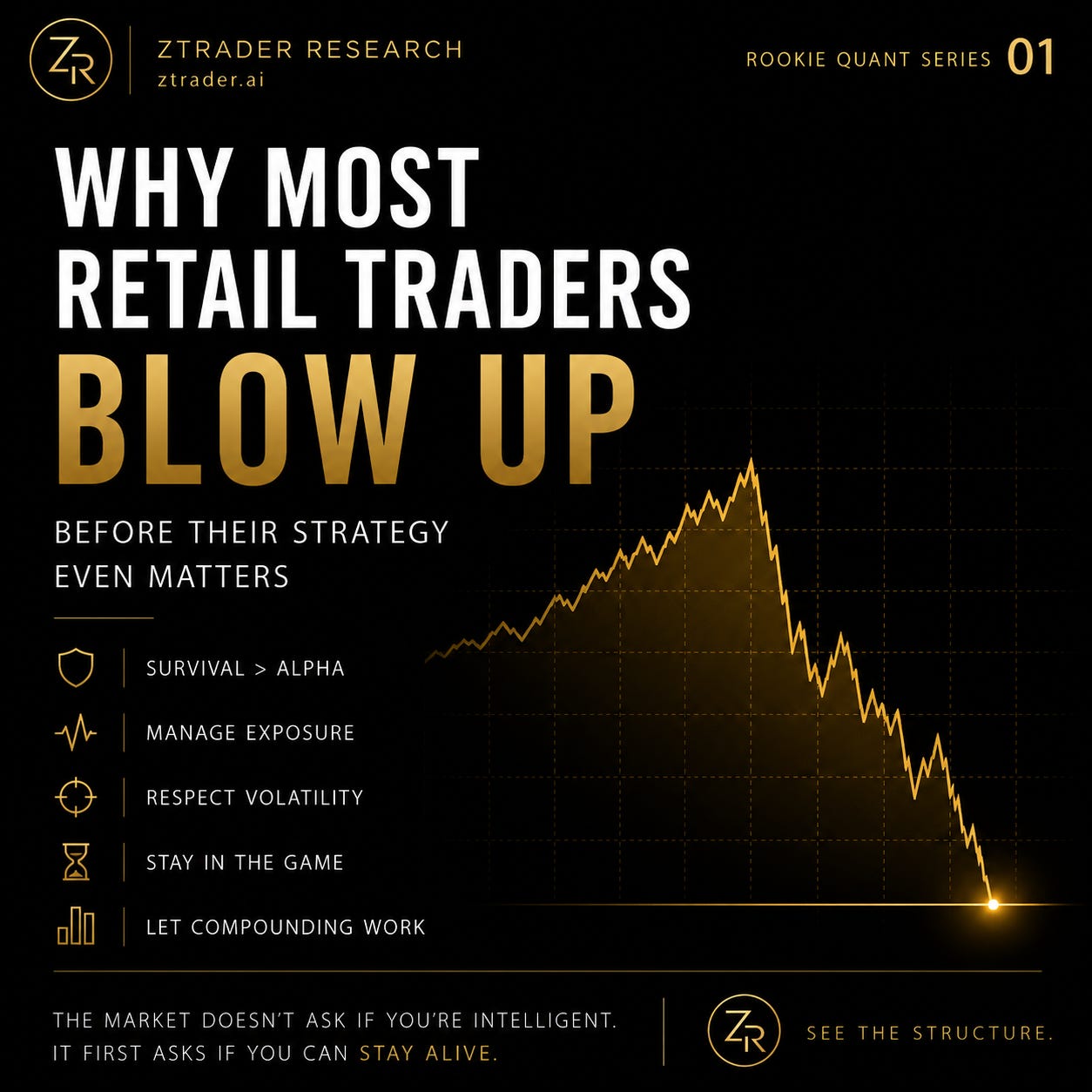
Rookie Quant Series 01: Why Most Retail Traders Blow Up Before Their Strategy Even Matters
Most retail traders think they lost money because their strategy wasn’t good enough.
In reality, most of them never survive long enough to discover whether the strategy had any edge at all.
That is the first brutal misunderstanding of markets.
People enter trading believing the game is about prediction:
predicting direction
predicting tops
predicting bottoms
predicting the next candle
But professional trading desks rarely think this way.
Because the market does not kill people primarily through wrong predictions.
It kills them through exposure.
A trader can be directionally correct and still get destroyed.
A trader can correctly identify a macro trend and still get liquidated before the move fully develops.
A trader can even build a statistically profitable strategy and still blow up because volatility, leverage, liquidity, or timing overwhelms the account before compounding can occur.
This is why survival is the first layer of trading.
Not alpha.
Not intelligence.
Not prediction.
Survival.
The retail world is obsessed with entries because entries feel exciting. Social media trains traders to believe success comes from “finding the perfect setup.”
Entire industries exist around this illusion:
indicator packs
signal groups
AI prompts
strategy screenshots
backtests with impossible fills
But almost nobody talks about the actual killers:
oversized positions
volatility clustering
emotional leverage
revenge trading
liquidity vacuum
forced exits
regime mismatch
These are what usually destroy accounts.
The irony is that many beginner traders accidentally focus on the least important part of trading.
Entry quality matters far less than exposure management.
A mediocre entry with disciplined sizing often survives.
A genius entry with reckless leverage often dies instantly.
Professional traders understand this deeply. This is why institutional desks spend enormous amounts of energy monitoring:
exposure
drawdown
liquidity
correlations
execution conditions
regime changes
…rather than obsessing over predicting every market move.
Because professionals know something retail traders usually learn too late:
You do not need to catch every move.
You only need to survive long enough for asymmetry to eventually appear.
This changes how you think about trading entirely.
Instead of asking:
“How much can I make from this trade?”
The better question becomes:
“How much damage occurs if I am wrong?”
That shift alone separates gambling from professional risk management.
The market is a probabilistic environment. Even strong strategies experience periods of pain. Even excellent traders suffer drawdowns. Even systematic funds can enter temporary failure regimes.
What matters is whether the system survives those periods.
This is why position sizing is more important than most people realize.
A trader risking 30% of capital on one idea does not actually have a strategy.
They have a countdown timer.
The mathematics of drawdown become vicious very quickly:
Lose 10% → need 11% to recover
Lose 25% → need 33%
Lose 50% → need 100%
Lose 80% → need 400%
This is where compounding quietly becomes destruction.
The market rewards longevity more than brilliance.
The trader who survives five years often outperforms the trader who looks like a genius for six months.
Because surviving allows:
adaptation
learning
statistical repetition
emotional stability
compounding
Dead accounts cannot compound.
This is also why small traders should stop trying to behave like large institutions.
Retail traders do not have institutional advantages:
no speed edge
no information monopoly
no balance sheet power
But small traders do possess one hidden advantage:
mobility.
A small trader can stay selective.
They can wait.
They can avoid crowded positioning.
They can remain flat during dangerous conditions.
Large institutions often cannot.
This means survival itself becomes a structural edge.
Especially in volatile markets.
Especially in modern markets dominated by leverage, options flows, passive liquidity, and algorithmic reflexivity.
The future of trading will likely become even more hostile to undisciplined exposure.
AI will compress informational advantages.
Execution competition will intensify.
Market reactions will accelerate.
But risk management will remain permanently human.
Because eventually every system encounters stress.
And when stress arrives, survival becomes the only thing that matters.
The traders who remain standing after volatility, after liquidity shocks, after crowded exits, are the ones who eventually reach compounding.
Not because they predicted perfectly.
But because they survived long enough for probability to work in their favor.
That is the part of trading most people discover only after losing money.
The market does not first ask whether you are intelligent.
It first asks whether you can stay alive.
ZTRADER RESEARCH
See the Structure.


