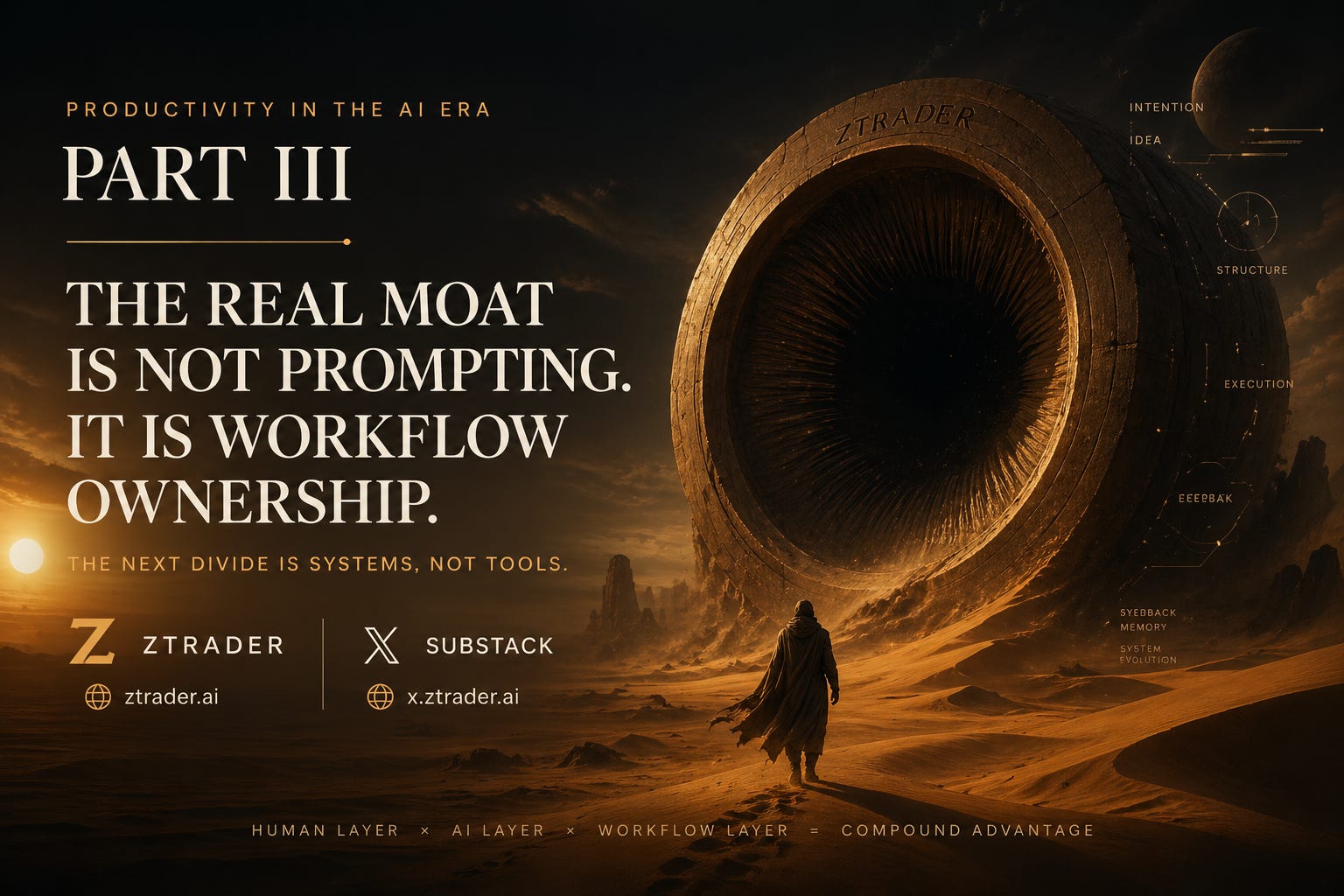
Productivity in the AI Era (Part III) ~ The Real Moat Is Not Prompting. It Is Workflow.
Most people still think the AI era is about asking better questions.
It is not.
Prompting is only the surface layer. It is the visible part, the thing people can screenshot, copy, teach in a course, and pretend they have discovered fire again.
The real divide is deeper.
The real divide is between people who use AI as a tool and people who turn AI into a workflow system.
That is the new productivity gap.
Not intelligence.
Not access.
Not even model quality.
Workflow ownership.
Because once everyone has access to powerful models, the advantage no longer comes from the model itself. The advantage comes from how fast you can turn intention into structure, structure into execution, execution into output, and output into a repeatable system.
Most people stop at the first layer:
Human asks AI.
AI gives answer.
Human feels productive.
Nothing compounds.
The output disappears into chat history. No pipeline is built. No memory is formed. No system improves. The same person returns tomorrow and asks the same type of question again, like a medieval farmer praying to a glowing autocomplete machine.
That is not productivity.
That is dependency with better typography.
The real AI-native operator works differently.
They do not ask AI for a single answer.
They build a loop.
Idea → Research → Structure → Draft → Chart → Publish → Feedback → Memory → Next Output
This loop is the product.
This loop is the moat.
This loop is the new factory.
In the old internet era, productivity was about using tools.
In the AI era, productivity is about designing flows between tools.
The person who owns the workflow owns the leverage.
The person who only owns prompts owns nothing.
A prompt can be copied.
A workflow is much harder to copy because it contains context, taste, judgment, data sources, distribution channels, memory, feedback, and execution rhythm.
That is why most AI products will become worthless.
Not because they are bad.
Because they are isolated.
One app writes.
One app summarizes.
One app makes slides.
One app makes charts.
One app searches.
One app stores notes.
Every app claims to save time, while quietly creating another tab, another login, another broken context window, another place where human attention goes to die in a subscription dashboard.
The AI-native future will not belong to people who collect tools.
It will belong to people who compress tools into operating systems.
This is why the human layer matters.
AI can generate.
But the human must decide what matters.
AI can accelerate.
But the human must define the direction.
AI can produce infinite text.
But the human must build the judgment filter.
Without that layer, AI just creates more noise faster.
The new productivity formula is:
Human Layer × AI Layer × Workflow Layer
If the human layer is weak, AI amplifies confusion.
If the workflow layer is missing, AI outputs random fragments.
If the system has no memory, every session starts from zero.
This is the hidden failure of most AI users.
They think they are moving faster because the output is faster.
But they are not compounding.
They are just generating more disposable material.
The real question is not:
Can you use AI?
The real question is:
Can your AI workflow remember, improve, route, publish, and evolve?
That is where the next divide will appear.
Some people will use AI to write faster emails.
Some people will use AI to build personal research desks.
Some people will use AI to create content engines.
Some people will use AI to build trading systems, intelligence systems, product systems, and decision systems.
Same models.
Different architecture.
This is the part most people still miss.
AI is not the product.
The workflow is the product.
The model is not the moat.
The system around the model is the moat.
The prompt is not the leverage.
The repeated executable loop is the leverage.
That is what I am building with Ztrader.
Not another AI wrapper.
Not another dashboard.
Not another “ask me anything” toy.
Ztrader is a workflow system for macro research, market structure, AI quant thinking, chart generation, content production, and decision support.
It is built around one idea:
Do not just consume information.
See the structure.
Explore more at:
Because the future will not reward the people who ask AI better questions.
It will reward the people who build better systems around the answers.


