

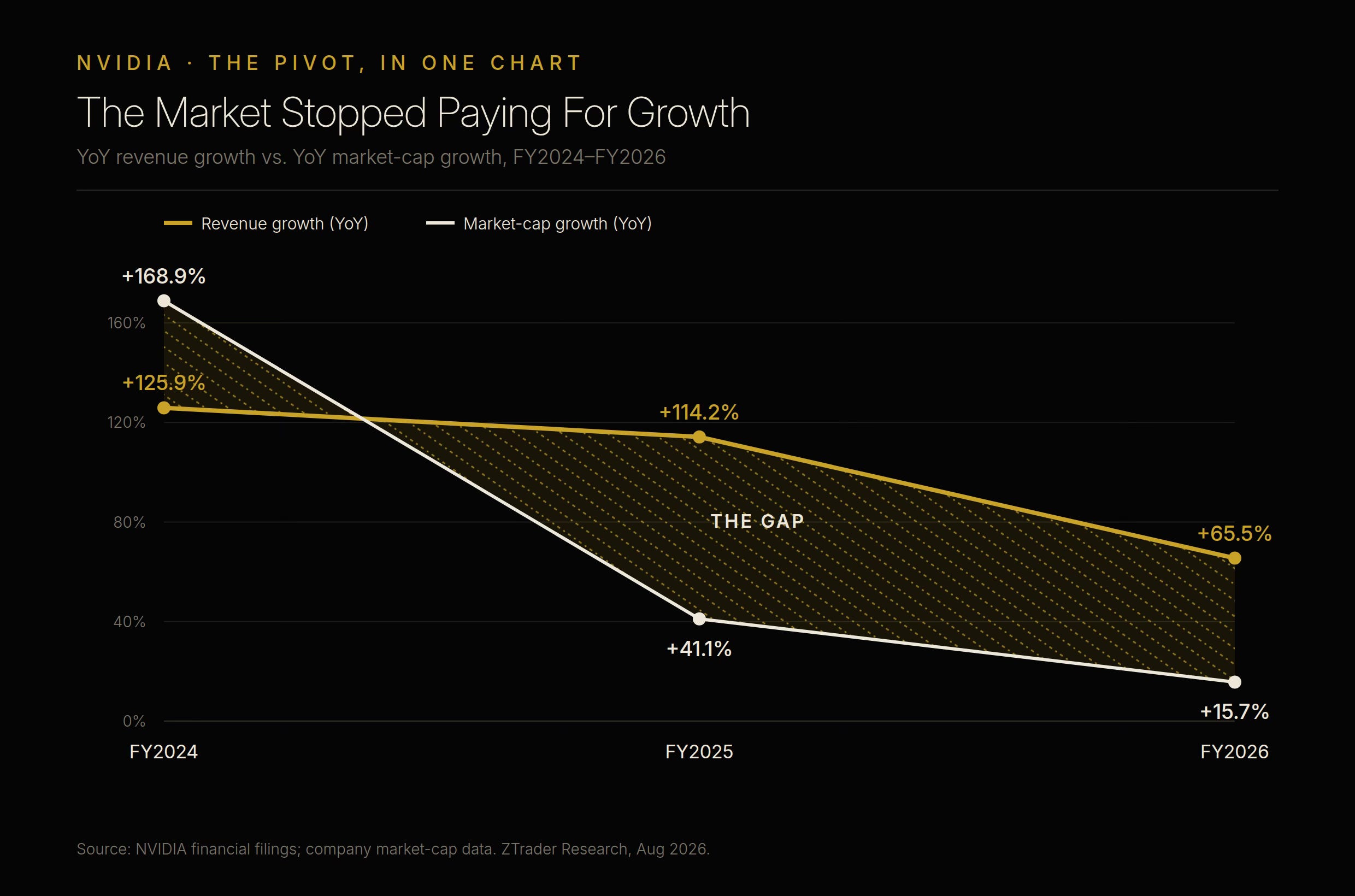
Nvidia doubled its revenue last night. Its market value has grown at roughly one-sixth that pace over the past twelve months.
The market bear are reading that spread as the top forming. It isn’t — not yet. Read it correctly and it says something sharper: the AI boom isn’t ending.
But THERE IS NO DOUBT WE ARE REACHING THE PIVOT POINT OF AI BUBBLE.
In this stage, we are seeing:
There is still growth in the AI sector but much slower.
The growth rate becomes much slower and capital efficiency will become lower.
The AI superscalers need to constantly breaking beating that estimates to have the same or less valuation from the market.
Real demand is not driving the growth, the self-reinforcing & financing loop does all the work.
The following is the brief technical of NVDA, more on
https://ztrader.ai ,the NEXT GEN OF MACRO OS
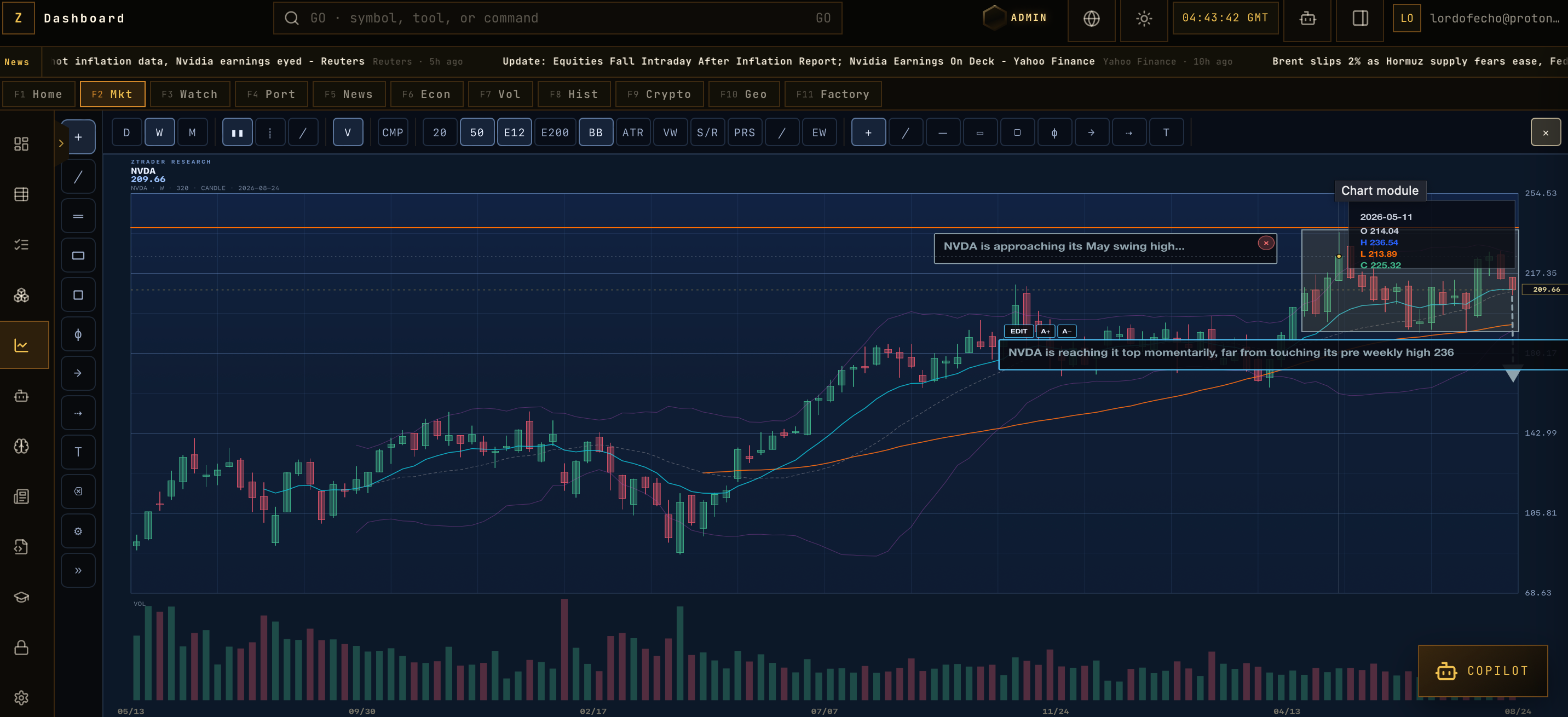
Nvidia popped to $218 after earnings, but the weekly high at 236.54 hasn’t been touched. 6 of the last 8 earnings reports faded after the pop — the question is whether this one breaks 236.54 first, or fades before it even gets there. Watch that level. It’ll answer itself.
THE NUMBERS THAT DON’T MATCH
From NVDA’s earning report:
The NVDA stock price reaction: up about 4.7% after hours.
Its revenue hit $96.2 billion, up 106% year over year and the Data Center revenue reached $89 billion, up 117%. Guidance for the current quarter sits at $108 billion, and management pointed to roughly 70% revenue growth into FY2028.
Most critics will argue that this read is good enough and AI is definitely not reaching the end of the bubble.
Growth may continue for a while, but the broader AI sector is gradually losing momentum.
More importantly, the growth is no longer the metric that matters. For serious investors, the game is now entirely about divergence
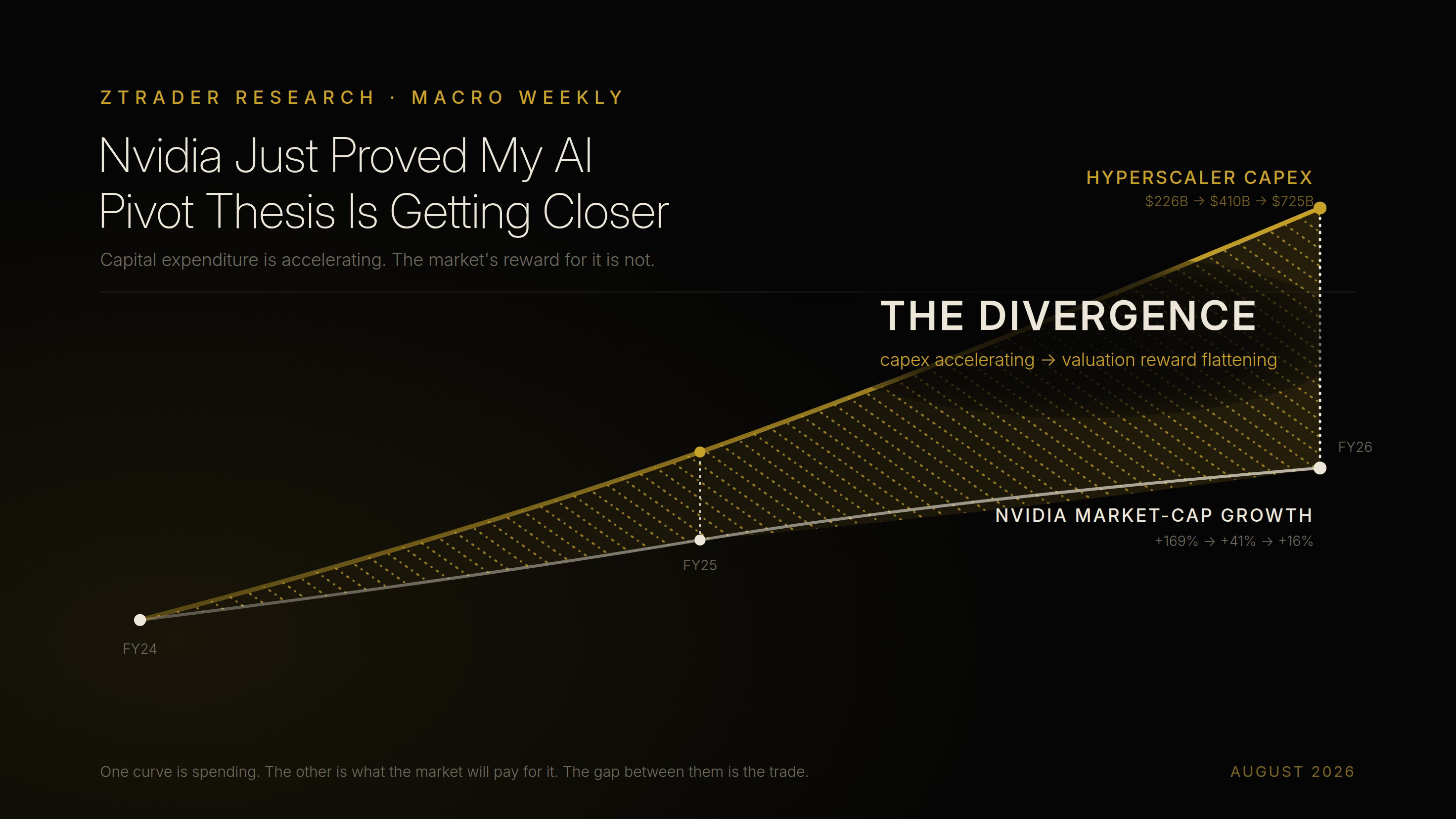
[CHART 1 — chart1_the_divergence.png]
We are seeing the shape of a pivot:
the fundamental AI growth story barely changed(for now) , but market’s willingness to pay for it fell off a cliff anyway.
Anyone still framing this quarter as “AI CapEx has peaked” is arguing with a chart that says the opposite.
The Capex alone hasn’t peaked.
To be precise, it’s the reward for CAPEX that has.
CASH AND CAPEX JUST RAN OUT OF GROWTH
Here is the core issue:
CAPEX isn’t ONLY outpacing the multiple.
It’s outpacing the CASH that funds it.
Epoch AI’s own tracking shows aggregate cash capex across Microsoft, Amazon, Alphabet, Meta, and Oracle overtaking operating cash flow around Q3 2026 — this quarter, with Capex growing roughly 70% a year against 23% growth in operating cash flow.
Bank of America’s estimates for a broader cohort of eight major cloud providers (the same four US hyperscalers plus Oracle, Alibaba, Tencent, and Baidu) put aggregate free cash flow margin at -2.8% this year, widening to -5.4% in 2027 and -5.8% in 2028.
Alphabet’s free cash flow went negative in Q2 2026 for the first time since the company went public in 2004.
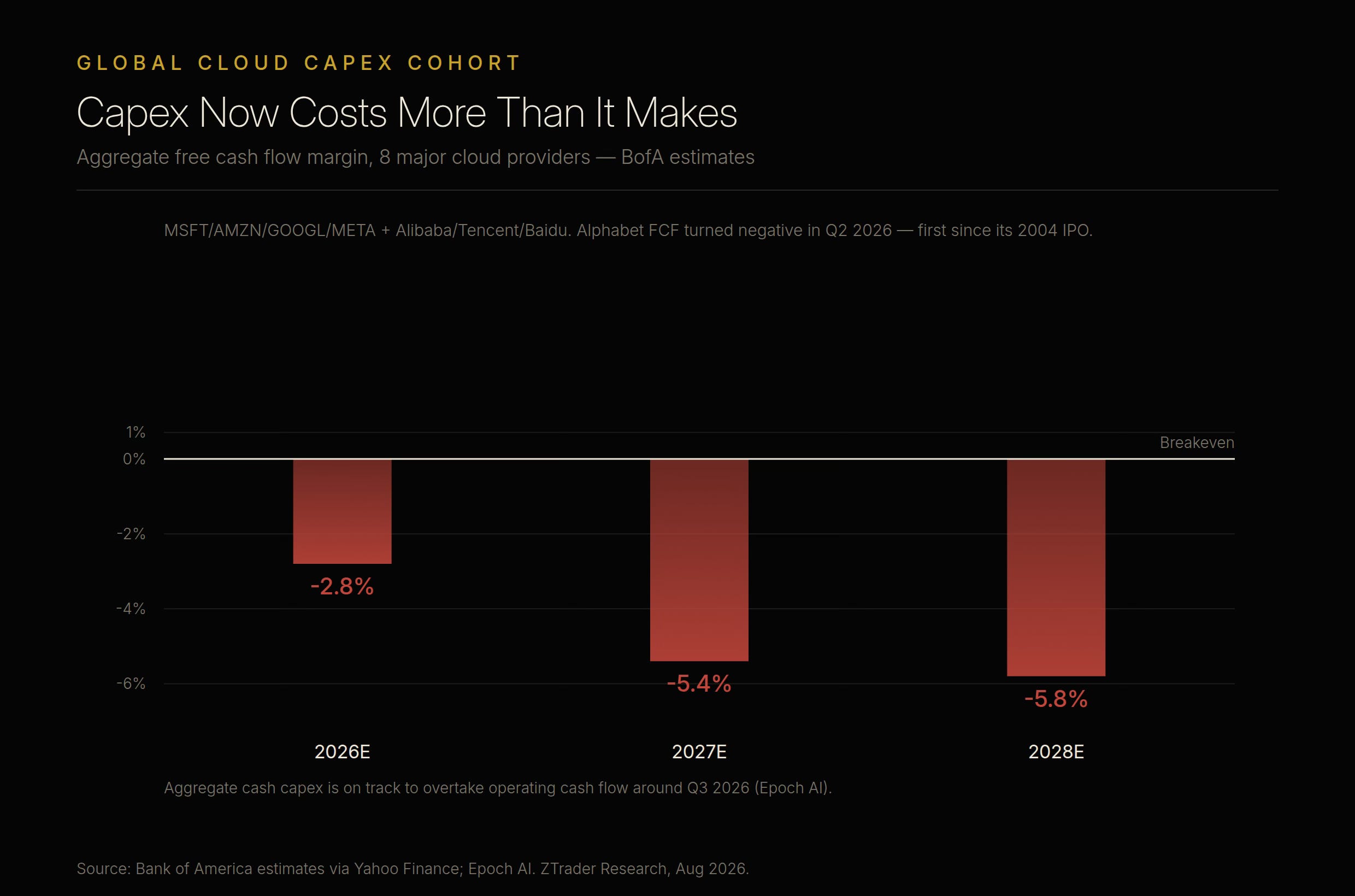
[CHART 2 — chart2_the_crossover.png]
THIS CASH BURN IS DEADLY:
these companies are now spending more building AI infrastructure than the business generates in cash, and Wall Street’s own estimates say that gap widens for at least two more years before it narrows.
As every dollar of that gap has to come from somewhere else.
WHERE THE MONEY IS COMING FROM NOW
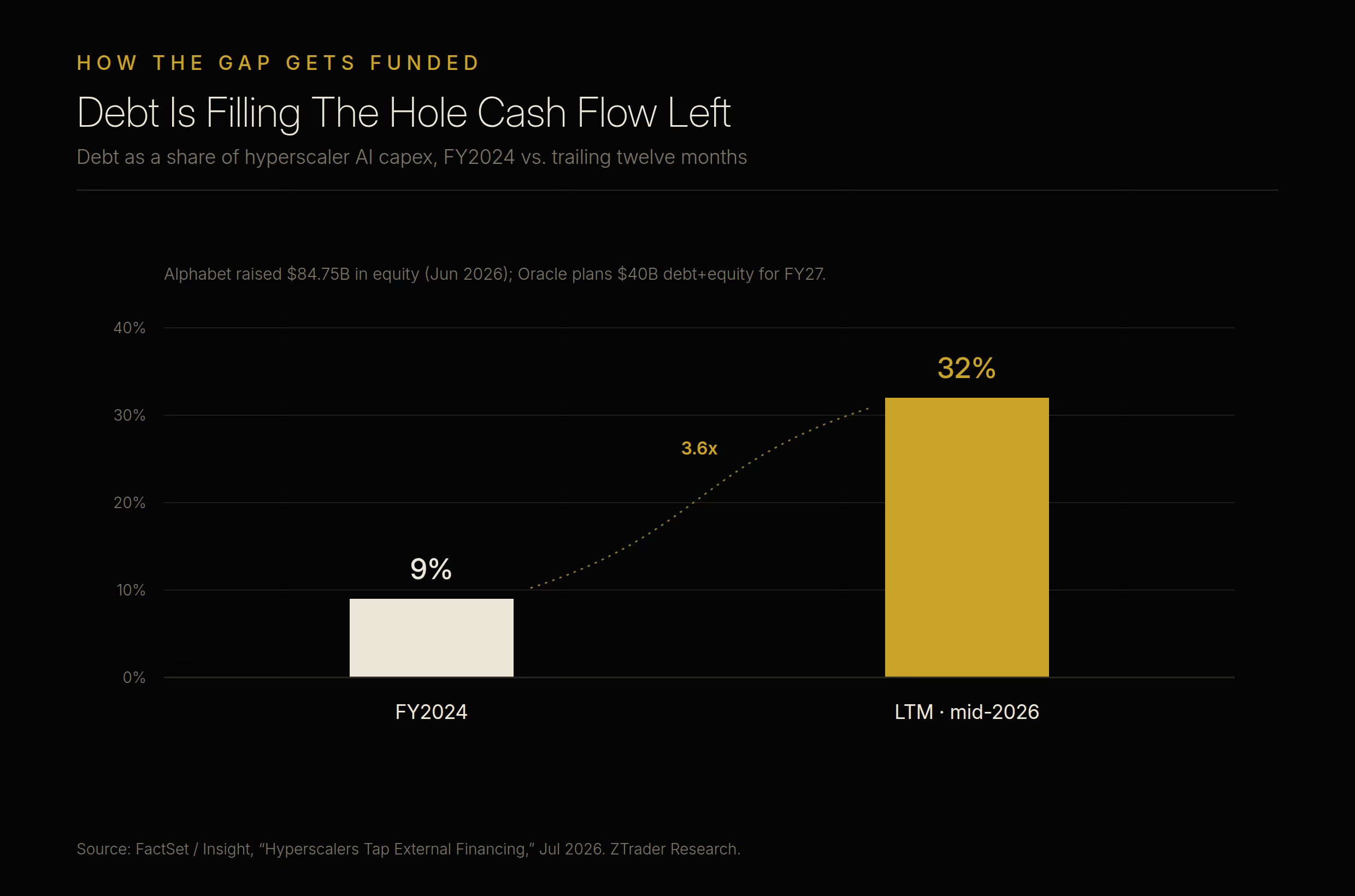
It’s coming from debt and diluted equity — at a pace that didn’t exist two years ago.
Debt financed roughly 9% of hyperscaler Capex in FY2024.
Over the trailing twelve months to mid-2026, that share has risen to 32% — a 3.6x jump. Alphabet priced an $84.75 billion equity raise in June 2026.
Oracle is planning $40 billion in combined debt and equity for FY2027.
With cash burn at this monstrosity level, any serious investor should ask a very serious question:
HOW LONG WILL IT LASTS?
[CHART 3 — chart3_financing_shift.png]
This is what “capex increasingly straining for returns” looks like in practice, not in theory:
the companies spending the money have quietly moved from self-funding the AI buildout to financing an increasing share of it externally, because operating cash can no longer cover it alone.
That’s not a sign of confidence being rewarded BUT THE SIGN of a funding model reaching its limit.
WHY NVIDIA’S PRINT DOESN’T REALLY MATTER?
Nvidia’s quarter was strong by any measure — revenue up 106% year over year, guidance pointing to roughly 70% growth into FY2028.
We can clearly identify the pivot pattern:
The rocket is still shooting up, but this could be its final burn.
If we look from the capital burn side:
The hyperscalers are burning cash faster than they generate it, patching the hole with debt and dilution.
