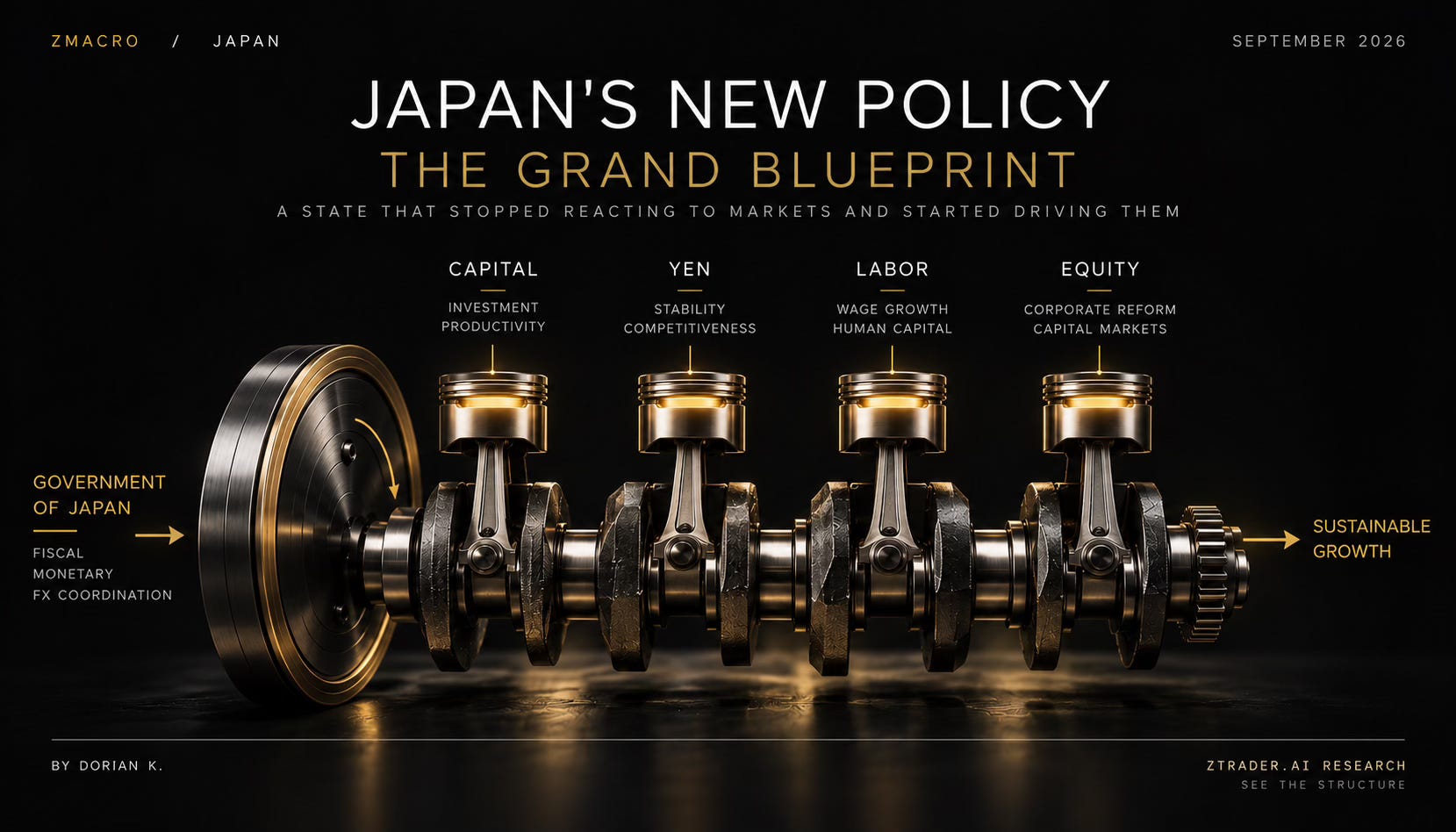
Japan is shifting from reacting to markets to actively driving them.
Takaichi’s framework is designed to restart an economic engine weakened by decades of underinvestment, with coordinated government policy providing the initial force and Capital, Yen, Labor, and Equity acting as four interconnected pistons.
Strategic public investment crowds in private capital; capital raises productivity and corporate returns; productivity feeds into wages and household income; stronger demand lifts earnings; and those earnings are recycled into investment, R&D, human capital, and shareholder returns.
The yen moves with the same engine, as Japan gradually shifts away from a model built on ultra-cheap funding and persistent currency weakness toward one supported by investment, productivity, and higher-value growth.
Investment → productivity → wages → consumption → earnings → reinvestment → growth.
Once the cycle begins feeding itself, a larger economy expands the tax base and improves debt sustainability. The objective is not simply to inject more money into Japan, but to restart the transmission mechanism and keep the flywheel turning.
Japan is not simply trying to reflate its economy,it has enough inflation already.
The truth is, Japan is trying to reposition/rebrand/reboost its economy.
Japan is now trying to redesign the mechanism through which capital moves across the entire economy by RECREATING THE POSITIVE CAPITAL SELF-REINFORCING LOOP.
For most of the post-bubble era, Japan never suffered from a shortage of money/liquidity.
Japan’s economy suffered from a shortage of productive uses for that money(the money circulation has stopped and almost like dead money).
Since the entire economy has less spending, the Household savings in the system accumulated, corporate balance sheets became increasingly conservative, banks sat on deposits and institutional investors sent enormous amounts of capital overseas.
The Bank of Japan eventually pushed interest rates below zero, yet even free money could not fully revive domestic capital formation.
That produced a strange equilibrium: Japan became one of the richest societies in the world in accumulated financial capital while simultaneously behaving as if capital itself were scarce.
The problem was the MONEY CIRCULATION.
The old Japanese capital machine can therefore be simplified into a closed loop:
[CHART 1 — The Old Loop: Savings → Cash → Low Investment → Low Wages → More Savings]
Japan is not having a poor problem.
Japan has a “DEAD MONEY PROBLEM”
Prime Minister Sanae Takaichi’s economic program should be understood against this background. Her government is not merely trying to increase fiscal spending or revive Abenomics under another name. It is attempting to use the state to change where Japanese capital goes, while the Bank of Japan simultaneously restores a positive price to that capital.
That combination looks contradictory from the surface.
It may actually be the central design.
The state puts capital to work.
The BOJ puts a price on capital.
The success of the entire experiment can then be reduced to one inequality:
PRODUCTIVITY > COST OF CAPITAL
JAPAN’S CURE: PHYSICAL AI?
Takaichi gave perhaps the clearest description of the government’s diagnosis on June 24.
The problem is that government is not taking the lead, and obviously not doing enough.
Japan’s technological capabilities and labor efficiency, she argued, are not fundamentally inferior to those of other advanced economies.
What Japan lacks is sufficient domestic investment since the Japanese Government was not managing economy actively but more in a pro-active fashion.
That distinction matters because it changes the Japanese economy policy prescription.
If the problem were simply weak aggregate demand, the solution would be conventional fiscal stimulus. Government could spend more, households could consume more and the resulting demand might temporarily lift nominal GDP.
If the problem is insufficient capital formation, however, temporary demand stimulus does not solve it. Japan needs companies to make investment decisions today whose returns may not appear for five, ten or fifteen years.
That requires a completely different fiscal architecture.
The government therefore selected 17 strategic sectors and narrowed them further into 62 major products and technologies where it believes Japan possesses either a strategic necessity or a credible competitive advantage.
The government estimates that cumulative public-private investment associated with these areas could exceed ¥370 trillion by FY2040 (Bloomberg reports the period as 14 years through March 2041; Mainichi frames it as by fiscal 2040 — same target, two conventions).
The important number is not really ¥370 trillion.
The important word is public-private. Government’s own contribution runs a little less than half of the total if inflation stays in line with expectations — the rest is meant to be pulled, not spent.
This is not a ¥370 trillion government spending plan. It is an attempt to use public policy as catalytic capital so that a much larger pool of private capital moves with it.
That makes Takaichi’s framework closer to an Investment State than a conventional stimulus state.
Government does not need to own the semiconductor fab, the robot manufacturer or the shipyard. What it can do is reduce the uncertainty surrounding whether those investments should be made in Japan in the first place.
That distinction sits at the center of the entire strategy.
THE ¥370 TRILLION BUDGET
The ¥370 trillion headline becomes more interesting once we examine how the government intends to create it.
Tokyo has mapped out multi-year action plans for the 62 technologies roadmap.
[CHART 2 — Where the Money Concentrates]
Japan has decided to ALL IN with Physical AI.
Japan has advantage with the physical & industrial part, and physical AI is the sector which can combine the Japan’s industrial power and edge.
Physical AI (¥10.5tn) + Semiconductors (¥68tn) = ¥78.5tn of the ¥370tn Total.
Contrast to show: how lopsided the allocation is toward one theme versus the other 15 sectors combined — not a bar chart, a proportion view.
Note on sourcing: Bloomberg cites ¥101.6 trillion for a broader “AI and chips” category that also folds in vertical AI and self-driving allocations. The ¥78.5 trillion figure here is the narrower physical-AI-plus-semiconductor line item from the government’s own June 24 release — the more conservative and more precisely sourced number.
Physical AI provides the clearest example of the logic.
Japan is unlikely to dominate the global market for general-purpose language models. The United States already possesses extraordinary advantages in compute, software ecosystems, frontier models and venture financing.
But the AI competition changes once intelligence leaves the browser and enters physical machinery.
Japan already has deep capabilities in industrial robotics, factory automation, precision machinery, automotive systems and advanced manufacturing. More importantly, Japanese industry possesses enormous amounts of real-world operational data generated inside factories, warehouses and other physical systems.
Takaichi’s government explicitly sees this as an opportunity. Japan does not necessarily need to win the model. It needs to own enough of the physical system that the model controls.
This is industrial policy built around comparative advantage rather than technological fashion.
The same logic runs through the rest of the strategy. Shipbuilding matters because Japan still possesses engineering capability and because maritime capacity has become strategically important again. Advanced materials matter because they sit upstream of multiple global supply chains. Defense and aerospace matter because economic security is increasingly inseparable from industrial capacity. Energy technologies matter because Japan remains structurally vulnerable to imported energy.
The 17 sectors are therefore better understood as a map of the capabilities Tokyo believes Japan cannot afford to lose — not simply a list of industries expected to grow quickly.
JAPANESE GOVERNMENT TRIES TO TAKE THE LEAD
One of the most important parts of Takaichinomics has received far less attention than the ¥370 trillion headline: the government wants to change the way Japan writes budgets.
Private investment depends on expected future returns.
Expected future returns depend partly on whether companies believe government policy will remain stable long enough for an investment to pay back.
For instance, all projects need to be long-term oriented especially in the industry like semiconductor.
Therefore THE JAPAN Government should play the KEY ROLE:
SETTING UP A LONG TERM TASK/PROJECT AND CAN BE EXECUTED SWIFTLY WITHOUT CONSTANT INTERRUPTION & DISTRACTION.
And this is precisely WHY Takaichi believes that Japan government should take the lead, not layback and wait.
Takaichi therefore wants policies that require continuing support to be incorporated more consistently into initial budgets rather than repeatedly relying on supplementary budgets.
The government is effectively trying to increase policy duration. That changes the investment equation because uncertainty itself is a cost of capital.
If a company believes that tax treatment, infrastructure support, procurement policy and strategic priorities will remain broadly consistent for several years, the expected risk-adjusted return on domestic investment rises even before the government spends another yen.
The fiscal state is therefore not simply spending capital. It is trying to alter the probability distribution around private investment returns — which is much closer to capital allocation than conventional stimulus.
THIS IS NOT THATCHERISM
There is something Thatcherite about the scale of the structural ambition, but the mechanism is almost the reverse.
Thatcherism attempted to move capital allocation away from the state and toward markets. Takaichinomics deliberately puts the state back into the capital allocation process — while ownership largely remains private, and the companies receiving support are still expected to produce commercial returns.
The better description is:
State direction + private ownership + market return discipline.
There are obvious historical echoes of Japan’s old developmental state, particularly the coordination role once associated with MITI. But the modern version operates inside a much more financialized economy where shareholder returns, global capital markets and corporate governance matter far more than they did during Japan’s postwar industrialization.
Takaichi is not trying to restore 1960s Japan. She is trying to rebuild the coordination capacity of the old Japanese state without abandoning modern capital-market discipline.
Takaichi’s government has explicitly said the Growth Strategy should not become a subsidy for large corporations.
Japan’s growth strategy should focus primarily on rebuilding and strengthen its industrial capabilities.
Its Regional Future Strategy instead uses major investments as anchors around which broader industrial clusters can form.
If the strategy works, the investment cycle will not remain confined to companies directly receiving industrial support. It should gradually transmit into regional banking, construction, logistics, industrial property and local labor markets. The multiplier does not come merely from government spending. It comes from clustering.
INFLATION IS NOT THE PROBLEM
DEAD MONEY IS THE PROBLEM
For decades, holding cash in Japan was even encouraged following its macro environment.
Yen is constantly lower and the FX volatility plus tax ate up almost all of the asset value growth.
In this environment, you are not encouraged to hold assets since there is very little growth, therefore most of asset holders are literally choosing between holding cash or buying US/ foreign equities for the upside.
When inflation is approximately zero, the real purchasing power of cash changes very slowly, and the opportunity cost of refusing to invest is low.
Persistent inflation changes this market equilibrium.
Once prices begin rising faster than the return available on cash, liquidity stops being economically neutral. Capital must start searching for somewhere else to go.
But inflation alone does not automatically creates the positive loop and productive investment. The real cost is NOT DOING ANYTHING WITH THE ‘DEAD MONEY’
Capital can respond by flowing into property, foreign assets or other stores of value without increasing domestic productive capacity at all.
The purpose of Takaichi’s Investment State is to intervene between the moment cash becomes less attractive and the moment capital chooses its destination:
[CHART 3 — Transmission Chain]
Inflation → Cash Loses Real Value → Capital Seeks Returns → State-Led Capital Allocation → Productive Investment. Contrast to show: where the state inserts itself between two market-driven steps.
Inflation creates pressure to move. Industrial policy tries to determine the direction.
THEN THE BOJ RAISES RATES
At first glance, this RATE HIKE MOVE appears insane.
The government wants hundreds of trillions of yen of new investment while the central bank is simultaneously making capital more expensive.
But Japan has already conducted the opposite experiment.
For years, the cost of capital was approximately zero, and productive investment did not explode. Extremely cheap money allowed companies to remain conservative without paying much of a penalty for holding cash, allowed weak businesses to survive longer, and turned the yen into one of the world’s dominant funding currencies.
The lesson: cheap capital is not the same thing as productive capital.
Positive interest rates introduce a hurdle rate back into the economy. A company considering a new project must increasingly ask whether its expected return exceeds its financing cost.
The BOJ does not necessarily contradict the Investment State. It potentially supplies the mechanism that prevents the Investment State from degenerating into indiscriminate cheap-money spending.
The state puts capital to work. The BOJ puts a price on capital. Japan is trying to increase the return generated by domestic investment while simultaneously increasing the minimum return required to justify that investment. That is a much narrower path than Abenomics had to walk.
THE THIRD LEVER NOBODY IS PRICING:
JAPAN STOPPED BEING PASSIVE
The convergence of global inflation trends and structural shifts in Japan has given economic policymakers—most notably under Prime Minister Sanae Takaichi’s administration—a unique and complex policy landscape.
Using the return of positive nominal growth, the government has attempted a delicate balancing act between two powerful, seemingly contradictory forces:
aggressive fiscal expansion and monetary rate normalization.
The legacy of a deflationary Japan is shifting as global inflation trends since 2020 inject a vital, positive nominal input back into the domestic economy.
Seizing this momentum, Sanae Takaichi’s administration has uniquely found the policy space to deploy two powerful, conflicting forces simultaneously: aggressive fiscal expansion at all costs, and relentless monetary rate normalization.
On the fiscal front, rejecting decades of self-defeating austerity, the government leans heavily into large-scale budgets, structural investments in AI, semiconductors, and economic security, alongside targeted household relief. The theoretical safety net here relies on Domar-type debt dynamics: backed by mild inflation and rising nominal GDP, the country’s astronomical debt-to-GDP ratio can be suppressed, provided nominal growth outpaces interest rates.
Simultaneously, the administration supports the Bank of Japan’s departure from radical easing, pushing forward with rate hikes and normalization.
This is non-negotiable to arrest severe currency depreciation, combat imported cost-push inflation, and restore rational risk pricing across Japanese capital markets.
Yet, running these dual engines creates a high-stakes structural tension. Fiscal expansion injects liquidity and stokes domestic demand, inadvertently fanning the flames of the exact inflation the BOJ is trying to manage.
Conversely, rate normalization spikes corporate borrowing costs and drastically increases the Japanese government’s debt-servicing burden on its massive sovereign debt. If long-term yields outpace nominal growth, the mathematical safety net dissolves—triggering a dangerous feedback loop of runaway borrowing costs and acute fiscal strain.
However, the core question to this revolution is:
How do you view this tightrope walk between growth-spurring fiscal stimulus and monetary tightening—can Japan successfully normalize its interest rates without destabilizing its public debt?
Fiscal expansion and monetary normalization are the two mechanisms everyone is watching.
There is a third one, and it is arguably the most radical of the three because it breaks with forty years of Japanese doctrine: the state has stopped treating the yen as something that merely happens to it.
The old playbook was passive by design. The BOJ set a policy rate, the yen moved wherever global rate differentials pushed it, and the Ministry of Finance issued verbal warnings that markets learned to ignore. A weak yen was tolerated, then quietly welcomed, because it subsidized exporters and helped manufacture the inflation Japan spent three decades trying to import. Intervention, when it happened at all, was rare, secret, and reactive — a circuit breaker, not a policy tool.
The truth is: that old model is gone.
In April and May 2026, Japanese authorities deployed a record ¥11.73 trillion to buy yen and sell dollars — the largest intervention on record, and the first since July 2024. What made it different from every prior episode was not just the size. It was the posture.
Officials confirmed the intervention publicly instead of letting markets infer it from BOJ account data days later, breaking with the deliberate ambiguity that had defined Japanese FX policy for decades. Finance Minister Satsuki Katayama moved from “monitoring with a sense of urgency” to “the time is finally approaching when we must take decisive action” within the same week. Vice Minister Atsushi Mimura told reporters flatly that there are no rules limiting how many times Tokyo can intervene — and then proved it by striking again during the Golden Week holiday period, when thin liquidity maximizes the impact of every yen spent. Authorities intervened at least twice in a matter of days, openly hunting the moments when speculative positioning was most exposed.
This is active management, not playing defense.
The distinction matters because it changes what the yen is for.
[TABLE 3 — Old Regime vs. New Regime]
Notice what this does to the yen’s old job.
For three decades, Japan was the world’s preferred funding currency precisely because its price was predictable and its downside was tolerated. Borrow yen cheap, buy anything that yields more, repeat — a trade large enough that analysts have called it a $20 trillion position spanning global asset markets. That trade needed one thing above all else: a Bank of Japan and a Ministry of Finance that would not fight the trend.
Takaichi’s government is now fighting the trend on three fronts simultaneously — fiscal expansion that pulls capital toward domestic investment, BOJ normalization that raises the cost of borrowing yen to fund the trade, and FX intervention that punishes speculative positioning directly rather than issuing warnings. Each front reinforces the others. A weaker yen used to be the release valve that made all three politically survivable at once. That valve has been deliberately shut.
This is also where the definition of “strong yen” and “weak yen” stops being a simple binary. Under the old regime, weak was good for exporters and bad for households, and policy defaulted to weak because exporters had the louder lobby. Under the new regime, the yen’s level is judged against whether it supports or undermines the productivity transition — a stronger yen that lowers imported energy costs and protects real wages can be the correct outcome even though it was unthinkable under Abenomics.
None of this is low-risk. Actively managing a currency while simultaneously running an expansionary fiscal program and tightening monetary policy is a materially harder policy problem than doing any one of those things in isolation — each lever can offset the others if timed wrong, and a sitting prime minister rarely gets credit for a currency that behaves; she gets blamed the moment it doesn’t. Takaichi is betting that Japan can hold all three levers at once without one of them snapping. That is the paradigm shift underneath the ¥370 trillion headline: Japan moving from a state that adapted to whatever the market and the BOJ produced, to a state that is trying to set the terms on capital, currency, and labor all at once. It is also why this is the single riskiest bet of her premiership — there is no historical precedent for a G7 economy running this combination of levers simultaneously and getting all three right.
THE REAL CONFLICT IS TIMING
The fiscal and monetary policies are not inherently contradictory. The problem is that they operate at completely different speeds.
Bond markets can reprice within minutes.
Productivity can take years.
That timing mismatch is where the real danger begins. Japan’s 10-year government bond yield closed a September 1 auction at a weighted average of 2.995% — its highest level since 1997. At the same time, the government’s FY2027 budget requests are set to exceed ¥143 trillion, a fourth consecutive record, while requested debt-servicing costs have risen to a record ¥36.64 trillion — up ¥5.36 trillion from the FY2026 initial budget.
[TABLE 1 — Japan’s Debt-Service Escalation]
This is no longer an abstract debate about whether Japan might eventually experience higher funding costs. It is happening.
The government’s investment strategy requires fiscal capacity today in exchange for productivity that may only become visible years from now. The bond market does not have to wait for that productivity. It can demand a higher yield immediately.
That creates the central race inside Takaichinomics:
can productive capacity rise before the cost of financing the transition consumes the fiscal space required to build it?
THEREFORE, THE UNDERLYING MATH IS
Not fiscal easing versus monetary tightening.
ITS :
Time COST versus SUNK cost.
WHY THE JGB MARKET MAY MATTER MORE THAN USDJPY
The yen naturally attracts attention because it moves quickly and because Japan’s extraordinary monetary regime made USDJPY one of the cleanest expressions of the global carry trade.
But the long end of the JGB curve may now tell us more about the success of the Japanese regime change.
The BOJ directly controls the short policy rate. It does not completely control the term premium unless it is willing to return to aggressive intervention in the bond market.
The government can issue debt to finance strategic investment, but investors determine the yield required to hold that debt. If they begin demanding additional compensation for inflation or fiscal risk, the government’s average funding cost gradually rises as old low-coupon bonds mature and are refinanced.
This process does not need to produce a dramatic fiscal crisis. It can work much more slowly: debt service takes a larger share of the budget each year, strategic spending competes with interest expenditure, and the government either reduces other spending, raises revenue or issues additional debt.
The institution trying to mobilize Japanese capital is also one of the world’s largest borrowers of that capital. The JGB market determines how expensive that contradiction becomes.
JAPAN’S CAPITAL MAY START COMING HOME
For decades, Japanese institutional investors faced an obvious problem: domestic bonds offered almost no return. That pushed enormous pools of Japanese capital overseas, and Japan became the largest foreign holder of U.S. Treasuries.
At a 3% 10-year JGB yield, the calculation begins to change. Foreign bonds may still offer higher headline yields, but Japanese investors must account for currency hedging costs and the additional risk of holding foreign assets.
As domestic yields become competitive again, part of the capital previously exported from Japan can rationally return home.
Japan does not necessarily need to create all of the capital required for domestic investment. Some of that capital already exists — it is simply invested somewhere else.
For thirty years, Japan exported capital because domestic capital had almost no price.
Now domestic capital has a price again.
That could eventually change global capital flows.
THE YEN IS ALSO ENTERING A DIFFERENT REGIME
Abenomics benefited enormously from currency depreciation because Japan was trying to escape deflation. The weaker yen lifted import prices, raised exporter profits and helped generate inflation expectations.
But the same mechanism becomes increasingly destructive once inflation is established.
Weaker yen continue to raise the domestic cost of imported energy and food, compresses household purchasing power, and makes nominal wage increases less meaningful in real terms.
At that point, yen weakness stops being useful to economy, it then fuels the reflation and becomes a tax on domestic demand.
This is why Takaichinomics does not require the permanently weak yen associated with the later Abenomics regime. Japan now needs investment returns to come increasingly from productivity rather than currency depreciation.
Japan is effectively trying to move from a cheap-yen competitiveness model toward a productivity competitiveness model. That distinction may become one of the defining macro transitions of the next decade.
THE ¥1.1 QUADRILLION GDP TARGET
Takaichi’s fiscal framework makes little sense if viewed purely through the size of government debt. Japan is not realistically going to solve its debt burden through conventional repayment. The strategy instead depends on expanding the denominator.
The government’s medium-term projections envisage nominal GDP approaching ¥1.1 quadrillion around FY2040 while placing the debt-to-GDP ratio on a declining trajectory.
Japan wants nominal GDP to grow faster than its debt burden. More precisely, the long-term arithmetic becomes manageable when nominal economic growth persistently exceeds the average effective cost at which the government funds itself.
This is why productive investment matters so much more than simple spending. Government consumption can raise GDP today. Productive capital formation can raise the economy’s capacity to generate GDP tomorrow.
The state is using its balance sheet to make a wager on its future denominator. That is a perfectly coherent strategy — and a dangerous one if the investment fails to produce the expected return.
THE ENTIRE EXPERIMENT COMES DOWN TO THREE RELATIONSHIPS
[TABLE 2 — The Three-Condition Test]
If a relatively small amount of fiscal support changes enough risk-adjusted returns to generate multiples of private investment, the Investment State has worked.
If government money merely replaces investment that companies would have made anyway, or sustains projects that cannot earn an adequate return without permanent subsidies, the apparent investment boom will eventually become another fiscal liability.
There is no clever accounting trick around this. The capital eventually has to earn something.
“JAPAN STOCKS ARE CHEAP?”
The structural Japan bull case is usually presented badly:
Japanese equities are cheap, corporate governance is improving, tourism is booming, the yen will recover. Those observations can all matter, but none captures the scale of the regime change.
The deeper bull case is that Japan finally succeeds in restarting domestic capital circulation.
Existing savings begin moving toward productive assets.
Companies increase domestic capex because expected returns improve.
Productivity allows wages to rise without simply destroying margins.
Higher household income supports domestic demand, while stronger corporate returns create additional capital for reinvestment.
Positive interest rates then stop being a threat and become evidence that the economy can finally tolerate a normal price of money.
If that cycle becomes self-sustaining, Japan no longer needs permanent monetary emergency settings to manufacture nominal growth. Japan would not simply become more expensive. It would become worth more.
THE BEAR CASE IS A FISCAL TRAP
The failure scenario begins when the order of operations reverses. Government spending appears immediately, but productive capacity does not. Inflation remains sticky enough to keep the BOJ tightening. JGB yields continue rising, which pushes debt-service costs higher just as the government needs fiscal room to maintain its investment commitments.
Private companies then face a higher hurdle rate before the government’s industrial strategy has materially improved their expected returns. At that point the Investment State begins crowding out the investment it was designed to create.
The government can respond by borrowing more, but additional issuance can place further pressure on yields. It can pressure the BOJ to slow normalization, but that risks weakening the yen and reigniting imported inflation. This is where fiscal activism can mutate into fiscal dominance — trapped between supporting the bond market, supporting the currency and supporting growth.
Every increase in long-term yields is the market raising the hurdle rate the strategy must clear.
HOW JAPAN IS REPRICING ITSELF
Japan spent decades suppressing several of the most important prices in its economy. The price of capital was pushed toward zero. Labor became accustomed to stagnant nominal wages. The yen became a global funding currency whose weakness was repeatedly tolerated because it helped reflation. Japanese companies accumulated cash while equity markets accepted unusually low returns on capital.
Those outcomes were not independent.
They belonged to the same economic regime.
That regime is now changing. Positive rates are repricing capital. A sustained wage cycle is repricing labor. BOJ normalization and official resistance to excessive depreciation are beginning to reprice the yen. Corporate governance reform and the demand for higher domestic investment are repricing equity.
Japan is not merely repricing four assets.
It is redesigning the mechanism that determines those prices — and doing so by choice rather than by drift. That is the difference between this cycle and every reflation attempt since the bubble burst: Japan stopped waiting for the market and the BOJ to decide its fate and started setting terms on capital, currency, and labor directly. A passive state produced three decades of stagnation. An active one is now the wager.
For decades, investors learned one Japanese macro playbook: the BOJ would remain exceptionally loose, the yen would remain a cheap funding currency, Japanese capital would search overseas for returns and the government would intervene only when the resulting distortions became extreme. That predictability itself became an asset.
Now almost every part of that reaction function is moving.
JAPAN’S INVESTMENT STATE
The most useful way to understand Takaichinomics is therefore not as fiscal stimulus and not as Abenomics 2.0.
Japan is attempting to move from a system designed to preserve accumulated capital toward one designed to circulate it. Inflation creates pressure on idle cash to seek a return. The state attempts to improve the expected return available from strategic domestic investment. Private companies remain responsible for turning those investments into profitable businesses. The BOJ restores a positive hurdle rate so that capital is forced to discriminate between productive and unproductive uses.
This explains why fiscal expansion and monetary tightening can coexist. They are not trying to accomplish the same thing. The fiscal state is trying to raise the return on capital. The central bank is raising the price required to access capital. The conflict appears only when the second rises faster than the first.
That leaves Japan with a remarkably clean macro test:
PRODUCTIVITY > COST OF CAPITAL
Everything else eventually feeds into that inequality. The ¥370 trillion public-private investment ambition matters only if it raises productive capacity. The 17 strategic sectors matter only if Japan develops businesses capable of generating adequate returns. Regional industrial policy matters only if clustering creates genuine productivity rather than geographically distributed subsidies. BOJ normalization works only if companies can clear the higher hurdle rate. Fiscal expansion remains credible only if the resulting nominal growth eventually outruns the government’s rising funding cost.
Japan spent thirty years making itself cheap because cheapness was one way to survive a post-bubble economy that had forgotten how to grow. Cheap money protected balance sheets. A cheap yen supported exporters. Cheap equity reflected weak expectations for domestic returns. Weak wage growth helped companies preserve margins in an economy with little nominal growth.
That system was remarkably stable. It was also remarkably stagnant.
Takaichi is now making a very different wager:
Japan does not need to remain cheap if Japanese capital can become productive enough to justify a higher price.
That is why the most important question for Japan over the next decade is not whether the BOJ hikes another 25 basis points, whether USDJPY trades at 150 or 160, or whether the government spends another ¥10 trillion. Those are expressions of the transition.
The actual question is whether Japan can raise the return on its domestic capital faster than the price of that capital rises.


