

By Dorian
Every capital-spending boom gets paid for twice, first by the companies that build and then by the shareholders who wait for the return.
In October 2026, the shareholders started asking how long that wait would be.
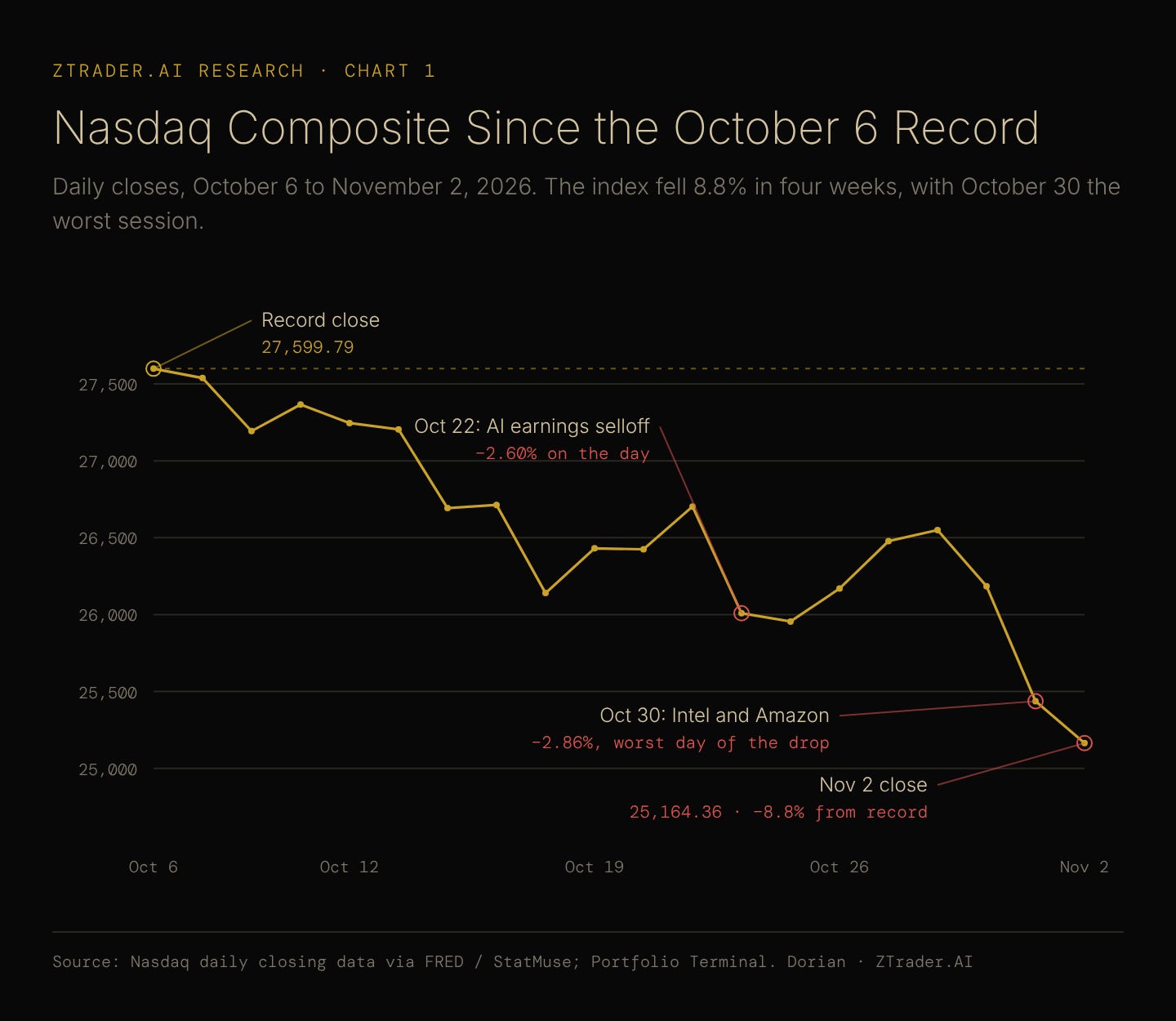
The Nasdaq Composite closed at a record 27,599.89 on October 6, and by November 2 it had fallen to 25,164.36, a decline of about 8.8%, while the S&P 500 finished that day 3.55% below its own October 6 record.
The heaviest blow landed on Friday, October 30, when Intel suffered the worst one-day drop in its history and the Nasdaq-100 headed for a monthly loss of more than $2 trillion in market value.
For anyone holding semiconductors or megacap tech, the question behind the headlines is practical:
is this the AI bubble bursting, or is it a repricing of how the buildout gets financed?
The answer decides whether you treat this drawdown as the start of something structural, or as a reset that separates the companies turning AI spending into cash from the companies burning cash to keep up.
[CHART 1 — Nasdaq Composite, October 6 to November 2, 2026]
I. THE FRIDAY AFTER INTEL AND AMAZON REPORTED
The selloff began in mid-October, but October 30 is the day investor concern about AI spending stopped being abstract and showed up in two specific sets of numbers. Both sets of numbers come back to the same two terms, so they are worth defining first.
Capital expenditure, or capex, is the money a company spends on long-lived assets such as data centers, servers and chips.
Free cash flow is the cash a business has left from its operations after it pays for that capex.
Free cash flow tells you whether a company can fund its own buildout or has to borrow to do it, and it sits at the center of everything that happened in October.
Intel: The Cash Flow Warning
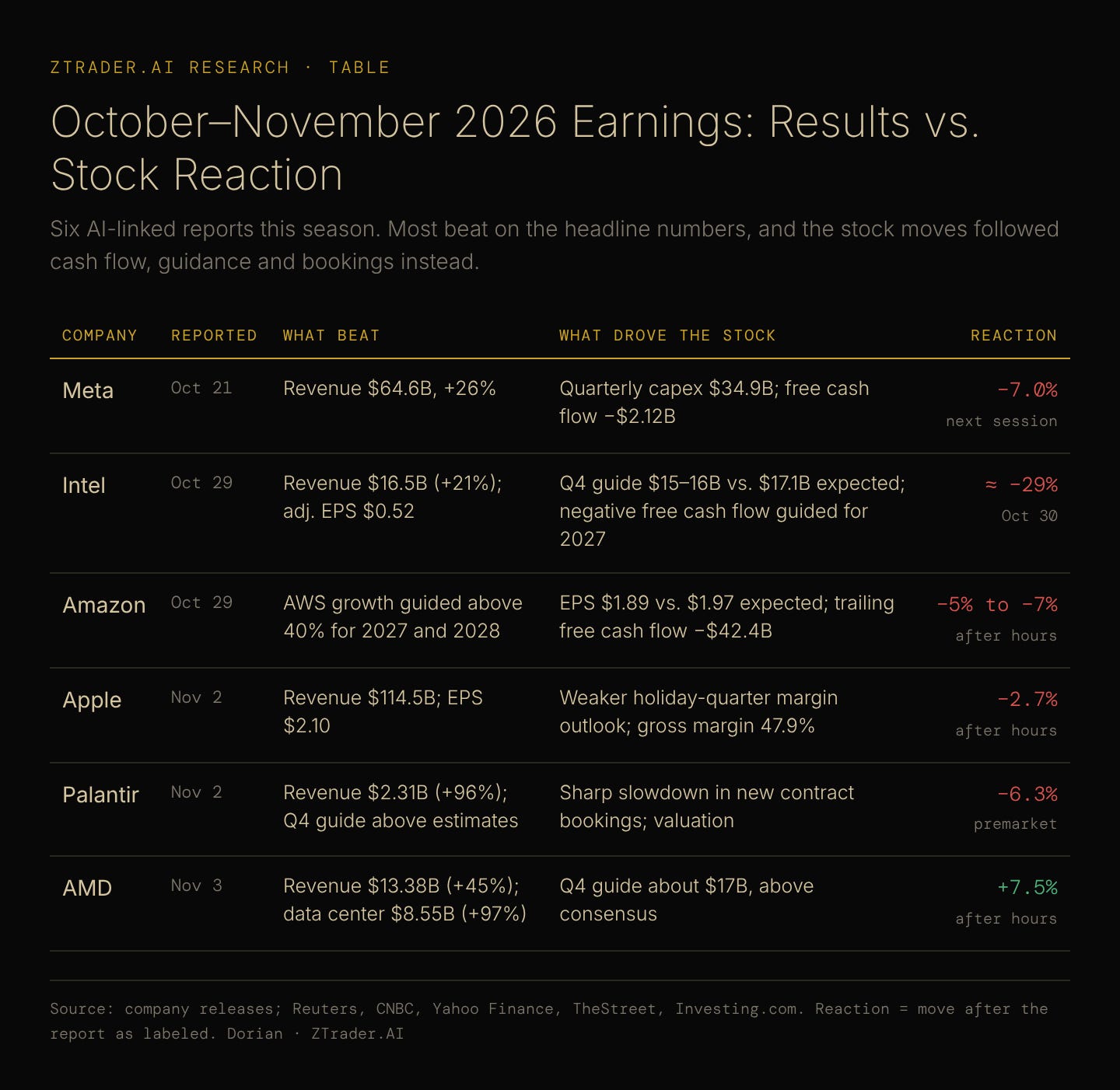
Intel beat its third-quarter estimates, with revenue up 21% to $16.5 billion and adjusted earnings of $0.52 per share, but the guidance that followed erased the beat. The company forecast fourth-quarter revenue of $15 billion to $16 billion against a consensus of about $17.1 billion, and adjusted EPS of $0.25 against roughly $0.43, with non-GAAP gross margin expected to fall to 38.0% from 44.1%.
Part of that weaker guide reflects the shutdown of its Kiryat Gat fab in Israel after an October 14 explosion, which Intel said would cost about $300 million in revenue.
The line that broke the stock came on the call, when CFO David Zinsner said there is “probably not a dynamic” in which Intel produces positive free cash flow in 2027, a year management has labeled an investment year as Intel 18A and Intel 3 ramp and preparation for Intel 14A begins.
Intel had already lifted its 2026 capex to about $20 billion, and Wall Street consensus does not see its free cash flow turning positive until 2028. The stock, which had more than doubled this year, fell nearly 29% on Friday.
Amazon: Spending Held, Cash Flow Gone
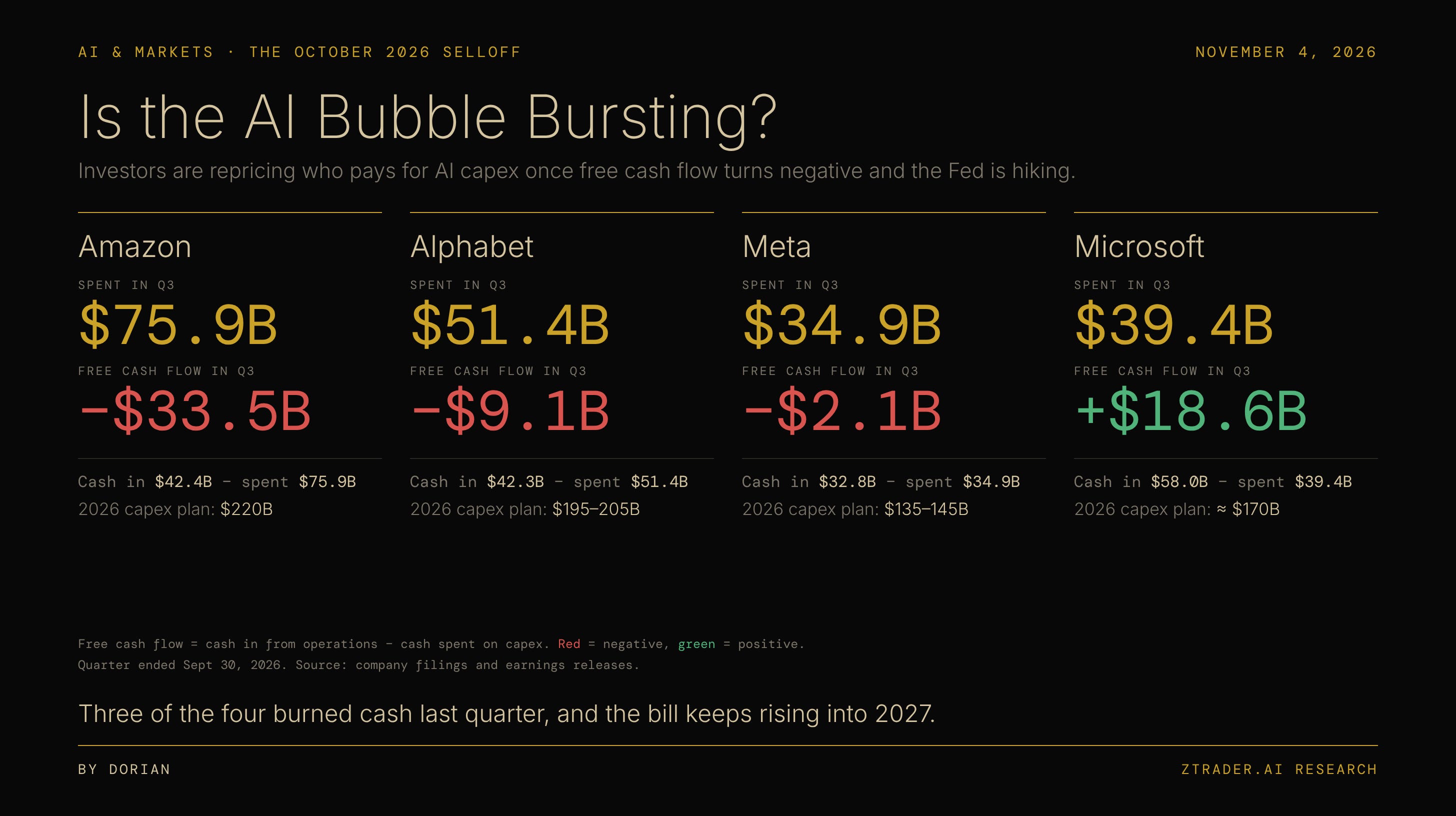
Amazon reported on October 29 with an earnings miss, EPS of $1.89 against $1.97 expected, yet the cash flow statement mattered far more than the earnings line. Capex reached $77.3 billion in the third quarter, up from $35.1 billion a year earlier, and trailing twelve-month free cash flow fell to negative $42.4 billion. Amazon held its 2026 cash capex guide at about $220 billion, and CEO Andy Jassy said the company expects to spend meaningfully more in 2027 without giving a figure. Jassy also projected AWS revenue growth of more than 40% in both 2027 and 2028, which is the revenue case for all that spending. Investors looked at the bill first, and the shares fell between 5% and 7% after hours.
Contagion: From Two Reports to the Whole Chip Complex
When the two reports landed together, the damage spread far beyond Intel and Amazon. On October 30 the Nasdaq Composite fell 2.48% to its lowest level in nearly three months, the broader chips index lost about 7%, AMD fell about 10% and Nvidia lost 3.7%, while server makers Dell and HP each dropped about 9%. None of those companies reported that day, so the selling targeted the funding model behind AI as a whole.
By the Friday close, the question had moved from how much AI demand exists to who can afford to keep paying for it.
II. WHAT THE HYPERSCALERS ARE SPENDING
To see why one Amazon number could hit the whole sector, you need the size of the combined budget that Amazon belongs to. Hyperscalers are the largest cloud operators, mainly Amazon, Microsoft, Alphabet and Meta, and their capex is the revenue line for almost every AI chip and server company you own.
Company Guidance: Where the 2026 Budgets Stand
The latest earnings week gave a fresh read on each company’s plan:
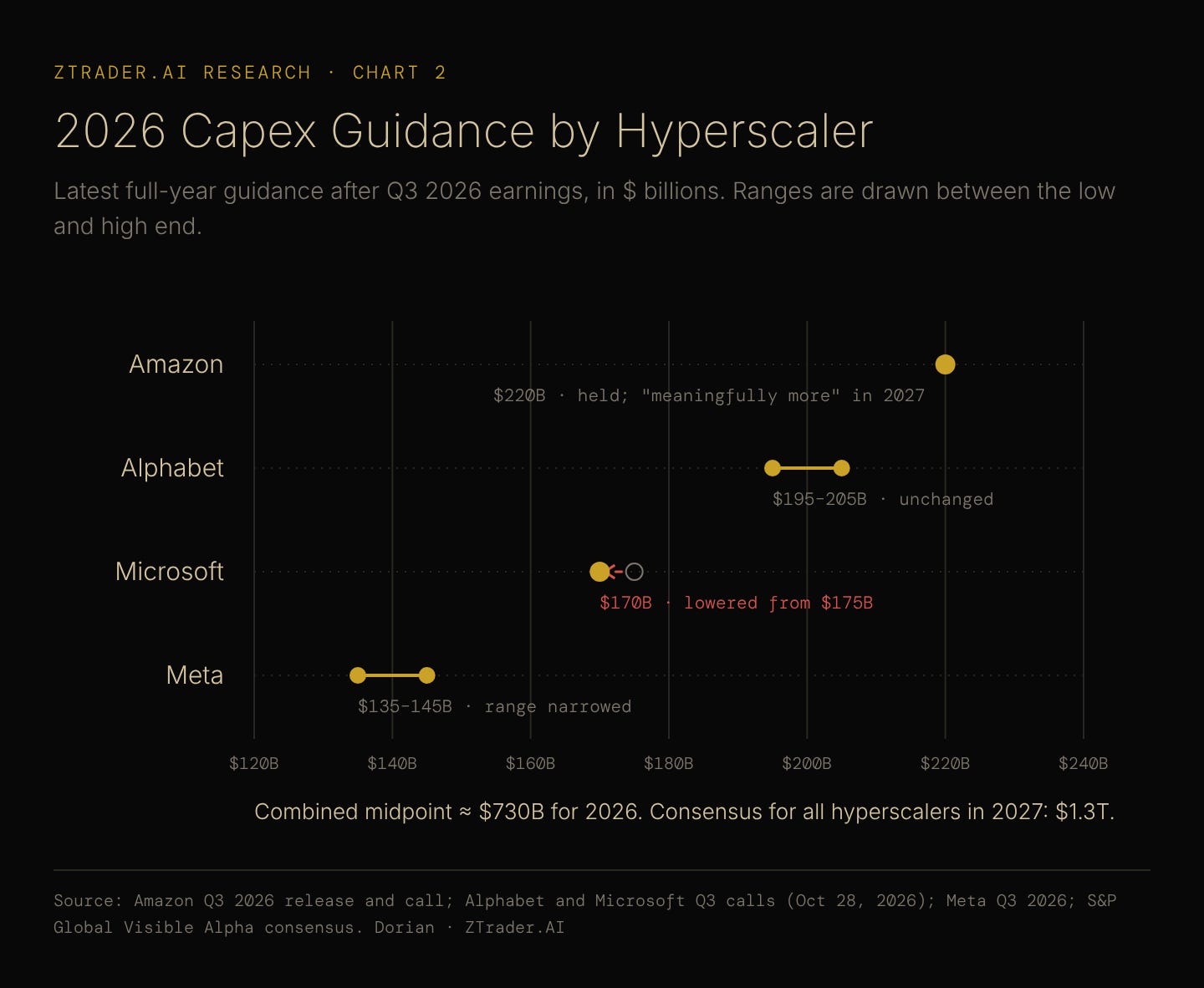
Amazon: Held 2026 cash capex at about $220 billion and guided to meaningfully more in 2027.
Alphabet: Kept its 2026 range at $195 billion to $205 billion and reported a Google Cloud backlog of $561 billion.
Microsoft: Lowered its 2026 capex forecast to $170 billion from $175 billion.
Meta: Narrowed its 2026 guide to $135 billion to $145 billion after quarterly capex of $34.9 billion and negative free cash flow of $2.12 billion, and the stock fell 9.4%.
Across the group, S&P Global’s Visible Alpha consensus has hyperscaler capex more than doubling to $762 billion in 2026 from $362 billion in 2025, then climbing to $1.3 trillion in 2027.
That puts total spending above $2 trillion in only two years, and the same consensus expects the spending to outpace revenue growth in the near term, which is exactly where free cash flow gets squeezed.
[CHART 2 — 2026 Capex Guidance: Amazon, Alphabet, Microsoft, Meta]
Investor Reaction: Palantir and Apple
This earnings season showed investors sorting companies by what they can show in return for the spending, and a headline beat no longer protected a stock.
Palantir grew revenue 96% to $2.31 billion and raised its outlook, yet the shares fell after the report because new contract bookings decelerated sharply and the valuation left no room for any slowdown.
Apple beat on revenue and earnings, then slid on a weaker margin outlook for the holiday quarter, with gross margin already down to 47.9% from 50.1% on rising component costs.
[TABLE — October–November 2026 Earnings: Results vs. Stock Reaction]
Through this earnings season, the stocks that held up were the ones whose cash generation kept pace with their spending.
III. FREE CASH FLOW AND WHERE IT WENT
Capex on its own would not have produced an 8.8% drawdown in the Nasdaq, because these companies have been raising capex for two years.
What changed in October is that the spending started to outrun the cash the spenders generate.
Same Squeeze, Different Balance Sheets
The pattern now runs across companies with very different businesses:
Amazon: Trailing twelve-month free cash flow of negative $42.4 billion, with 2027 capex set to rise further.
Meta: Negative free cash flow of $2.12 billion in the third quarter, without a cloud business to rent the capacity out directly.
Alphabet: Earlier this year reported its first negative quarterly free cash flow since going public, at negative $5.9 billion, as annual capex heads toward $205 billion.
Intel: Guided to negative free cash flow in 2027, with consensus pushing the turn back to positive into 2028.
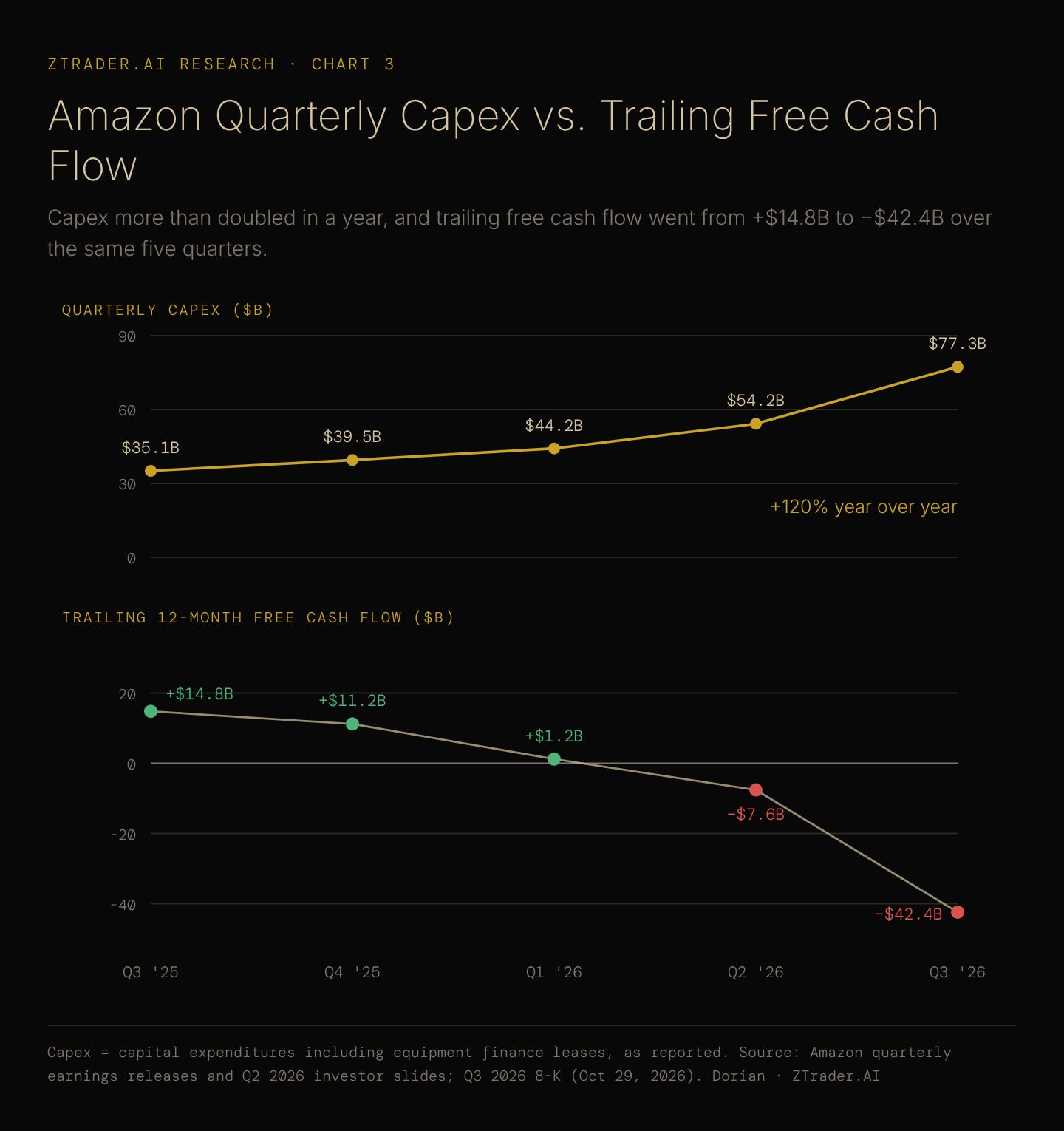
[CHART 3 — Amazon Quarterly Capex vs. Trailing Free Cash Flow]
Why Negative Cash Flow Changes the Funding Question
When free cash flow is positive, operations pay for the capex, and a slowdown in AI returns simply means smaller buybacks.
When free cash flow turns negative, the gap has to be filled from outside, through bond issuance, private credit, leases and joint ventures, so the cost of capital becomes part of the AI trade itself.
Amazon argues that AI chip servers typically break even in less than three years once deployed, and that payback period is the bet investors are now being asked to underwrite with borrowed money.
Once the buildout depends on outside funding, the price of that funding matters as much as the demand for AI.
IV. BORROWING FOR DATA CENTERS WHILE THE FED IS HIKING
Debt-financed buildouts are sensitive to the price of money, and the price of money went up this fall in both the policy rate and the credit spread.
The Fed: From Cutting to Hiking
The rate path that most AI financing plans were built on has reversed:
September 16 (Hike): The Fed raised rates by 25 basis points, its first hike since July 2023.
October 28 (Hold): The FOMC held the target range at 3.75% to 4.00% in a 10 to 2 vote, with Lisa Cook and Beth Hammack both preferring a quarter-point hike.
After the decision (December pricing): CME FedWatch priced an 85% chance of a 25 basis point hike at the December 8 to 9 meeting.
The link to AI stocks was explicit in the tape. The mid-October legs of the selloff came on concerns that higher rates could curb investment in AI infrastructure, and the Nasdaq 100 posted its worst week since the April 2025 tariff turmoil.
Credit Markets: Spreads and Data Center Debt
Credit default swaps, or CDS, are insurance-like contracts that pay out if a borrower defaults, so a wider CDS spread means protection costs more and lenders see more risk.
Goldman Sachs counted $489 billion of AI-related supply in global corporate bond and loan markets through late July, already well above its full-year 2025 estimate of $322 billion.
By early October, five-year CDS on hyperscaler debt were nearing their widest levels of the year, driven by the September rate hike and surging Treasury yields, and debt backing data centers was selling off in the secondary market. Oracle added to the stress when it sent a force majeure notice to the developer of a large New Mexico data center. Moody’s still describes credit metrics at most of these companies as very strong, but it also flags a material shift in the structure of their balance sheets.
The Treasury market shows why this goes beyond the level of rates.
On October 22 the 10-year yield fell about 0.19 percentage point to 4.953% as investors bought government bonds for safety, and the Nasdaq still fell 2.6% that day. Lower yields did not help, because the problem sits in the size of the funding need and the spread lenders now charge on top of Treasuries.
Collateral: What the GPUs Themselves Are Worth
Part of the financing behind the neoclouds, the smaller AI cloud providers such as CoreWeave and Nebius, is secured by the GPUs themselves. I covered how these GPU-backed loans are structured in an earlier piece, and the follow-up will look at what happens to recoveries when a tenant downgrade and a drop in GPU resale prices arrive together.
Higher policy rates, wider credit spreads and a bigger funding gap all point the same way: the cost of carrying the AI buildout went up in the same month that free cash flow went negative.
V. AMD’S QUARTER AND THE BUBBLE QUESTION
If AI demand were collapsing, AMD’s November 3 report would be one of the first places it showed up, because AMD sells directly into the hyperscaler budgets described above.
AMD on November 3: The Data Center Numbers
AMD reported third-quarter revenue of $13.38 billion, up 45% from a year earlier, with adjusted EPS of $2.09 against estimates near $1.94. Data center revenue nearly doubled to a record $8.55 billion, while client and gaming fell 8% to $3.7 billion. Guidance for the fourth quarter came in at about $17 billion, plus or minus 3%, above consensus, and CEO Lisa Su said she expects growth to accelerate further as Helios rack systems and Venice server chips scale. The stock rose 3.65% in the regular session to $483.90 and then about 7.5% after hours to roughly $520, after falling about 25% over the previous month. Neoclouds such as CoreWeave and Nebius also rallied.
Valuation: Nineteen Times Earnings
After the October decline, the S&P 500 trades at about 19 times expected earnings, its lowest valuation since 2023. The Nasdaq is about 8.8% below its record, which is a correction in progress and well short of the 20% decline that defines a bear market. Bubbles burst when demand disappears and the valuation collapses with it, and so far the demand data from AMD, AWS and Google Cloud points the other way.
The Calendar From Here
The next five weeks will test whether funding stress or demand wins out:
November 4 (Arm and Qualcomm earnings): The next read on chip demand outside the data center.
November 6 (October payrolls): The jobs report feeds directly into December hike odds.
December 8 to 9 (FOMC): Markets price an 85% chance of a hike, which would raise funding costs again for every debt-financed buildout.
The demand side of the AI trade passed its test on November 3, and the funding side faces its test in December.
VI. PUTTING THE CAUSES TOGETHER
The October selloff has four causes that feed into each other.
Hyperscaler capex is on track to more than double this year and reach $1.3 trillion in 2027.
That spending has already pushed free cash flow negative at Amazon and Meta, at Alphabet for at least one quarter, and at Intel for next year. Negative free cash flow forces the buildout onto bond markets and private credit just as CDS spreads widen.
And the Fed has turned from cutting to hiking, with a December hike priced at 85%. Demand has not broken, as AMD’s 97% data center growth and AWS’s guidance for more than 40% growth show. So the answer to the title question is no, at least on the evidence so far:
October repriced the cost of funding AI and the speed of turning it into cash, and the bubble label runs ahead of that evidence.
For positioning, this split favors the companies that receive the capex over the companies that borrow to spend it. Chip and server suppliers with accelerating data center revenue, like AMD this quarter, get paid in cash now, while the spenders carry the funding risk and the payback period.
The risk to that view is the December FOMC: a hike alongside wider hyperscaler CDS would test the suppliers too, because their revenue is the spenders’ capex.
Until then, watch free cash flow guidance and credit spreads more closely than headline earnings beats, since October showed which of those the stocks actually trade on.