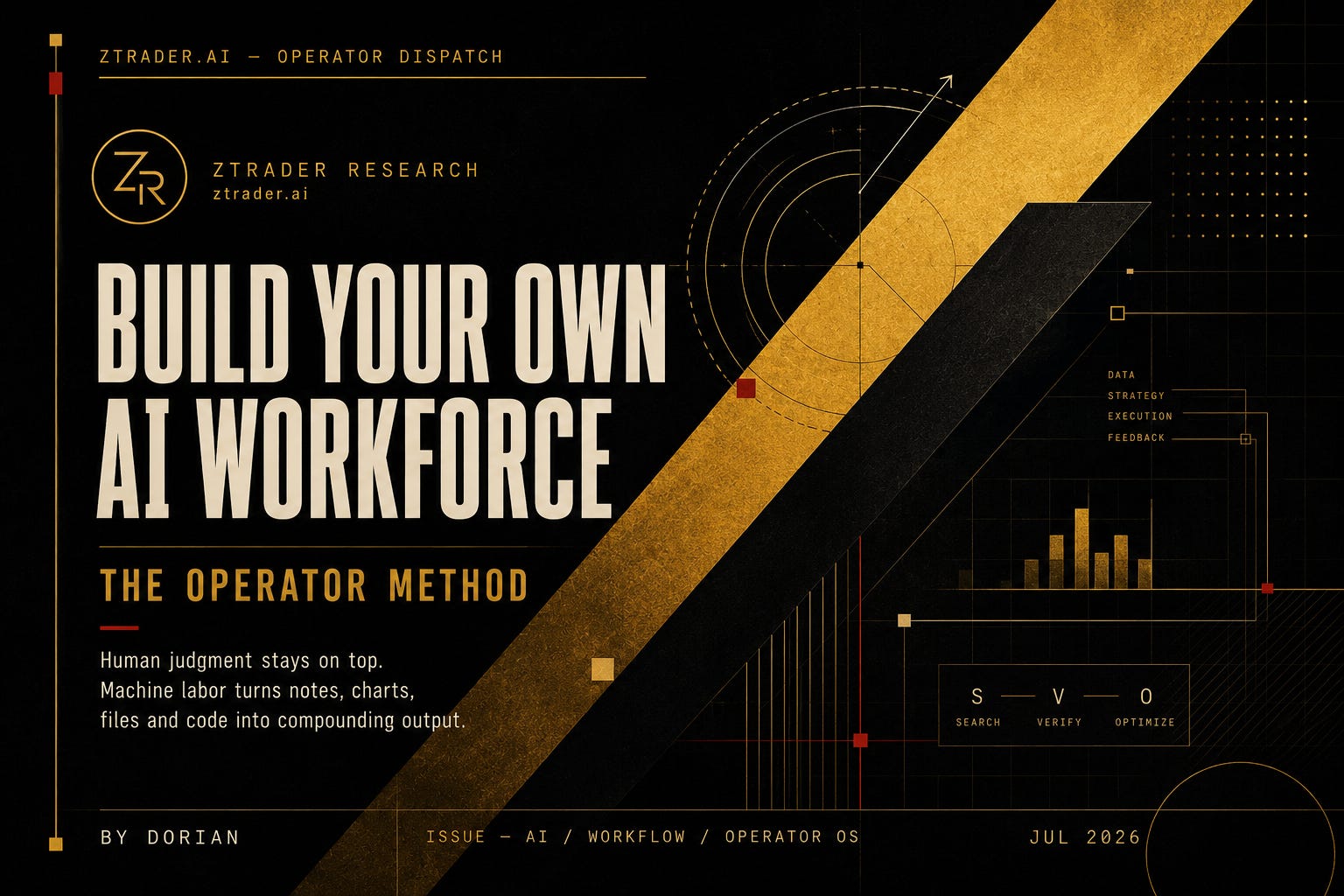
How to Build Your Own AI Workforce 01
Most people treat AI like a smarter search box.
From Vision to AI Workforce
Most AI users are deeply frustrated by their output quality. They realize they are generating the exact same style of images, videos, music, and articles—no matter how much effort they invest in designing their prompts.
GPT, Claude, and Gemini all tend to generate remarkably similar results at the exact same quality level. Even the articles and words read identically, trapped in predictable loops:
“A… A…”
“It’s not A, it’s B.”
“It’s, it’s, it’s...”
The endless, rigid, robotic structure and clean-up nonsense generated via AI.
Even lines of code look exactly the same. Because of this, the core question has shifted. It is no longer: “Can I keep using AI? Are they right?”
It is now: “How do I actually maximize the power of AI?”
Some users are giving up on AI models entirely. But the answer behind this plateau isn’t that complicated. You need to know how an AI model actually works, and you must customize your own infrastructure, workflows, and pipelines to co-work with it.
The Reality Split: What the Model Actually Does
A model can summarize, draft, compare, translate, code, format, classify, test, and generate variations at absurd speed.
🟢 What the Model is Good For
Quick Scanning: Instantly parsing massive, complicated files, dense documentation, and hidden risks.
Concept Breakdown: Summarizing and breaking down incredibly tough, complex subjects into digestible layers.
Pattern Matching: Spotting anomalies, bugs, loopholes, and inconsistencies across large datasets instantly.
Agentic Orchestration: Acting as a highly efficient orchestrator capable of driving different tools and organizing multi-step, complicated tasks.
Extreme Customization: Adapting completely to specific guardrails and style files—though 99% of users have no idea how to leverage this.
🔴 What the Model is Bad For
Running Numbers: Doing precise mathematical tracking or handling complex Excel logic without making hallucinated errors.
Original Writing: Writing your homework, essays, or thought-leadership pieces with a genuine, soul-driven human voice.
Subtle Optimization: It cannot give you deep, powerful control over code or prose unless you already know how to direct, manipulate, and rewrite it.
High-Context Nuance: Handling messy, emotionally complicated, political, or deeply human-centric matters.
Replacing Judgment: It is an execution layer, not a decision-maker.
The Real Workspace: Building the Worker Layer
The strongest use case for AI is deeply practical: build a worker layer around your own mind.
Your brain sets the direction.
The machine handles the repeatable execution.
Your taste decides what survives.
That is the split.
When someone asks a model to think for them, the result is fluent sludge. But when a user gives it hyper-specific context, standards, strict constraints, files, source examples, and a rigid task boundary, the exact same tool becomes incredibly powerful.
Prompting matters, but prompt worship has become astrology with keyboard shortcuts. The deeper edge comes from context, workflow, memory, taste, and rigorous verification.
The machine needs to know exactly what you are building, what counts as garbage, what your audience values, where your unique edge sits, and which decisions must remain human.
Without that, it just hands you back the average of the internet.
Chart 01 VISION TO AI WORKFORCE MAP
The Real Edge is about WHO is using AI
And how to use AI
NOT AI Computing Power
Everyone may have access to similar models. Very few people have the same judgment.
Two users can open the same tool and get completely different results. One gets filler. Another gets research notes, code patches, chart drafts, product copy, learning maps, task trees, and a publishable pipeline.
The model did not change.
The user did.
Capable AI user will breaks down all their visions as different variables: goals, constraints, tastes, notes, domain knowledge, examples, standards, they will write MD file and standardized these outputs.
They will try to make to monitor and optimize their entire AI workflow to get best/ same quality of outputs each time.
The Model Output will therefore because the machine no longer has to guess what “good” means.
Good = Higher hidden domain knowledge?
Or Good = look good?
How good is good?
Most of AI users failed to define these variables and standard, so the entire prompts fall apart, what they spent hours to generate look just the same.
A trader with real market sense can use the tool to scan, compare, and test ideas faster.
Tech founder with product taste can turn messy notes into roadmap, copy, user flows, and code tasks.
Authentic writer with a real point of view can sharpen prose without surrendering voice.
The weak request says: “Write this for me.”
The stronger version says: “Here is my thesis,
audience, draft, standard, and blacklist.
Clean the grammar, flag weak logic, remove filler, preserve the edge, and show what breaks.”
That is a different game.
Break the goal into nodes
Big goals are too large to execute directly.
“Build a company”
“Learn trading”
“Use AI better”
All above are merely BIG WORDS.
Vision becomes useful only after it is cut into NODES and executable TASK.
A node is a unit with a role, boundary, and output.
For a start-up founder, the major nodes may be product, data, content, distribution, pricing, onboarding, retention, and support.
For a trader, they may be market scan, thesis, instrument selection, risk, entry, invalidation, review, and journal.
For a writer, they may be capture, claim, outline, draft, edit, chart, title, publish, and recycle.
Once these parts exist, the model can help sequence them. Dependencies become visible. Bottlenecks stop hiding inside vague ambition. Work starts turning into a map.
1. Build the node stack
After the long-term aim is cut into nodes, each part needs rank.
This is where most people lose the plot. They confuse motion with progress. Opening another app feels like work. Renaming a folder feels like strategy. Making a dashboard feels like control. Humanity has an amazing talent for building decorative cages and calling them systems.
A useful stack forces order:
Long aim → domain nodes → priority → tasks → shipped asset.
Example:
Long aim: build a paid research platform.
Domain nodes: writing, charts, data, auth, pricing, distribution.
Priority: landing page, paywall, article format, chart pipeline.
Tasks: write article, export charts, place paywall, publish, track conversion.
Output: one paid post with visuals, clear split, and reusable layout.
Now the machine can help. It can draft copy, generate chart specs, check grammar, create social snippets, list implementation steps, or convert the same piece into a script.
Without the stack, the model guesses and drifts.
With the tool stack, it executes.
2. Give the system context
A model with no context behaves like a polite intern from nowhere.
It can produce surface-level material, but it does not know your standards, voice, product history, audience, current bottlenecks, or forbidden phrases.
Context Management is EVERYTHING.
Keep a working context file. Include active projects, target readers, voice rules, product layout, pricing, preferred examples, banned phrasing, recurring mistakes, strongest ideas, unfinished drafts, and current goals.
“Make this better” produces mush.
“Clean grammar only, keep my voice, remove generic startup language, preserve the trading angle, avoid motivational framing, and return a Substack-ready version” produces usable work.
The point is not to craft the perfect prompt. The point is to give the worker layer a world to operate inside.
Brief the worker.
Define the standard.
Assign the task.
Check the result.
Somehow this ancient desk logic had to be rediscovered through GPUs. Civilization is very dramatic.
3. Turn skill into process
Most people have hidden skill but no workflow.
A trader says, “I read markets well.”
A writer says, “I have taste.”
A founder says, “I understand product.”
Useful, but too vague to delegate.
Find the sequence underneath the skill.
For a trader: scan rates, check dollar, check oil, compare equities, read volatility, look for cross-asset disagreement, form thesis, define invalidation.
For a writer: capture raw thought, identify the claim, remove fake sophistication, add mechanism, sharpen rhythm, cut filler, place the strongest line near the end.
For a founder: find user pain, reduce the product promise, map the first action, remove friction, ship one proof point, watch where users stall.
Once the sequence is visible, the machine can handle parts of it: scan, sort, compare, expand, compress, test, format, and produce variants.
The human keeps the judgment calls.
4. Build the content pipeline
A modern creator, trader, or founder produces more raw material than they notice.
Screenshots, charts, voice notes, market observations, code snippets, customer messages, private journals, article fragments, reading notes, product ideas, failed trades, sharp comments.
Most of it dies because there is no pipeline.
A simple flow is enough:
Capture → sort → draft → verify → package → publish → archive → reuse.
One observation can become a paragraph, chart caption, paid note, short post, lesson, product feature, or prompt template.
The machine is useful because it lowers the cost of format conversion. It can turn fragments into outlines, outlines into drafts, drafts into snippets, snippets into scripts, scripts into slides.
The source material should still come from you.
The model processes ore. It should not pretend to be the mine.
5. Run S-V-O before shipping
Every serious workflow needs a quality gate.
S-V-O means:
Search
Verify
Optimize
Search gathers material: sources, files, notes, charts, data, code, examples, and prior decisions.
Verify checks truth, logic, freshness, consistency, calculation, claims, and implementation.
Optimize improves final form: order, rhythm, chart placement, title, examples, usefulness, and delivery.
This loop prevents smooth nonsense from escaping into public.
Without search, output is trapped inside limited context. Without verification, confident errors sneak in. Without optimization, the result stays bloated or badly arranged.
No serious claim should ship without passing through this loop.
Chart 03 · S-V-O Control Loop
6. Keep the labor split clean
The fastest way to ruin the system is to delegate the wrong thing.
Use the machine for drafting, sorting, summarizing, comparing, formatting, testing, naming, tagging, refactoring, and generating variants.
Keep human control over goal, taste, risk, final claim, strategic direction, and publishing standard.
Cross that line, and the work starts sounding like everyone else.
Respect it, and one person can operate with the output surface of a small team.
Table: Operator vs Machine Labor
Final model
Build your own AI workforce like this:
Start with a real goal.
Cut it into nodes.
Rank the nodes.
Give the system context. Turn personal skill into workflow. Build a pipeline for notes, charts, files, code, and media.
Use the machine to reshape hard concepts. Run serious output through S-V-O. Keep judgment human. Let the tool layer handle repeatable labor. Write first. Refine second. Publish only after review.


