

Most investors think volatility appears when panic begins.
In reality, volatility often starts moving long before the headline arrives.
The market does not price events.
The market prices the probability distribution of future uncertainty.
That distinction is the entire game.
As U.S. equities continue trading near record highs and implied volatility remains relatively subdued, many investors interpret low VIX readings as evidence of stability.
That interpretation is often incomplete.
Because volatility traders rarely focus on the spot number alone.
The real signal lives underneath.
The curve.
The shape of volatility across time frequently reveals stress before price does.
Before liquidity disappears.
Before forced hedging begins.
Before financial media discovers a narrative.
Most retail investors treat VIX as a fear gauge.
Professional volatility desks treat volatility as a transmission mechanism.
The difference matters.
Fear is emotional.
Volatility is structural.
One exists inside human psychology.
The other exists inside option pricing, dealer inventories, hedge demand, and balance-sheet constraints.
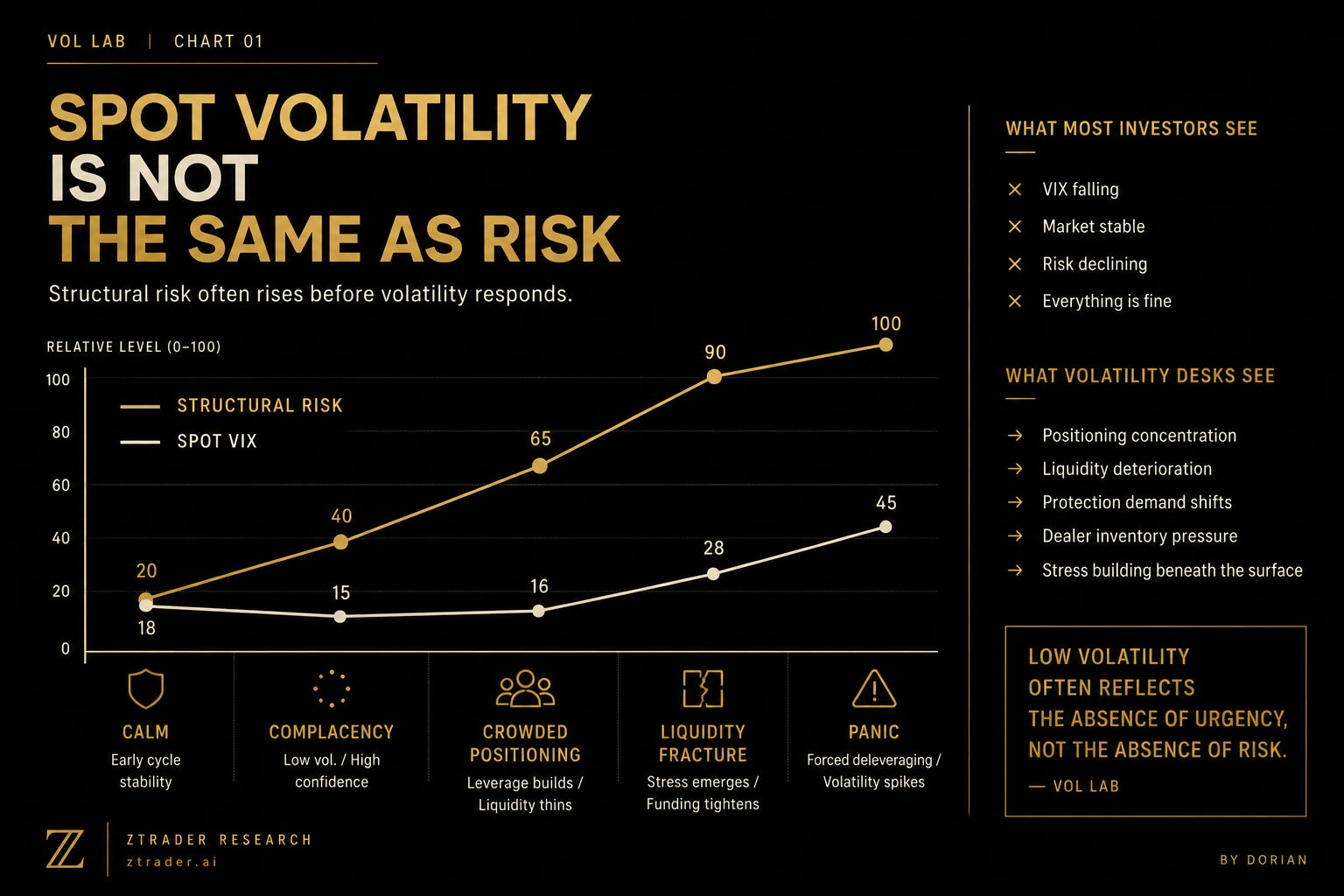
That is why a market with a VIX of 15 can sometimes be more dangerous than a market with a VIX of 30.
Low volatility does not necessarily mean low risk.
Sometimes it means risk has not yet been repriced.
Sometimes it means investors are comfortable.
Sometimes it means nobody is paying attention.
The important question is not:
“Where is VIX?”
The important question is:
“Where is stress building inside the curve?”
Because the curve is not measuring fear.
The curve is measuring where fear is being transferred.
Spot volatility tells you where the market is.
The curve tells you where pressure is building.
And sometimes those are very different places.
Why This Matters
Every major volatility event follows a similar path.
Positioning becomes crowded.
Liquidity becomes thinner.
Protection demand slowly rises.
The curve starts changing.
Then the headlines arrive.
Most investors only notice the final stage.
Volatility desks watch the first stage.
That is where the edge lives.
Premium members can continue below for the full framework.
Most investors learn volatility through fear.
Professional traders learn volatility through structure.
Deep Volatility is a research series focused on the mechanics behind modern markets: term structure, dealer positioning, volatility carry, liquidity transmission, and the hidden architecture of risk.
Premium members receive the full framework, charts, and tactical implications.
