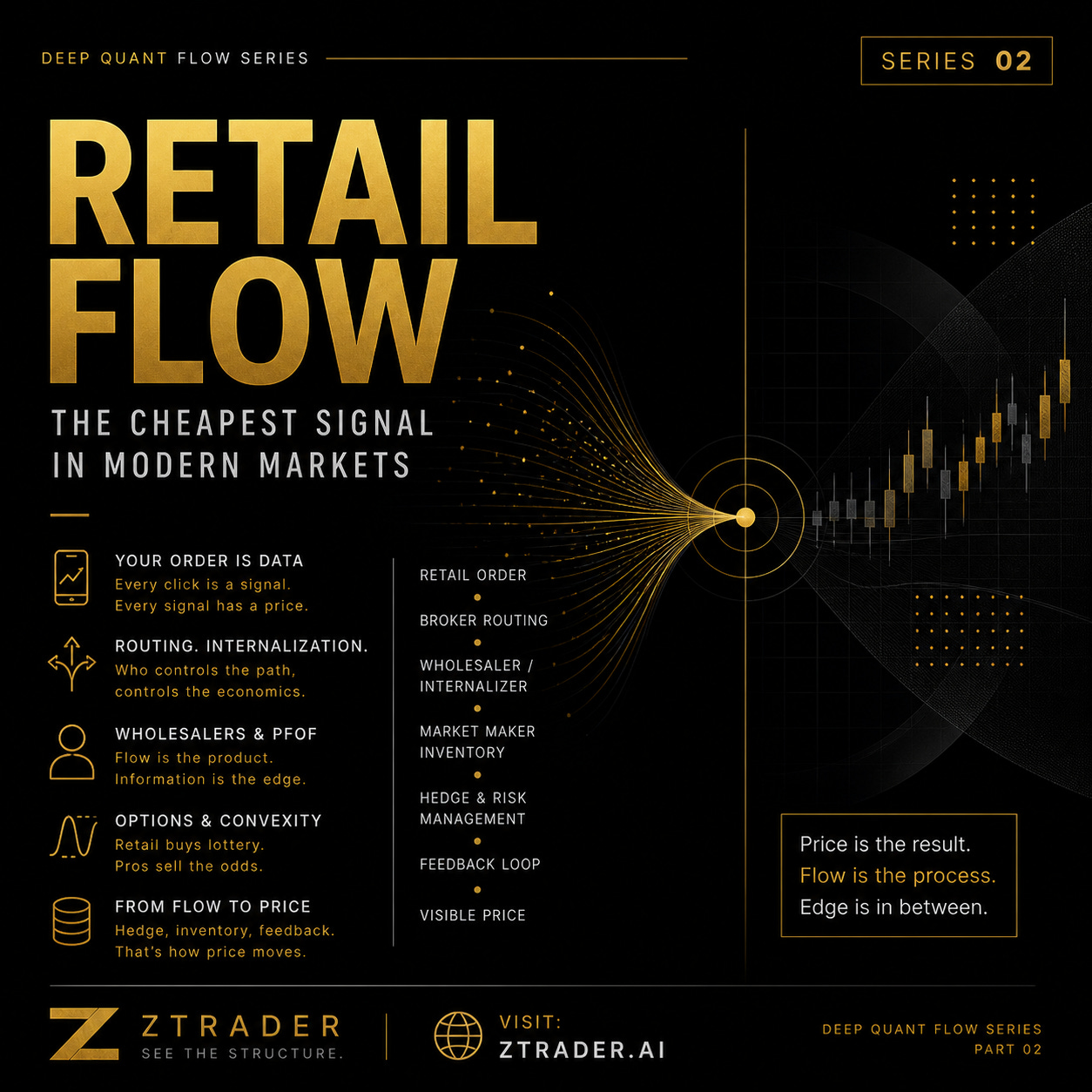
Deep Quant Flow Series 02 Retail Flow: The Cheapest Signal in Modern Markets
Why free trading was never free, and why your order is worth more than your opinion
Most retail traders believe they are trading the market.
They are not.
They are entering a routing system.
Before their order becomes a print, it becomes something else first: a signal, a probability object, a spread-capture opportunity, a hedging input, a toxicity score, a broker revenue unit, and sometimes a data point inside a much larger liquidity machine.
That is the first real lesson of modern market structure.
Retail flow is not important because retail traders are brilliant.
Retail flow is important because most of it is statistically useful.
Not always right.
Not always wrong.
Useful.
Useful to brokers.
Useful to wholesalers.
Useful to market makers.
Useful to options exchanges.
Useful to firms that do not need to predict the future in heroic cinematic fashion, because they can price the flow, classify it, fill it, hedge it, and repeat the process thousands or millions of times.
That is the machine.
And retail flow is one of its cheapest fuels.
1. The great illusion: zero commission
Zero commission was one of the most successful product designs in financial history.
It made trading feel frictionless.
It made markets feel democratic.
It made every user feel like they had direct access to Wall Street.
The trick is simple: remove the visible fee, monetize the invisible path.
The old model was easy to understand:
You trade
→ Broker charges commission
→ Cost is visible
The modern retail model is more subtle:
You trade
→ Broker routes order
→ Market maker pays for flow or captures spread economics
→ Broker gets revenue
→ You get “free” trading
→ Cost migrates from explicit commission to execution quality, spread, routing incentives, and product behavior
This does not automatically mean retail traders are being robbed on every order. That is the low-resolution version, usually delivered by people who think every hidden mechanism is a conspiracy because reading market structure documents causes emotional damage.
The truth is more interesting.
Retail traders often receive price improvement versus displayed quotes, and wholesalers can compete by offering better execution than the national best bid or offer. But the conflict is structural: the broker’s economic incentive may not perfectly align with the customer’s execution outcome. SEC Rule 605 exists because execution quality has to be disclosed and compared, and the SEC has extended the compliance date for amended Rule 605 reporting to August 1, 2026.
The fact that the disclosure regime is being expanded tells you the real battlefield.
The battle is not “commission or no commission.”
The battle is:
Who controls routing?
Who captures spread?
Who receives flow?
Who measures execution quality?
Who decides what “best execution” really means?
That is where the money lives.
2. Retail flow is valuable because it is usually less toxic
Market makers fear toxic flow.
Toxic flow means the person hitting your quote knows something, or is part of a larger informed pressure wave, or is trading ahead of a move that will make your fill immediately bad.
If a market maker buys from an informed seller right before price collapses, the market maker loses.
If a market maker sells to an informed buyer right before price rips higher, the market maker loses.
So the first question for any liquidity provider is not:
“Is this trader smart?”
The question is:
“Is this order toxic?”
Retail market orders are often considered attractive because many of them are small, urgent, fragmented, behavior-driven, and less information-rich than institutional flow.
A parent order from a large asset manager slicing millions of shares may signal persistent demand. A merger-arb desk may know event risk. A macro fund may be repositioning after a rates shock. A retail order buying 17 shares because a YouTube thumbnail looked persuasive is, from the market maker’s perspective, easier to price.
Not harmless.
Just less toxic on average.
That is why retail flow can be monetized.
A simplified market maker classification model looks like this:
Incoming Order
→ Estimate information content
→ Estimate urgency
→ Estimate spread capture
→ Estimate hedge cost
→ Estimate inventory impact
→ Decide fill / price improvement / hedge / offset
Retail flow often has low institutional toxicity, high immediacy demand, and predictable behavioral clustering.
That combination is valuable.
Not because retail is “dumb.”
Because retail is classifiable.
And in markets, anything classifiable can become a business model.
3. Payment for order flow is not the product. Flow control is the product.
Most people reduce this entire issue to PFOF, payment for order flow.
That is too narrow.
PFOF is one visible payment mechanism.
The deeper object is flow control.
The firm that controls flow controls the first look at liquidity demand.
And first look is power.
A retail broker owns the customer relationship. A wholesaler wants access to the order. An exchange wants displayed volume. A market maker wants flow it can price better than competitors. The customer wants fast execution and a good fill, preferably while pretending markets are a fair arena rather than a fragmented routing labyrinth designed by committees with caffeine addictions.
The broker’s routing decision creates the first fork in the market structure tree:
Retail order
→ Broker
→ Wholesaler / internalizer
→ Exchange
→ ATS / dark venue
→ Auction mechanism
→ Smart order router path
Every branch changes who sees the flow, who trades against it, who earns spread, and what public market sees afterward.
That is why Rule 605 and Rule 606 disclosures matter. They are not boring compliance files. They are fragments of the map.
The SEC’s amended Rule 605 framework extends execution quality reporting obligations, and reporting entities will need to collect data from August 2026 and make reports covering that data publicly available afterward.
For a quant flow researcher, that is not bureaucracy.
That is future raw material.
4. The retail flow refinery
Think of retail flow as crude oil.
On its own, it is messy.
But routed through the right infrastructure, it becomes refined product.
Raw retail order
→ Broker routing
→ Wholesaler pricing
→ Internalization decision
→ Price improvement calculation
→ Hedge or inventory transfer
→ Execution report
→ Broker economics
→ Customer confirmation
The customer sees one thing:
Bought 100 shares at $X
The market structure sees many things:
Order type
Order size
Symbol
Time of day
Broker source
Customer segment
Market condition
Spread width
Volatility regime
Hedge cost
Fill probability
Adverse selection risk
The value is not only in the execution.
It is in the classification.
A modern wholesaler does not merely ask:
“Can we fill this order?”
It asks:
How much price improvement is needed?
How likely is this flow to move against us?
Can we hedge cheaper elsewhere?
Is this flow correlated with other incoming flow?
Is volatility stable?
Is spread wide enough?
Is inventory already biased?
Is the customer broker flow historically profitable?
The customer thinks in trades.
The wholesaler thinks in distributions.
That is why the retail trader’s “view” is often less important than the aggregate statistical behavior of the flow bucket.
The individual is noisy.
The bucket is tradable.
5. The hidden trade: retail pays with optionality
In stocks, the economics are mainly spread, routing, execution quality, and adverse selection.
In options, the game becomes more powerful.
Options retail flow is structurally richer because an option is not just a directional instrument. It embeds volatility, convexity, time decay, strike selection, maturity choice, and hedge feedback.
A stock order says:
I want delta.
An options order says:
I want delta, convexity, implied volatility, skew exposure, expiry exposure, and a dynamic hedge profile.
That is much more monetizable.
This is why options PFOF and options internalization deserve their own layer. A 2026 Review of Financial Studies paper argues that option trades generate high PFOF and that exchange mechanisms such as designated market maker assignments and price improvement auctions can facilitate internalization while creating imperfect competition in option wholesaling.
This is the part most retail traders miss.
When they buy short-dated calls, they think they bought a lottery ticket.
The market maker sees:
Strike demand
Expiry demand
Implied volatility paid
Gamma transferred
Vega transferred
Hedge schedule created
Potential feedback into underlying
A retail options order is not just a bet.
It is a small volatility package sold into a professional inventory system.
And if enough of those packages cluster in the same strikes and expiries, they can reshape dealer hedging.
6. Retail options flow: the convexity trap
Retail traders love short-dated options because the payoff feels asymmetric.
Small premium.
Big dream.
Civilization’s oldest scam, now with Greeks.
The problem is that short-dated options are extremely sensitive to entry price, implied volatility, spread, timing, and gamma decay. The trader can be directionally right and still lose because the option was overpriced, the move was too slow, or the spread was too wide.
For the flow receiver, this is beautiful.
Retail is often willing to pay for convexity at poor implied terms because the psychological unit is not fair value.
The psychological unit is possibility.
The market maker prices possibility.
Retail buys feeling.
That gap is the business.
A simplified options flow monetization chain:
Retail buys OTM call
→ Wholesaler / market maker sells option
→ Market maker collects implied volatility premium
→ Market maker delta-hedges dynamically
→ If realized move is smaller than implied price, option decays
→ If flow clusters, hedge pressure may temporarily reinforce price
→ If move fails, retail convexity collapses
This does not mean buying options is always stupid.
It means buying options without understanding implied volatility, spread, dealer positioning, and hedge feedback is less like trading and more like donating to a mathematically literate predator.
A noble cause, apparently.
7. Robinhood is not just a broker. It is a behavioral flow interface.
Robinhood’s importance is not only that it popularized zero-commission trading.
Its importance is that it turned trading into a behavioral interface.
The product design compressed friction.
The app made trading feel immediate.
The business model leaned heavily on transaction-based revenue and PFOF risk disclosures in its filings. Robinhood’s 2025 annual reporting still names reliance on transaction-based revenue, including payment for order flow, as a business risk.
By 2025, Robinhood reported record full-year revenue of $4.5 billion and record net deposits of $68 billion, with Robinhood Gold subscribers reaching 4.2 million.
This matters because retail flow is no longer just a brokerage byproduct.
It is a scalable consumer-finance pipeline.
The platform does not only route orders.
It shapes behavior:
Interface design
→ Watchlist attention
→ Push notifications
→ Options accessibility
→ Margin availability
→ Crypto integration
→ Social narrative feedback
→ More order flow
The market maker sees the result as tradable flow.
The broker sees it as revenue.
The trader sees it as empowerment.
All three may be true, which is exactly why the structure is so durable.
8. Retail flow is not dumb money. It is unstable signal.
Calling retail “dumb money” is lazy.
Retail flow can be wrong, but it can also create real price pressure.
Especially when retail behavior clusters.
Retail is weak individually.
Retail is powerful when synchronized by narrative, options convexity, leverage, and social feedback.
The correct model is not:
Retail = dumb
Institution = smart
The correct model is:
Retail flow = low-information on average, but high-impact when synchronized
That distinction matters.
Most of the time, retail flow is useful to fade, internalize, or monetize.
Sometimes, retail flow becomes the catalyst that forces the professional side to hedge.
That is when the flow becomes dangerous.
The GameStop era made this obvious, but the lesson extends far beyond meme stocks.
The same structure can appear in AI stocks, zero-day options, crypto proxies, leveraged ETFs, and crowded thematic names.
The question is not whether retail is right.
The question is whether retail flow forces someone else to trade.
That is the real edge.
9. The market maker does not need to hate retail. It only needs to price retail.
A lot of retail commentary imagines market makers as villains.
That is emotionally satisfying and analytically useless.
Market makers do not need to hate retail.
They need to survive retail.
They quote prices. They absorb flow. They manage inventory. They hedge. They compete for routing. They calculate expected adverse selection. They decide how much improvement to offer and how much risk to warehouse.
The market maker’s equation is closer to this:
Expected Profit =
Spread Captured
+ Rebates / routing economics
+ Inventory edge
+ Hedge efficiency
- Adverse selection
- Volatility shock
- Capital cost
- Operational risk
Retail flow is attractive when:
Spread captured > adverse selection + hedge cost
That is the core.
Everything else is decoration.
10. Retail flow creates shadow information
Even when retail orders do not directly move the market, they create shadow information.
A cluster of retail call buying tells you something.
A burst of small-lot buying in an illiquid name tells you something.
Retail concentration in a single expiry tells you something.
Retail order flow into leveraged ETFs tells you something.
Retail panic selling at the open tells you something.
Not because each order is informed.
Because the aggregate reveals behavioral pressure.
For a quant flow system, retail flow can be treated as a behavioral sensor.
Retail Flow Sensor Inputs:
- Small-lot trade imbalance
- Off-exchange volume share
- Options volume by strike
- Short-dated option concentration
- Spread widening during retail surge
- Price improvement / execution quality changes
- Social narrative velocity
- Broker platform activity
The output is not “buy” or “sell.”
The output is:
Flow pressure regime
That is a much more useful object.
11. The retail flow regime map
Retail flow has regimes.
It does not behave the same way in calm markets, panic markets, meme markets, or volatility compression markets.
A useful regime map:
Regime
Retail Behavior
Market Maker Problem
Trading Interpretation
Calm grind
small directional chasing
low toxicity, easy internalization
fade extremes, spread capture dominates
Narrative chase
concentrated buying in themes
inventory skew, crowding risk
momentum can persist until flow fades
Vol shock
panic selling / put buying
hedge urgency, spread widening
liquidity becomes more valuable than signal
Gamma squeeze
call clusters, short-dated options
dynamic hedge pressure
price can overshoot fundamentals
Meme eruption
social synchronization
toxicity changes rapidly
historical models break
Post-shock decay
retail keeps chasing after impulse
convexity reprices lower
mean reversion / vol crush risk
The mistake is treating retail flow as one thing.
It is not one thing.
It is a regime-dependent signal.
12. How a poor man’s retail flow radar can be built
You do not need Citadel’s infrastructure to build a useful retail flow model.
You cannot see everything.
But you can infer enough.
A public-data retail flow radar can combine:
1. Off-exchange volume share
2. Trade size distribution
3. Options volume by strike and expiry
4. Put/call imbalance
5. Implied volatility change vs realized move
6. Bid-ask spread behavior
7. ETF flow proxies
8. Social narrative velocity
9. Price reaction after retail-heavy sessions
10. Dealer gamma estimates
The goal is not perfect reconstruction.
The goal is directional inference.
Observed traces
→ Flow hypothesis
→ Liquidity condition
→ Hedge feedback estimate
→ Trade path
This is the Ztrader way to think about it:
Price is the surface.
Flow is the hidden field.
Retail flow is the cheap sensor.
Options flow is the convexity signal.
Execution quality is the footprint.
Dealer hedge is the feedback loop.
That is the architecture.
Not another indicator.
A flow compiler.
13. The key mistake retail makes
Retail traders think the trade ends when they click buy.
Professionals know the trade begins there.
Because after the retail order is placed, the real chain starts:
Order routed
→ Flow classified
→ Fill priced
→ Inventory updated
→ Hedge executed
→ Risk recycled
→ Data stored
→ Future routing economics adjusted
The retail trader sees outcome.
The market structure sees process.
And process is where edge lives.
This is why most retail traders misunderstand their own role.
They are not just market participants.
They are inputs.
Sometimes they are profitable inputs.
Sometimes they are dangerous inputs.
Sometimes they become the spark that lights a forced hedging chain.
But they are still inputs.
The professional question is not:
“Are retail traders right?”
The professional question is:
“What does retail flow force the rest of the system to do?”
That is the entire game.
14. Why this matters now
Retail flow matters more today because market structure is more fragmented, options participation is larger, zero-day options have compressed trading horizons, off-exchange activity is structurally important, and disclosure regimes are evolving.
The SEC formally withdrew its proposed Order Competition Rule in 2025, meaning the specific auction-based reform path was abandoned for now, but execution quality disclosure remains a key regulatory front through amended Rule 605.
That combination is important.
The regulatory system may not force a full redesign of retail auctions immediately, but it is moving toward more granular measurement of execution quality.
Measurement creates data.
Data creates comparison.
Comparison creates research opportunity.
For Ztrader, this is exactly the kind of structural seam that matters.
Not because it tells us tomorrow’s SPY candle.
Because it tells us where the next layer of market transparency will emerge.
15. The final model
Retail flow is not stupid.
Retail flow is not sacred.
Retail flow is not free.
Retail flow is a monetizable behavioral stream moving through a fragmented execution architecture.
The broker controls access.
The wholesaler prices the flow.
The market maker manages the risk.
The options system transforms opinions into convexity.
The hedge feedback loop translates order flow into price pressure.
The trader sees the chart last.
That is the hierarchy.
Retail attention
→ Retail order
→ Broker routing
→ Wholesaler/internalizer
→ Market maker inventory
→ Hedge venue
→ Options / ETF / futures feedback
→ Visible price
Most traders start at the bottom.
They stare at visible price.
The edge starts higher.
At the flow layer.
The modern trader does not ask:
“Did price break resistance?”
The modern trader asks:
What type of flow caused the move?
Was it toxic or non-toxic?
Was it internalized or displayed?
Did it create hedge pressure?
Did liquidity absorb it or retreat?
Is the flow persistent or exhausted?
That is the shift.
From chart worship to flow intelligence.
From retail psychology to market structure.
From trading opinions to routing-aware inference.
Retail flow is the cheapest signal in modern markets.
Not because retail knows the future.
Because retail reveals pressure before price admits it.
Closing note
This is Part 02 of the Deep Quant Flow Series.
Part 03 will break down Citadel Securities as the retail flow refinery: how internalization, price improvement, execution quality, scale, and routing economics turn millions of small orders into a market structure empire.
Visit: Ztrader.ai
See the Structure.


