

ZTRADER RESEARCH · Single Name Brief · June 2026
Bitcoin Isn’t Crashing.
Capital Is Repricing Risk.
The market is reading the price.
The structure is in the flows.
What looks like a Bitcoin correction is something more precise: a coordinated institutional risk-off, amplified by leveraged longs that replaced real spot demand. The cascade was structural, not emotional. Understanding the difference is the edge.
[TABLE 01 — KEY DATA]

I. What Happened — The Market Is Looking At The Wrong Number
Bitcoin peaked at $126,198 on October 6, 2025. By June 3, 2026, it was trading near $66,965 — a drawdown of roughly 47% over eight months. In the past week alone, BTC dropped approximately 10–12% as it broke below $73,000 for the first time in months. Nearly $1 billion in leveraged positions were liquidated in a single session. Social media refilled with familiar questions.
Is the bull market over?
Have institutions abandoned the trade?
Has the halving thesis failed?
Is crypto entering another winter?
These questions are understandable. They are also the wrong questions. Because the most important story is not the price.
The most important story is the flow of capital.
“The market is focusing on the decline. The smarter question is why the capital left in the first place.”
— ZTrader Research, June 2026
II. Chart 01 — Institutions Left First: ETF Flows vs. Bitcoin Price
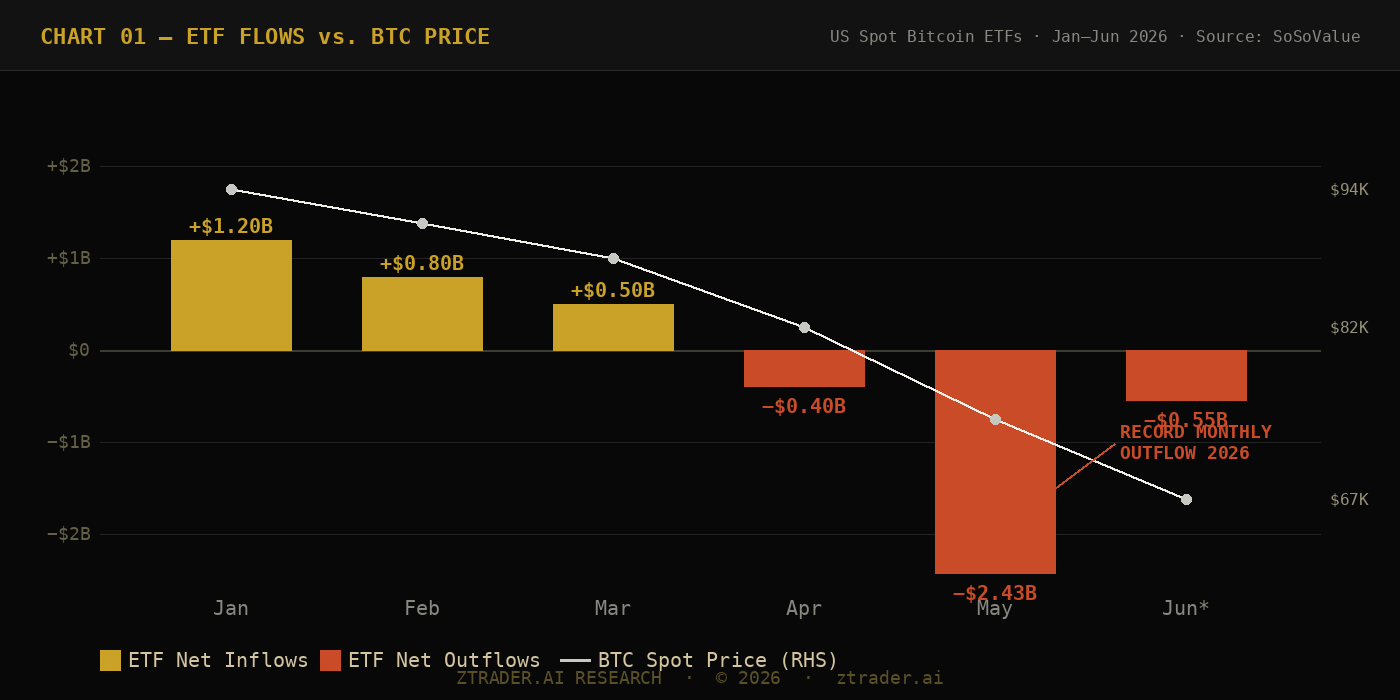
One of the biggest structural changes in Bitcoin over the past two years has nothing to do with block rewards or on-chain activity. It is ETFs.
The approval of spot Bitcoin ETFs in January 2024 fundamentally changed who participates in this market.
Pension funds, family offices, asset managers, and macro funds can now access Bitcoin through regulated vehicles.
For the first time, Bitcoin became embedded in the global asset allocation framework.
Institutional assets behave differently. They rise when capital enters.
They fall when capital leaves.
May 2026 tells the story precisely. US spot Bitcoin ETFs recorded $2.43 billion in net outflows — the largest monthly withdrawal of 2026. That single month extended into a 10-day consecutive outflow streak from May 15 to May 30, totaling $2.97 billion in redemptions. The streak broke the prior record of eight consecutive sessions. ETF assets under management fell from $104.29 billion to $94.17 billion in two weeks — roughly $10 billion erased from the combined institutional book.
Price weakness followed.
The market is focusing on the decline. The smarter question is why the capital left.
III. Why It Matters — 2021 Framework. 2026 Market.
Many investors are still running a 2021 analytical framework on a 2026 market structure.
They believe Bitcoin rises because people believe — and falls because people panic. That narrative held when retail investors dominated price discovery.
It holds less well today.
ETF-era Bitcoin increasingly trades like an institutional asset. Institutions do not allocate based on social media sentiment. They allocate based on risk budgets, portfolio construction, correlation coefficients, liquidity conditions, and expected returns relative to competing opportunities.
In May 2026, three forces converged to trigger the institutional exit: the S&P 500 climbing to successive all-time highs above 7,568 driven by AI and semiconductor rotation absorbed the marginal institutional dollar; April CPI printing at 3.8% and PPI at 6.0% eliminated Fed rate-cut expectations; and the 10-year Treasury yield near 4.45–4.50% strengthened the dollar, compressing risk appetite globally.
The market structure has changed. Many investors have not.
Conclusion :
Bitcoin is becoming an institutionalized asset — and institutionalized assets are governed less by emotion and more by capital allocation decisions. Flows matter more than narratives. The next major move in Bitcoin may depend less on what people believe and more on where risk capital decides to go.
You’ve seen the framework.
The free section told you why institutions left.
The premium section tells you what the positioning structure looks like right now — and which six variables determine whether this gets worse.
Most investors will keep watching price.
[Unlock Full Analysis →]
