

By Dorian
I. THE WEEK NVIDIA LOST ITS FOUNDER
Nvidia’s board accepted Jensen Huang’s resignation on 12 November, four days after he admitted in a letter to employees that he had been unfaithful to his wife.
The letter followed two New York Times reports:
on 29 October the paper described a close relationship between Huang and Alice Huang, a former managing director of the Nvidia customer Megaspeed, and on 6 November it reported a secret administration memo that described her as a spy for China’s Ministry of State Security.
Nvidia’s board opened an independent inquiry the day the letter went out.
On 11 November the Times reported a second affair, with an Nvidia vice president who reported directly to Huang, and he resigned the next day as president, chief executive and director. CFO Colette Kress became interim CEO while keeping the finance job, and Harvey Jones became the company’s first board chair.
Nvidia shareholders took the hit in stages.
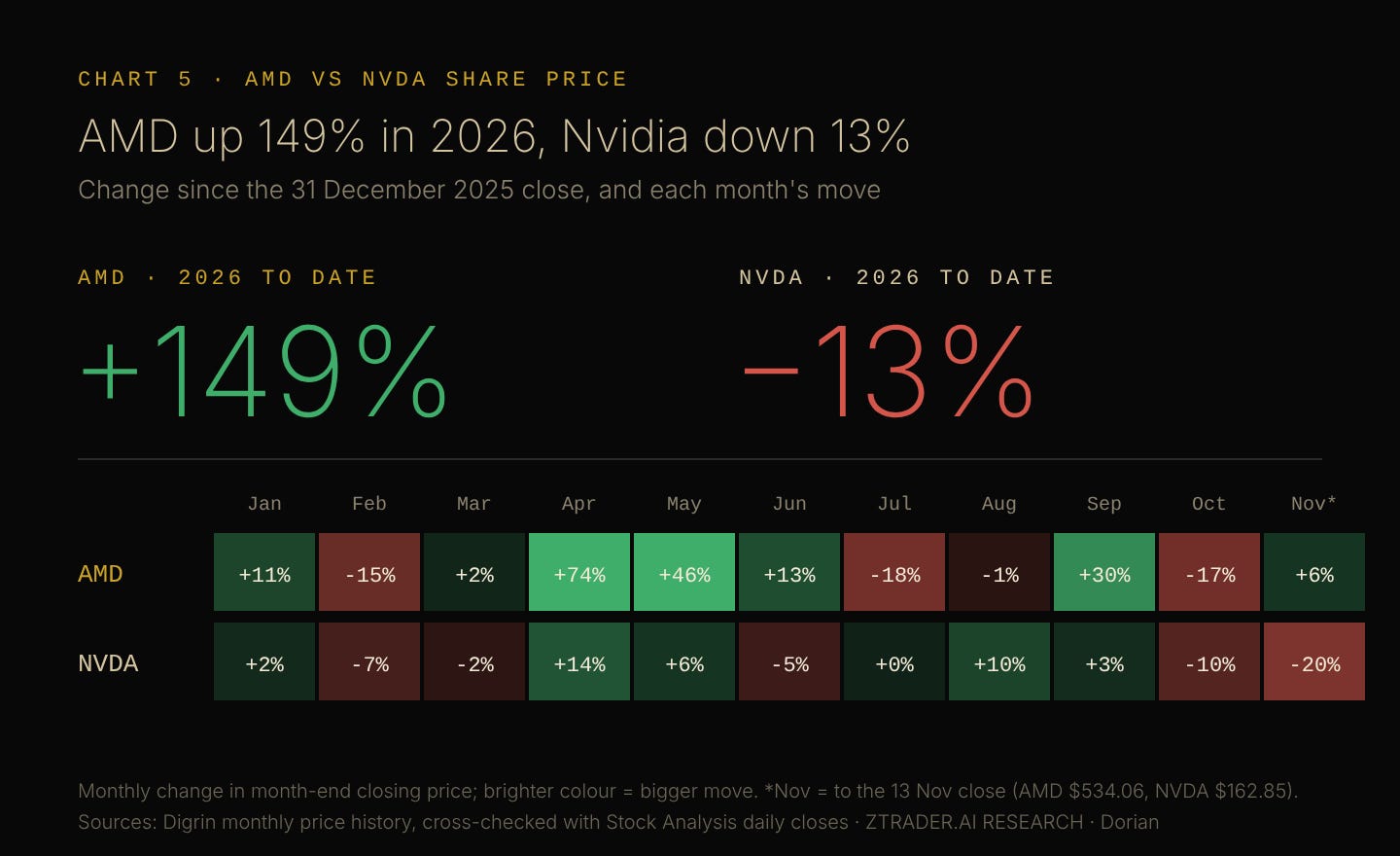
The stock fell 4.27% on 9 November, the first session after the letter, lost 11% over the four sessions after the 6 November close, and slipped another 2.01% on 13 November to $162.85. AMD rose 30% over those same four sessions and then gave back 8.75% on 13 November, so buyers who treated AMD as the clean alternative held that view for about one trading day after the resignation.
Nvidia’s problem now runs well beyond a personal scandal.
Huang’s exit put a federal criminal inquiry, a bipartisan congressional fight and new export legislation on Nvidia’s agenda at once, and each of them reaches into how Nvidia sells chips outside the United States. The question for AMD investors is how much of that risk pushes business toward AMD, and how much of it lands on AMD as well.
II. HOW SERIOUS IS THE NATIONAL-SECURITY CASE?
What US Authorities Have Done
US investigators began examining Megaspeed and Alice Huang in 2024 on suspicion that Nvidia chips the company bought had been routed illegally into China, according to the Times.
Megaspeed’s Malaysian sister company bought at least $4.8 billion of AI equipment containing Nvidia chips between June 2024 and February 2026.
In August 2025, while the Commerce Department’s inquiry was running, Nvidia general counsel Tim Teter emailed the case agents and told them that Jeffrey Kessler, the under secretary who runs the Bureau of Industry and Security, had authorized Nvidia to reach out.
The agents refused to meet and forwarded the emails to Kessler, and some officials saw the contact as a breach of procedure that could taint the case. The Justice Department then asked Commerce to pause its work and took over the matter as a criminal inquiry into Megaspeed. Commerce says Kessler never told anyone to share information with Nvidia, and Nvidia says it was providing information and seeking guidance.
What Has Not Been Shown
Prosecutors had filed no charge against Nvidia, Megaspeed or anyone at either company as of 14 November, and no authority has accused Huang of espionage. Nvidia says it has found no evidence of illicit chip transfers.
The spy allegation against Alice Huang rests on intelligence assessments that have not been released; China rejects the claim, and Singapore’s home affairs ministry says it has not investigated her. Milton Mueller of the Internet Governance Project argues that government officials planted the story to discredit Huang’s opposition to export controls, and he notes that no investigative evidence has been made public.
What the US Law Says
US export law gives prosecutors a wide range of outcomes.
Under the Export Control Reform Act, the Commerce Department can impose civil penalties of up to twice the value of each illegal transaction, and criminal violations carry fines of up to $1 million and up to 20 years in prison per violation.
The test for a seller is whether it knew, or had reason to know, that its chips were headed to a barred end user, and selling to a Singapore or Malaysian company is legal in itself. Cadence Design Systems set the recent benchmark in July 2025, when it agreed to plead guilty and pay more than $140 million over chip-design tools sold to a Chinese military university through a front company.
Capital & Compute puts Nvidia’s worst-case civil exposure at about $9.6 billion, twice the Megaspeed purchases, which it calculates as roughly two weeks of Nvidia’s profit.
The fine is the manageable part, of course.
Prosecutors will want to know why Nvidia’s top lawyer contacted agents investigating one of its customers, and that question can reach Nvidia itself in a way the Megaspeed purchases alone do not.
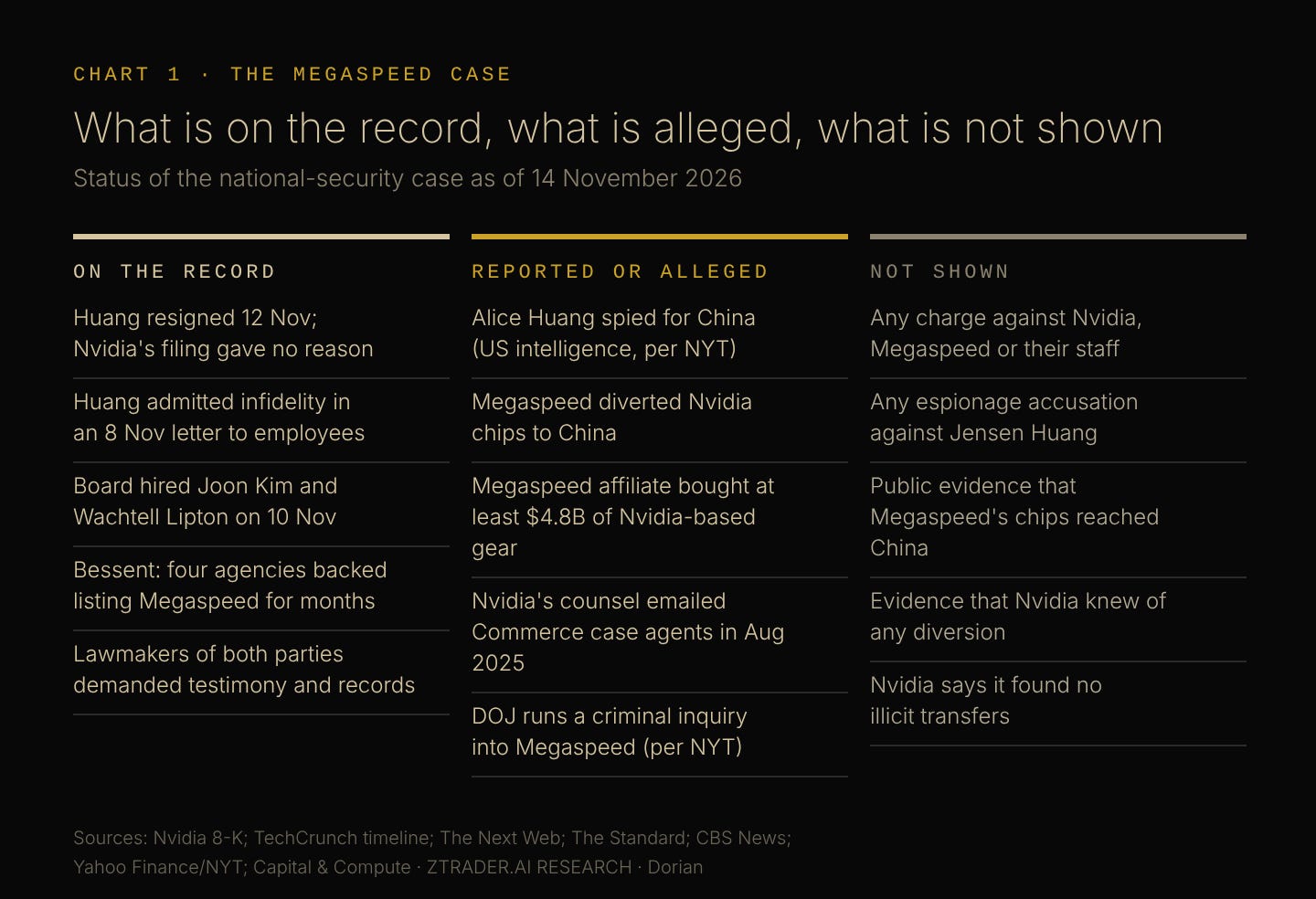
[CHART 1 — The Megaspeed case: what is on the record, what is alleged, what has not been shown]
III. WHO IN WASHINGTON WANTS WHAT
Republican Pressure
Republicans who control Congress until January are pressing Nvidia hard. House China committee chair John Moolenaar, joined by Foreign Affairs chair Brian Mast and Intelligence chair Rick Crawford, demanded closed-door interviews with Huang, Teter and Kessler, and Moolenaar threatened a subpoena; Huang has agreed to testify before Thanksgiving. Senate Majority Leader John Thune backs a Senate investigation, and Banking Committee chair Tim Scott wants Huang and Commerce Secretary Howard Lutnick to testify. House Speaker Mike Johnson says Congress has “a growing consensus” for tighter chip export controls.
Democratic Pressure
Democrats are aiming at the Trump administration as much as at Nvidia. Senator Ron Wyden and Representative Richard Neal, the ranking Democrats on Senate Finance and House Ways and Means, wrote to Lutnick on 12 November about the H200 arrangement, under which Taiwan-made chips travel to the United States, pay a tariff on arrival and then receive an export license for China; their letter calls it “what appears to be an unconstitutional export tax system.”
They also asked why Commerce let Megaspeed keep buying after US intelligence reportedly warned Lutnick, and whether Nvidia’s $26 million in donations to Trump projects, including the ballroom, were connected to the export approval. Senator Michael Bennet asked the Justice Department for an update on its Megaspeed case, and Senators Elizabeth Warren and Chris Coons asked the administration to preserve export records.
That minority oversight is about to gain subpoena power.
Democrats won majorities in both chambers in the 3 November midterms, according to CBS News projections, and the new Congress sits in January, so questions that Wyden and Neal can only ask today can become compelled testimony in 2027.
The White House and Treasury
President Trump is the outlier. On 12 November he said Huang is “going through hell,” called him “a tremendous talent,” said whether Alice Huang was a spy “I don’t know if that’s been determined yet,” and promoted Apple’s Tim Cook as Nvidia’s next chief executive. Treasury Secretary Scott Bessent took a harder line, saying the Treasury, Defense and State departments and the US Trade Representative had backed adding Megaspeed to the Entity List “for months,” and blaming Commerce’s Bureau of Industry and Security for not acting.
The Bills
Export legislation is riding on the defense bill. The Senate’s manager’s amendment to the fiscal 2027 NDAA carries the Chip Security Act, which would require security mechanisms to verify that controlled chips are not diverted to countries such as China, along with bills to license powerful chips and to keep chipmaking equipment away from countries of concern. The House version has no matching language yet. China’s foreign ministry has already warned against “the abuse of export control measures.”
Why AMD Cannot Watch From the Sidelines
AMD sells into China through the same machinery. AMD’s third-quarter 10-Q says the company holds US licenses to ship MI308 chips to some China-based customers, that US officials expect the government to receive 15% of that revenue, and that MI325 chips licensed for China must first be inspected in the United States and pay a 25% tariff on import. Wyden and Neal call that structure an unconstitutional export tax when Nvidia uses it, so any hearing, ruling or rule change aimed at Nvidia’s China arrangement lands on AMD’s China business too. AMD’s own filing warns that tighter controls could leave it unable to sell inventory built for those customers.
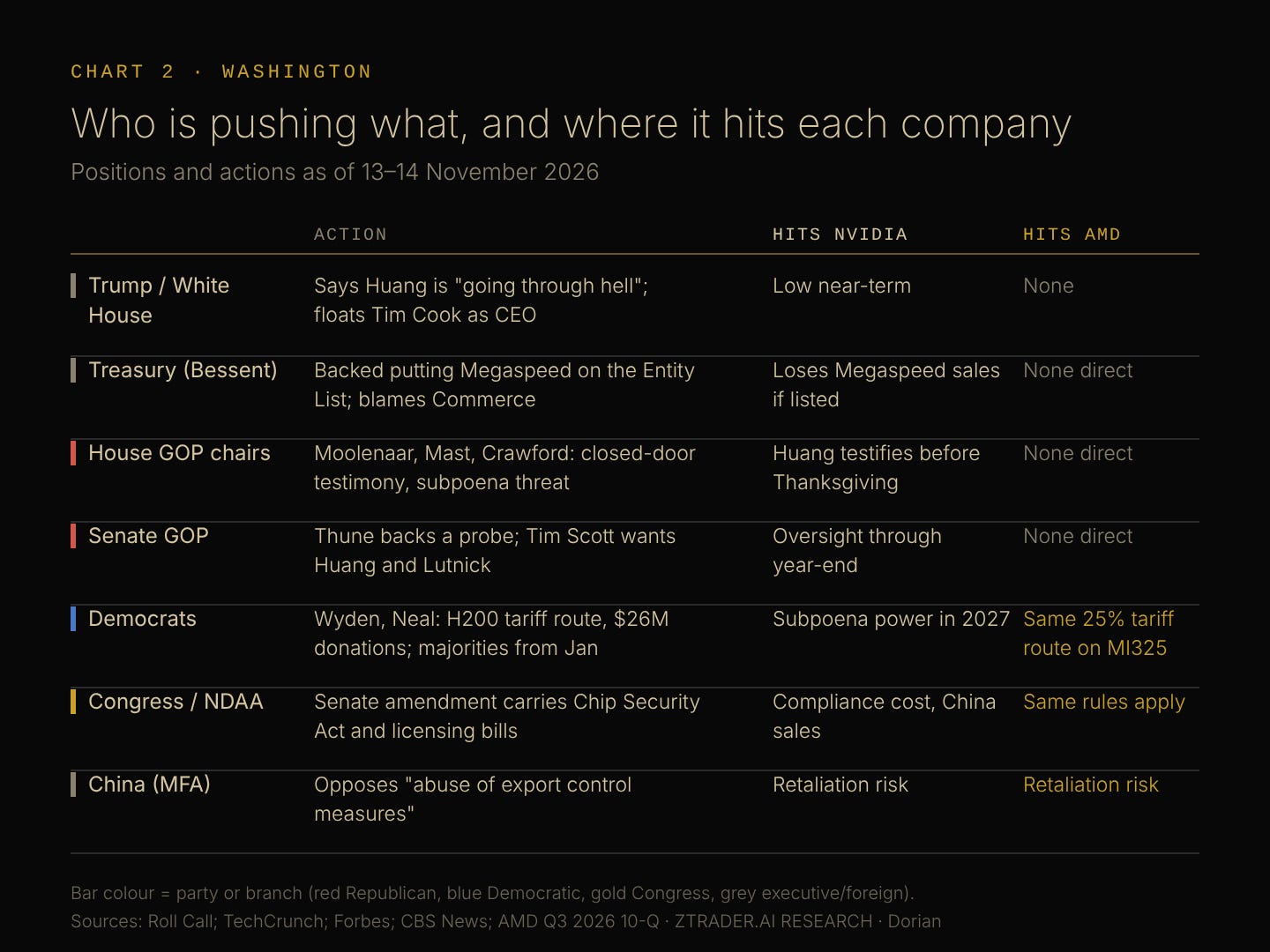
[CHART 2 — Washington: who is pushing what, and where it hits Nvidia and AMD]
IV. WHERE EACH COMPANY MAKES ITS MONEY
Nvidia: The Full-Stack Toll
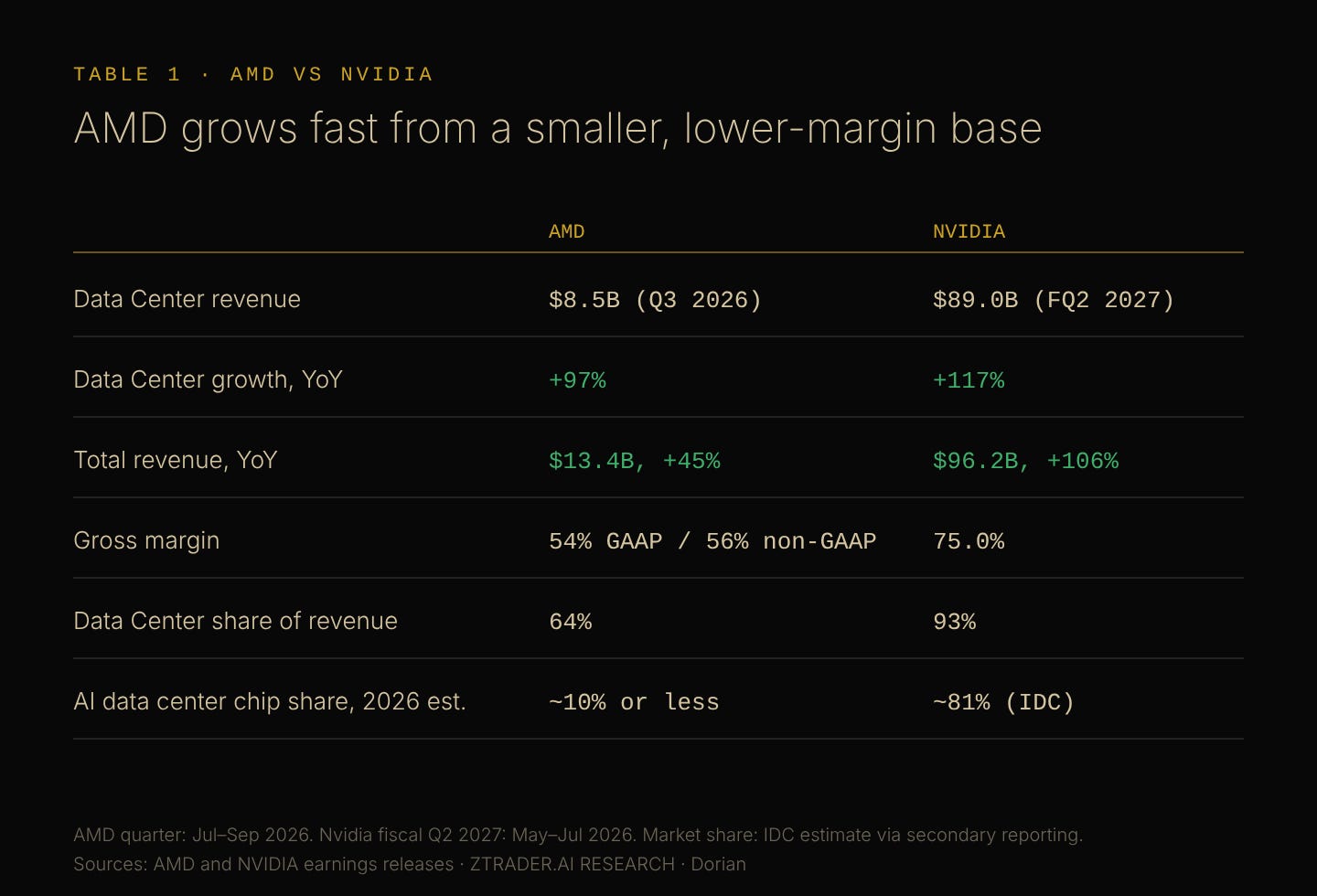
Nvidia booked $89.0 billion of Data Center revenue in fiscal Q2 2027, the three months to 26 July, up 117% from a year earlier and 93% of total revenue of $96.2 billion. Nvidia sells hyperscalers the GPU, the NVLink interconnect, the networking and the CUDA software as one system, so a customer who switches vendors has to replace far more than a chip. That bundle let Nvidia hold a 75.0% gross margin in the quarter, a figure most hardware companies only see in investor-day slides.
AMD: The CPU Company That Became a GPU Company
AMD reached the data center through EPYC server processors and now sells Instinct GPUs and complete Helios racks on top of them. Data Center revenue was $8.5 billion of AMD’s $13.4 billion in the September quarter, or 64%, up from 47% a year earlier. The older businesses split: Client and Gaming revenue fell 8% to $3.7 billion, while Embedded grew 29% to $1.1 billion. Lisa Su told analysts she expects Data Center to account for more than 80% of AMD’s revenue in 2027, which would tie AMD’s earnings almost entirely to the same AI spending cycle that drives Nvidia’s.
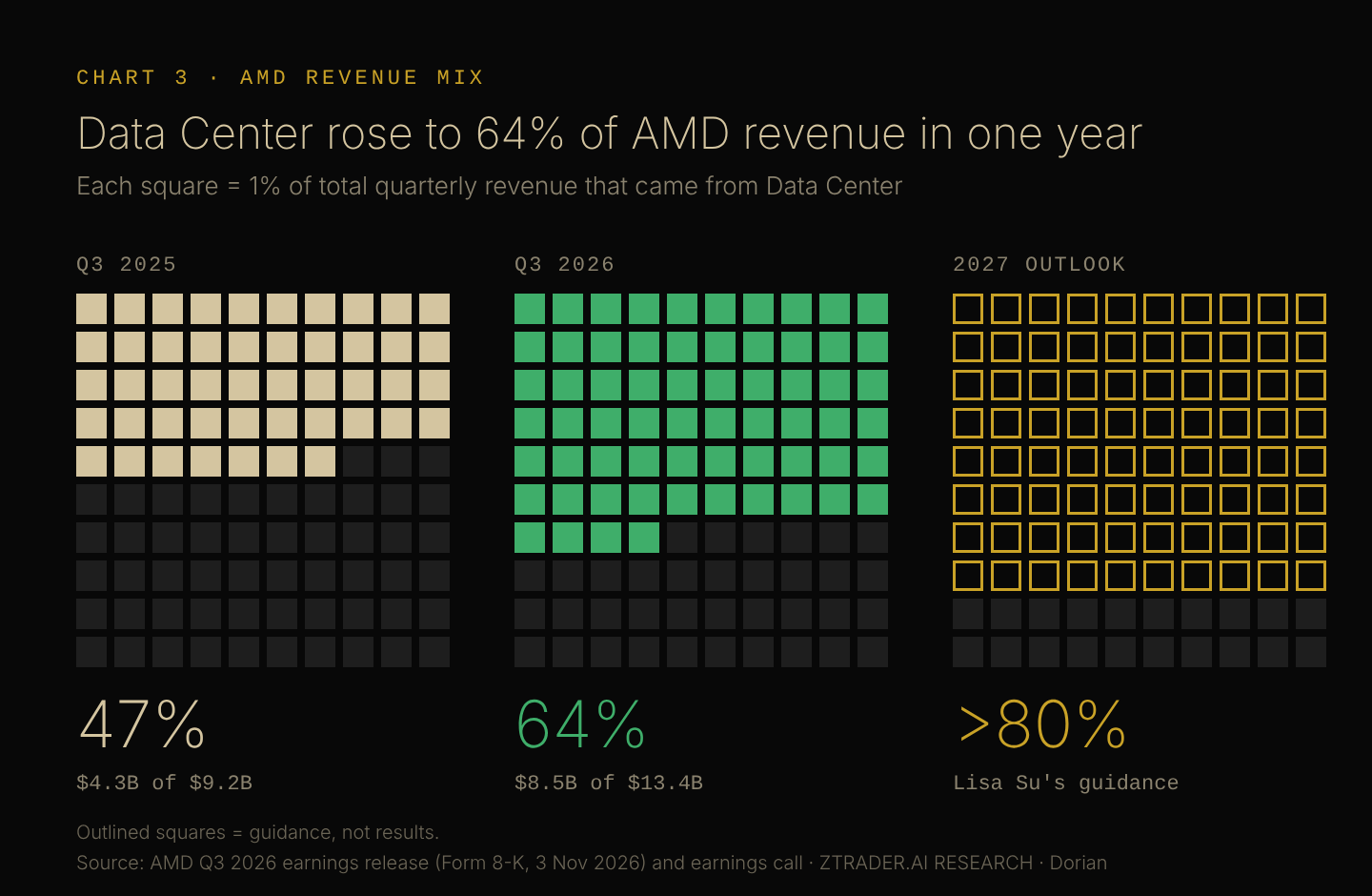
[CHART 3 — AMD revenue mix: Data Center share of total revenue, Q3 2025 vs Q3 2026]
Scale
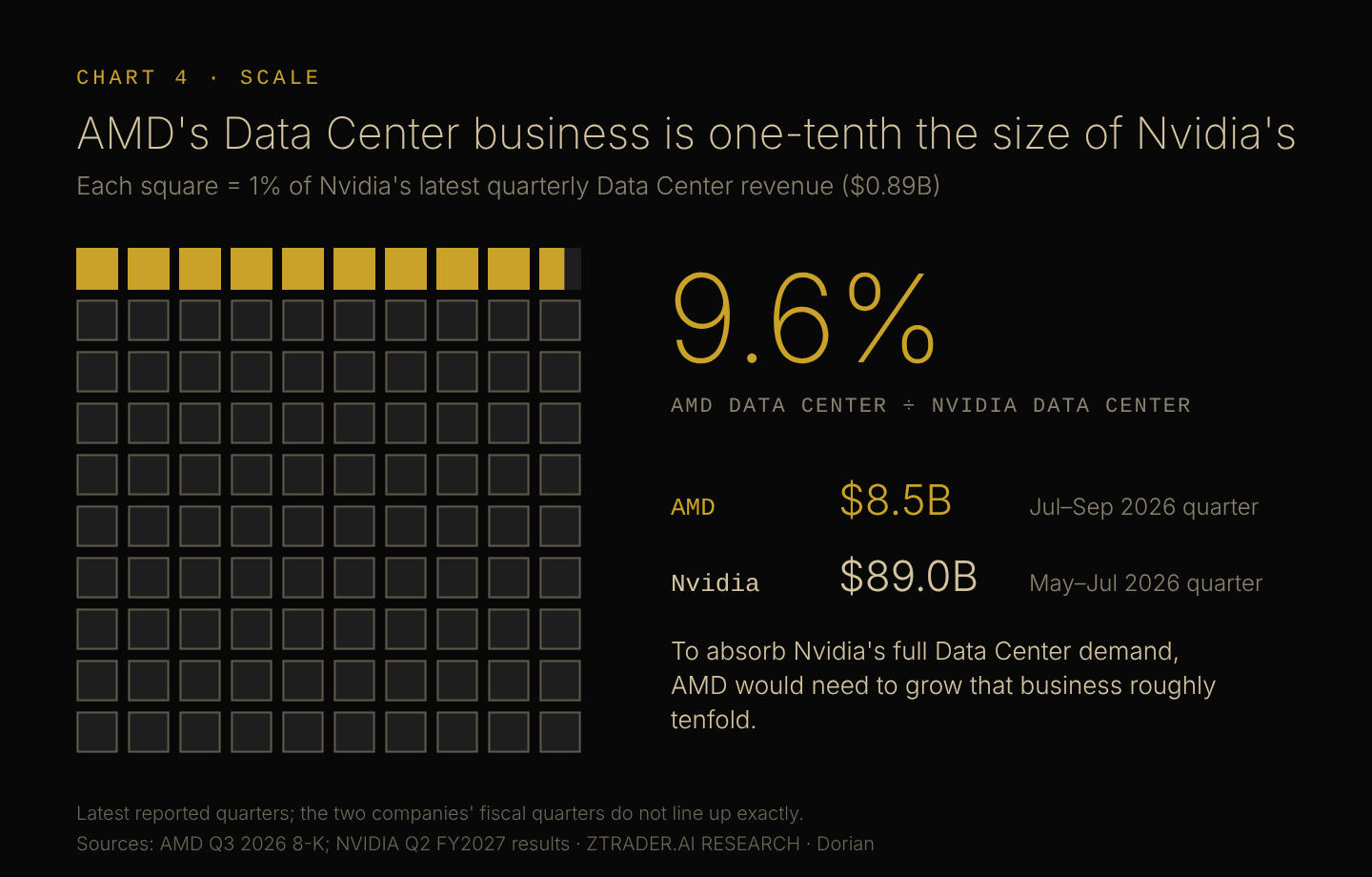
Scale answers the replacement question before the scandal enters it.
AMD’s $8.5 billion of quarterly Data Center revenue equals about 9.6% of the $89.0 billion Nvidia booked in its latest quarter, so a hyperscaler industry that moved its whole Nvidia budget to AMD would be asking AMD to grow its data center business roughly tenfold.
[CHART 4 — AMD’s quarterly Data Center revenue as a share of Nvidia’s]
V. MI450, HELIOS AND THE CUDA PROBLEM
The Product Cadence
AMD credits the launch of its Instinct MI450 GPUs for the 97% jump in Data Center revenue. Anthropic, Meta, Microsoft, OpenAI and Oracle Cloud Infrastructure are already running models on the first Helios racks, which pair MI450 with sixth-generation EPYC CPUs. Nvidia has answered with Vera Rubin NVL72, which it says delivers up to 30 times the throughput per megawatt of its own GB300 NVL72 on agentic workloads. That figure comes from Nvidia’s blog and peaks on a single model, DeepSeek V4 Pro, so investors should treat it as marketing until customers report production numbers. If even part of the claim holds, AMD is selling MI450 against a target that keeps moving.
Software
ROCm is still AMD’s weakest product. Most AI engineers learned on CUDA, so every hyperscaler that deploys MI450 at scale pays its own engineers to port and tune code that already runs on Nvidia hardware. That porting bill is the real price of a second supplier, and it explains why Nvidia held around four-fifths of the market even after AMD shipped competitive silicon.
Customers
AMD’s answer to the software gap is to sign the largest buyers directly and let them absorb the porting cost. OpenAI’s 6-gigawatt GPU agreement with AMD, announced in October 2025, anchors that strategy. The scandal hands procurement teams a new argument: a buyer whose main supplier faces a federal export inquiry and a hostile Congress has a board-level reason to qualify a second vendor, and AMD is the main merchant alternative.
VI. AMD’S Q3 NUMBERS, CHECKED AGAINST NVIDIA’S
AMD beat the top of its own guidance with $13.4 billion of Q3 revenue, up 45% from a year earlier and 16% from the June quarter. Non-GAAP EPS rose 74% to $2.09, and CFO Jean Hu expects operating expense growth to run at no more than half of revenue growth, which is how revenue gains turn into faster earnings gains. The Q4 guide asks for a lot more: about $17 billion, plus or minus 3%, a 27% jump in a single quarter. Su then told analysts she expects revenue to grow more than 80% in 2027.
Margins show the gap still remains.
AMD reported a 56% non-GAAP gross margin and guided Q4 to about 55%, so its margin slips a point while revenue jumps. Nvidia reported 75.0% and guided its October quarter to about 74%. IDC puts Nvidia at about 81% of AI data center chips in 2026, with no rival above roughly 10%, while Silicon Analysts puts Nvidia closer to 75%; both estimates sit below the roughly 87% Nvidia held in 2024.
[TABLE 1 — AMD vs Nvidia: Data Center revenue, growth and margins]
Valuation
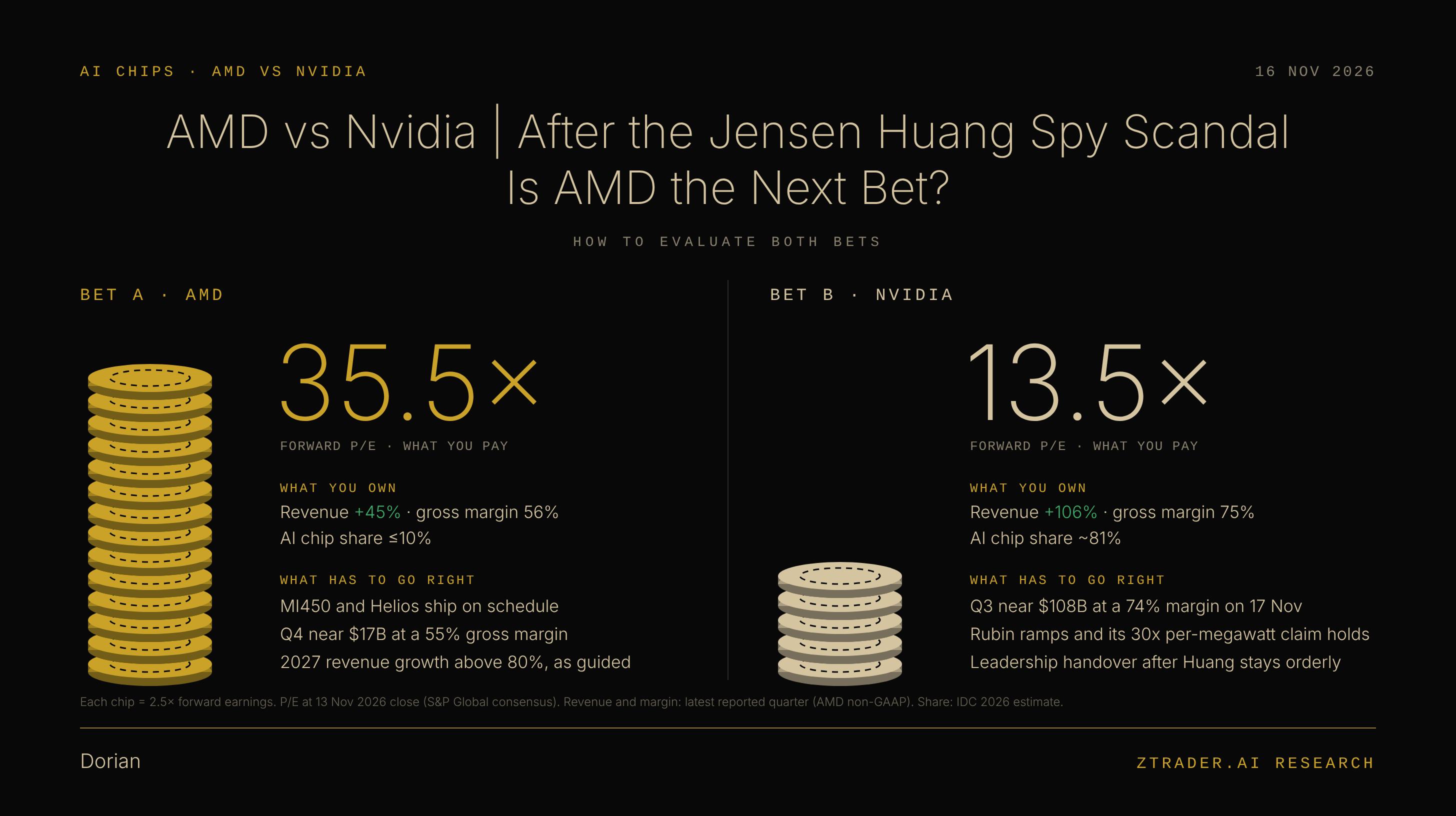
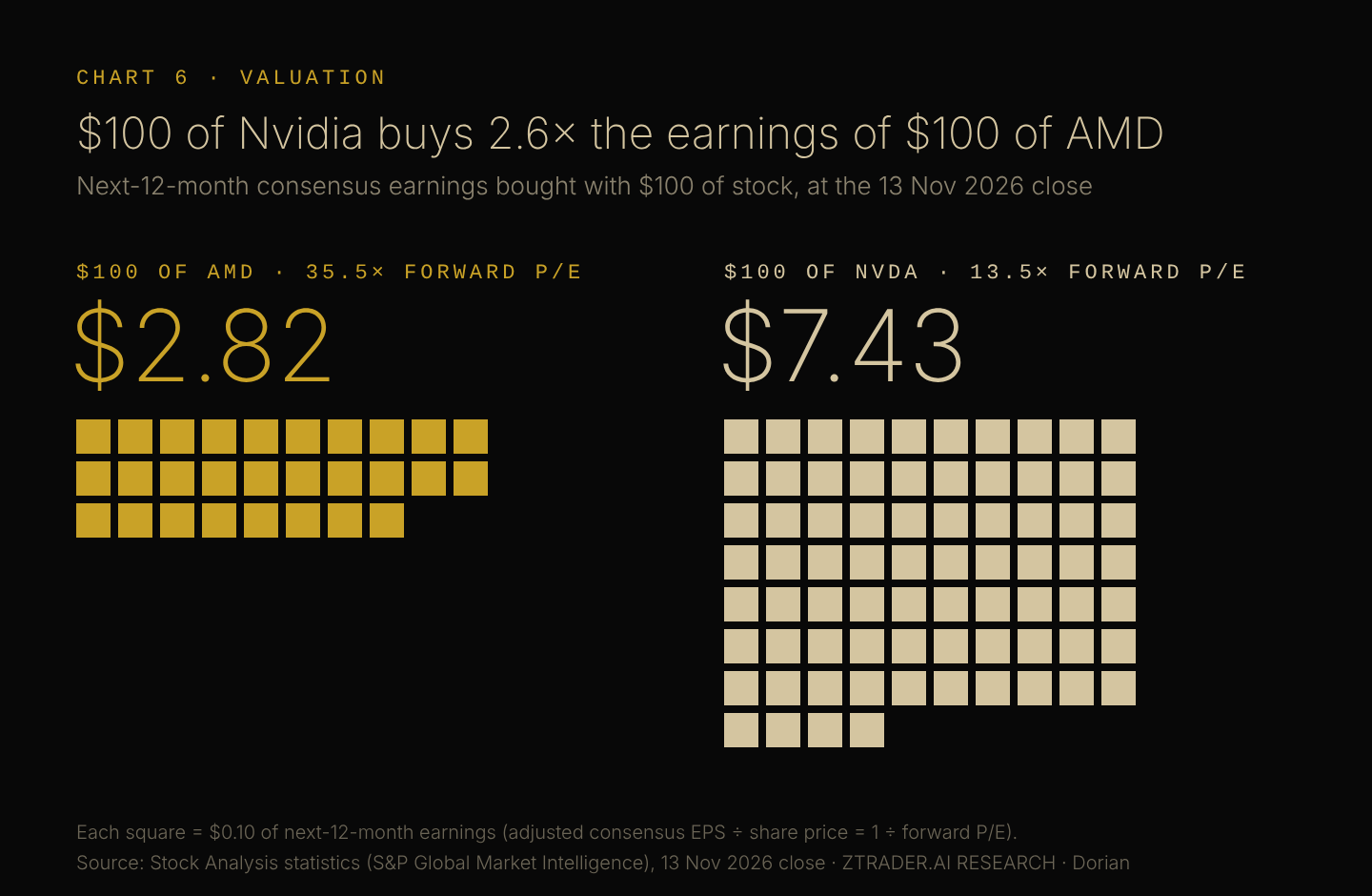
AMD investors have already paid for the share gains. At the 13 November close of $534.06, AMD traded at 116 times trailing GAAP earnings and 35 times forward earnings on S&P Global consensus, which uses adjusted figures, while Nvidia traded at 21 and 13 times on the same basis.
In cash terms, $100 of Nvidia stock buys $7.43 of next year’s expected earnings and $100 of AMD buys $2.82. AMD gained 74% in April and 46% in May alone, so most of this year’s gain came months before MI450 revenue appeared in the Q3 results.
Nvidia’s forward multiple now sits at roughly half its three-year average of about 30 times, according to TIKR, so Nvidia’s price already carries a discount for the legal and political risk in sections II and III. AMD’s 35 times carries no such discount, even though AMD’s China licenses run through the same inspection-and-tariff route that Congress is now investigating.
[CHART 5 — AMD vs NVDA share price, 2026 to date and month by month]
[CHART 6 — Valuation: what $100 of AMD vs Nvidia stock buys in earnings]
VII. SCENARIOS FOR NVIDIA, AND WHAT EACH MEANS FOR AMD
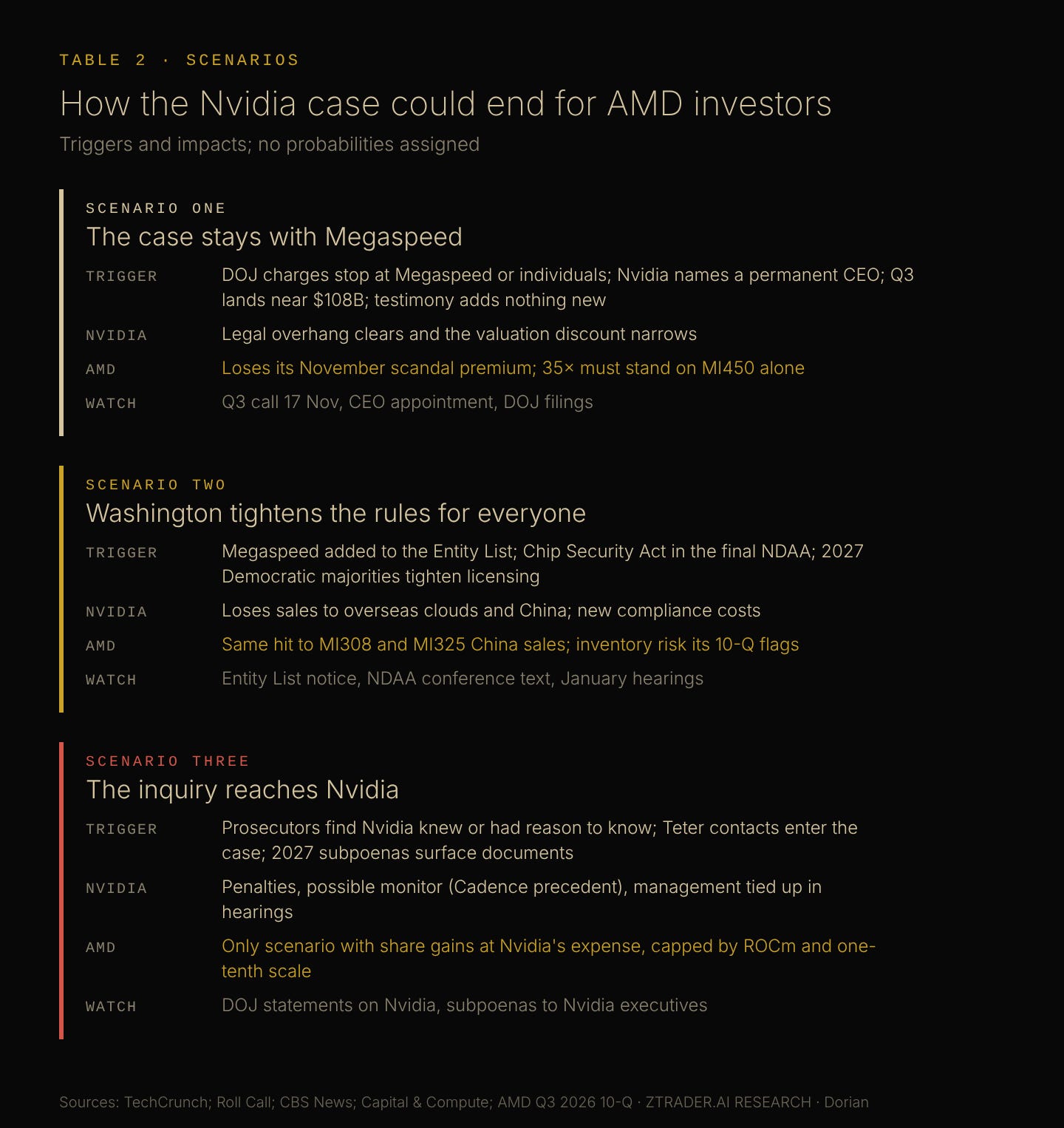
None of the outcomes below comes with a reliable probability, so the triggers matter more than any odds an analyst could attach.
Scenario One: The Case Stays With Megaspeed
The Justice Department charges Megaspeed or individuals and stops there, Nvidia names a permanent chief executive, Q3 lands near the $108 billion guide, and Huang’s testimony adds nothing new. Nvidia’s discount narrows as the legal overhang clears. AMD loses the scandal premium it picked up in November, and its 35 times multiple has to stand on MI450 deliveries alone.
Scenario Two: Washington Tightens the Rules for Everyone
Commerce adds Megaspeed to the Entity List, the Chip Security Act survives into the final NDAA, and the new Democratic majorities use 2027 to tighten licensing and challenge the inspection-and-tariff route. Nvidia loses sales to overseas clouds and Chinese customers and pays for new compliance systems. AMD takes the same hit to its MI308 and MI325 China business and faces the inventory risk its 10-Q already flags, so the scenario hurts both stocks and gives AMD no relative gain.
Scenario Three: The Inquiry Reaches Nvidia
Prosecutors conclude that Nvidia knew, or had reason to know, where Megaspeed’s chips were going, or the Teter contacts become part of the case, and congressional subpoenas in 2027 put more internal documents on the record. Nvidia faces penalties and possibly a compliance monitor on the Cadence model, and its management spends 2027 in hearings.
Hyperscalers accelerate second-source qualification, which makes this the only scenario in which AMD wins share at Nvidia’s expense, and even here ROCm and AMD’s one-tenth scale limit how much business can move.
[TABLE 2 — Scenario matrix: triggers, impact on Nvidia, impact on AMD, signals to watch]
VIII. CAN AMD REPLACE NVIDIA RIGHT NOW?
AMD cannot replace Nvidia today, and the scandal does not change that very fact.
AMD’s Data Center business brings in about one dollar for every ten Nvidia books, IDC puts AMD at roughly 10% of the market or less, the first Helios racks went live this autumn, and every workload that moves still has to leave CUDA behind.
In the worst Nvidia scenario, AMD’s realistic gain is a larger slice of the orders hyperscalers place over the next two years.
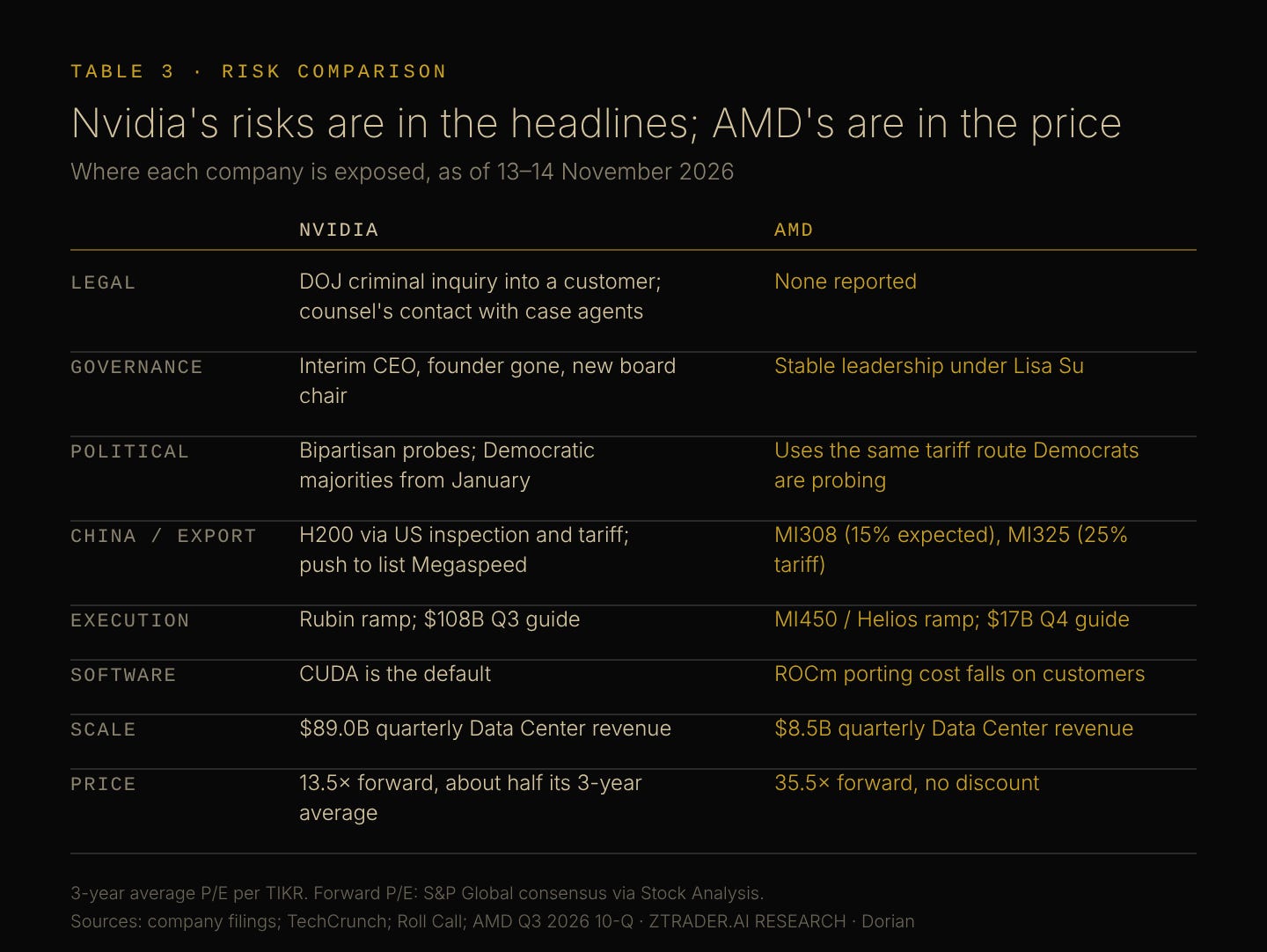
The risks also differ in kind. Nvidia’s risks are legal, political and governance problems that can be resolved or escalated by prosecutors, Congress and the board, and its stock already trades at about half its usual multiple.
AMD’s risks sit in execution and valuation, on top of the China exposure it shares with Nvidia, and its stock trades at full price. Investors who own AMD as a substitute for Nvidia are swapping a discounted stock with headline risk for an expensive stock with delivery risk, while keeping the regulatory risk they meant to escape.
[TABLE 3 — Risk comparison: Nvidia vs AMD]
IX. 17 NOVEMBER AND AFTER
Nvidia reports fiscal Q3 results on 17 November against its own guide of $108.0 billion, plus or minus 2%, at a gross margin near 74%, and Huang testifies to House committees before Thanksgiving.
Kress’s call will show whether customers changed their orders after the scandal, and Huang’s testimony will show whether the Teter contacts and the Megaspeed sales reach Nvidia itself.
The final NDAA text will show whether the Chip Security Act survives, and the Congress that sits in January will decide how far the Wyden–Neal inquiry goes.
For AMD, the Q4 print near $17 billion at a 55% margin is the next hard test.
Nvidia now carries a criminal inquiry into one of its Southeast Asian customers, a Congress that turns Democratic in January and a board running without its founder, and at 13 times forward earnings its shareholders are being paid something to hold those risks.
AMD offers faster growth, but at 35 times it charges full price while sharing Nvidia’s China exposure and supplying about one-tenth of Nvidia’s data center revenue.