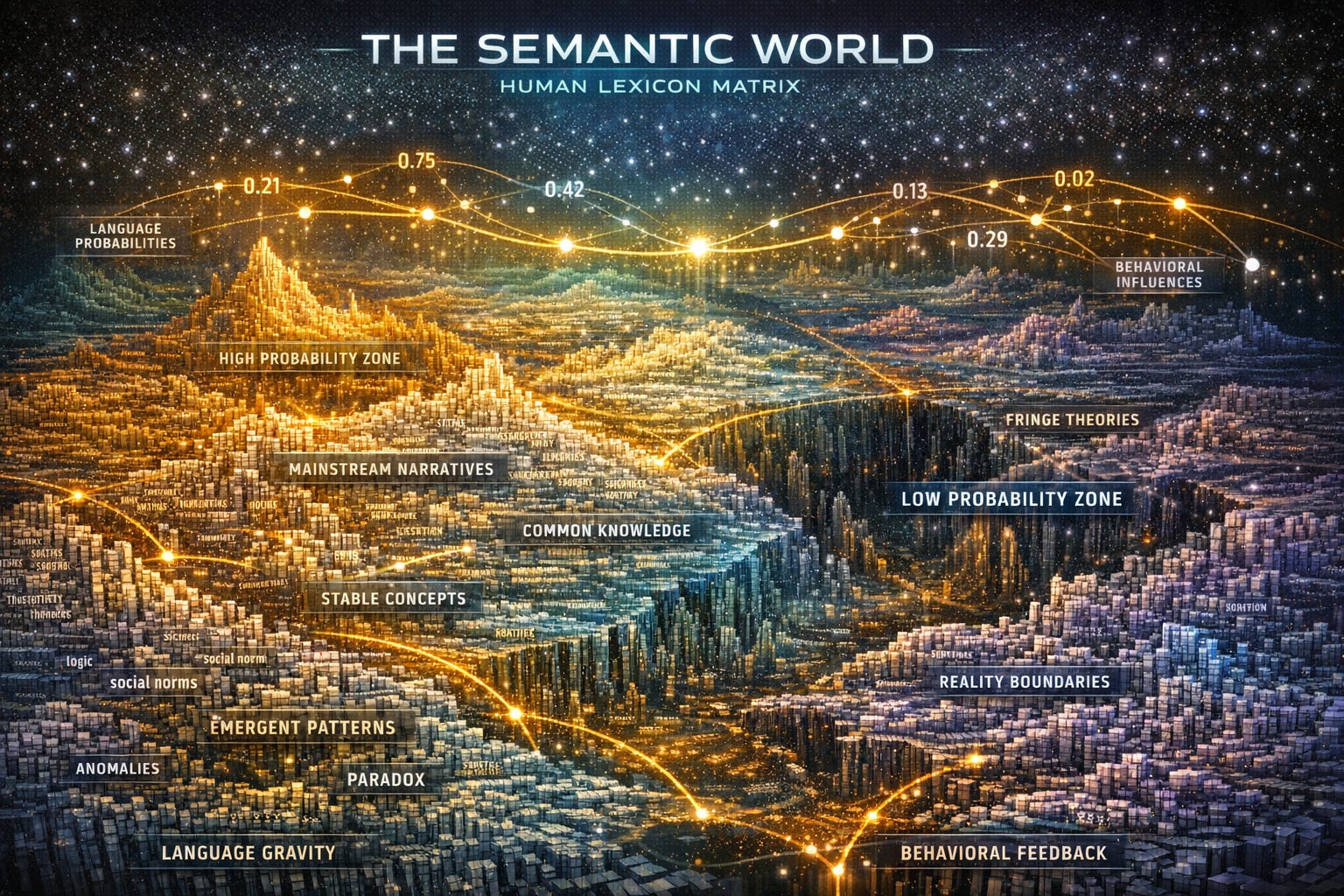
AI Primer 03 : Emergence, Latent Space, and the Semantic World
Why AI Appears Smarter Than It Actually Is
(Ephemeral Release · Read Before Removal)
Most discussions about AI stop at tools, prompts, and productivity.
What actually determines whether AI compounds value over time is none of that.
It is whether you hold the correct mental model of what this system is and what it is not.
Many people, after prolonged use of AI, experience a subtle but powerful illusion:
AI seems to understand me.
AI seems to reason.
AI seems to grasp the world better than I do.
This essay exists to dismantle that illusion.
Not because it is false, but because it is dangerously convincing.
I. Emergence Is Not Awakening, It Is Structural Visibility
“Emergence” is often described as something mystical, even romanticized as a form of intelligence awakening.
That framing is wrong.
A more precise definition is this:
Emergence occurs when system scale, complexity, and interaction density cross a threshold, making previously implicit patterns observable.
Nothing new is born.
No consciousness appears.
No intent emerges.
What changes is visibility.
In large language models, the combination of:
parameter scale
compression
long context windows
and constraint density
causes latent structures to display continuity, coherence, and behavior that resembles reasoning.
Emergence does not create intelligence.
It reveals structure that was already there.
II. Latent Space Is Not Knowledge, It Is Relational Geometry
A foundational misconception is that LLMs “store knowledge”.
They do not.
A more accurate description is:
Latent space is a high-dimensional geometry of relationships between linguistic and conceptual elements.
It does not contain truth.
It contains structure.
You can think of it as an abstract map where:
similar concepts cluster
frequently co-occurring ideas form pathways
interchangeable expressions overlap
incompatible narratives diverge
When an LLM produces an answer, it is not recalling facts or executing logic.
It is:
navigating latent space along high-probability trajectories toward regions that resemble “good answers” under the given context.
This explains why AI can:
hallucinate confidently
produce internally consistent but externally false reasoning
collapse when confronted with real-world constraints
The optimization target is linguistic plausibility, not reality correctness.
III. Introducing the Semantic World: A Higher-Order Space
This brings us to the core concept: Semantic World.
If latent space is the internal structural geometry of a model,
then Semantic World is a broader, more dangerous layer:
The Semantic World is the high-level conceptual space constructed by human language, narratives, symbols, and explanatory frameworks.
It does not belong solely to the model.
It does not belong solely to text.
It exists in:
economic paradigms
market narratives
political discourse
media framing
social consensus boundaries
and individual cognitive models
These are not reality itself.
They are:
reality after it has been named, interpreted, compressed, and structured by language.
The true power of LLMs is not factual recall.
It is their ability to navigate, reorganize, and compress the Semantic World at high speed.
What AI gives you is rarely truth.
What it gives you is:
the smoothest, most coherent, most readable path through semantic space that resembles truth.
IV. Why AI Feels Like It Is Reasoning
AI outputs feel like reasoning because they exhibit:
continuity
structural completeness
confident tone
contextual consistency
narrative closure
The human brain is wired to interpret these signals as:
understanding, intention, intelligence.
In reality, what often happens is simpler:
The model finds a highly fluent path through the Semantic World, and the human mind misidentifies fluency as reasoning.
This is not AI awakening.
It is human pattern recognition completing the picture.
V. The Most Dangerous Mistake: Confusing Compression With Insight
The core capability of LLMs is compression.
They compress:
massive redundancy
repeated explanations
fragmented discourse
into clean, elegant outputs.
This is extremely useful.
But it is critical to distinguish:
compression ≠ insight
coherence ≠ correctness
elegance ≠ applicability
True insight carries cost.
It emerges from:
contradiction
failure
loss
friction
real-world penalty functions
None of these exist inside the Semantic World.
They only exist outside, in reality.
VI. Why Advanced Users Feel AI “Understands Them Better Over Time”
Many users claim that AI “learns them”.
This is incorrect.
What actually happens is:
the user becomes better at providing constraints and steering probability distributions.
As objectives sharpen and boundaries become explicit, outputs migrate from:
the center of the distribution (generic templates) to:
the low-probability tails (high-density, specialized outputs)
AI does not learn you.
You learn how to cut paths through the Semantic World.
VII. Why Nonlinear Domains Feel More “Alive”
In domains such as:
macro analysis
strategy
systems design
narrative construction
there is no single correct solution.
These domains tolerate:
ambiguity
approximation
competing frameworks
This aligns perfectly with latent-space navigation.
In contrast, in mathematics or safety-critical systems, approximation is fatal.
The difference is not intelligence.
It is error tolerance.
VIII. The Correct Mental Model
AI is not:
a thinker
an oracle
a judge of truth
It is best understood as:
a semantic-space navigator, a structural compressor, and a candidate-path generator.
Truth convergence happens only in one place:
the real-world feedback loop.
Markets, execution, physics, user behavior, PnL, failure.
AI explores possibilities.
Reality collapses them.
Conclusion: The Real Battlefield Is Your Semantic World
The dividing line in the AI era is not model access or technical skill.
It is whether you understand and control:
your own Semantic World
your conceptual boundaries
your narrative structures
your constraint systems
your feedback loops
If you do not, AI will anesthetize you with beautifully coherent explanations while silently detaching you from reality.
AI is not dangerous because it lies.
It is dangerous because:
it can construct an extremely comfortable world
in which reality’s penalty function is temporarily forgotten.
Premium Note
The logical continuation is practical, not philosophical:
AI Primer 04: Designing AI Loops That Cannot Self-Deceive
— From Semantic World to Reality Loop
At that point, this stops being a series of essays.
It becomes a personal AI operating system.
And not everyone should run it.


